There are ten types of hoodie a brand realistically chooses between. That choice sets your fabric, your construction, and your cost before a single unit is cut. The category is enormous. Fortune Business Insights values the global hoodies and sweatshirts market at USD 241.11 billion in 2025, rising to a projected USD 442.64 billion by 2034 (Fortune Business Insights, 2025).
Estimates vary widely depending on how a research firm draws the category boundary, so treat that figure as one firm's scope rather than a settled fact. What doesn't vary is the engineering underneath the hoodie itself.
This guide covers all ten types of hoodie: pullover, full-zip, half-zip, cropped, oversized, athletic, sleeveless, technical, sherpa-lined, and hooded flannel. It also covers the decisions underneath them, French terry against fleece, GSM weight bands, kangaroo against split pockets, and raglan against set-in sleeves. For each style it explains what the style suits and, in relative terms, what it costs to make.
Heads up: We're OneAim, a group of 100+ documented clothing manufacturers across 15+ countries. The relative cost ordering, the cost-driver table, and the two first-hand findings below come from our own sourcing and production pipeline, 2024 to 2026. Market figures are cited to Fortune Business Insights, and the GSM bands are common industry convention rather than a published standard.
Key Takeaways
- The hoodie category splits by closure first. Pullover, full-zip, and half-zip are three different garments with different pattern pieces, different operations, and different unit costs.
- Fabric weight defines the product more than the silhouette does. Midweight sits around 280 to 350 GSM, heavyweight around 400 to 500 GSM, and the number tells a customer more than the marketing copy will.
- The market is large and growing. Fortune Business Insights puts hoodies and sweatshirts at USD 241.11 billion in 2025, rising to a projected USD 442.64 billion by 2034 at a 7.08% CAGR (Fortune Business Insights, 2025).
- Synthetic and blended fabrics dominate. The same report projects the synthetic-material segment at 56.80% of the category in 2026, which is why poly-cotton blends and tech fabrics are so common on spec sheets.
- Construction details drive cost quietly. A double-lined hood, a zipper placket, split pockets, and ribbed cuffs each add fabric, operations, or both.
Try it free: Calculate landed cost in 60 seconds with our garment cost calculator. No email required.
What are the main types of hoodie?
Ten styles cover almost everything on the market. The pullover and the full-zip are the two core types. The other eight are variations on closure, fit, sleeve, or lining: half-zip, cropped, oversized or boxy, athletic or fitted, sleeveless, technical or performance, sherpa-lined, and the hooded flannel. Every hoodie you see in a store is one of these, or a hybrid of two.
Choosing between them isn't a styling exercise. Each type carries a different pattern, a different fabric weight, a different set of sewing operations, and a different production cost. A brand that picks "oversized heavyweight pullover" has already made four decisions a factory needs before it can quote. A brand that says "a hoodie, like everyone else's" has made none, and the quote it gets back will be a guess.
The table below is the whole category on one screen. Read the GSM column as a common-practice range, not a standard, and the cost column as relative to a standard pullover at the same fabric quality.
| Hoodie type | Closure | Typical fit | Usual GSM band | Front pocket | Relative cost |
|---|---|---|---|---|---|
| Pullover | None, over the head | Standard or oversized | 280 to 450 | Kangaroo | Baseline |
| Full-zip | Zip, hem to collar | Standard or athletic | 280 to 400 | Two split pockets | Higher |
| Half-zip | Zip, collar to mid-chest | Standard, elevated casual | 280 to 400 | Kangaroo optional | Slightly higher |
| Cropped | Usually pullover | Short body, above waist | 280 to 380 | Kangaroo or none | Lowest |
| Oversized or boxy | Usually pullover | Wide body, drop shoulder | 380 to 450 | Kangaroo | Higher |
| Athletic or fitted | Pullover or full-zip | Close cut, set-in or raglan | 200 to 300 | Split or none | Comparable |
| Sleeveless | Pullover | Gym or streetwear cut | 280 to 400 | Kangaroo | Lower |
| Technical or performance | Pullover, half-zip, or full-zip | Athletic, raglan sleeve | 180 to 260 | Zip or none | Comparable to higher |
| Sherpa-lined | Pullover or full-zip | Standard, roomy | 500 to 600+ combined | Kangaroo or split | Highest |
| Hooded flannel | Button front, woven body | Shirt fit | Woven, not knit | Chest patch | Higher, woven line |
Source: see in-text citations in this section.
Two columns in that table are the ones brands skip. Fit and GSM travel together: an oversized silhouette in a 280 GSM fabric collapses, and a fitted athletic hoodie in 450 GSM fleece is a straitjacket. The closure and the pocket travel together too, because the front pouch survives only when the front body is one piece.
Citation capsule: Hoodie styles divide into ten main types: pullover, full-zip, half-zip, cropped, oversized or boxy, athletic or fitted, sleeveless, technical or performance, sherpa-lined, and hooded flannel. Each type carries its own pattern, fabric weight, and sewing operations, which is why the style choice sets the production cost before any fabric is bought.
What is a pullover hoodie, and why is it the default?
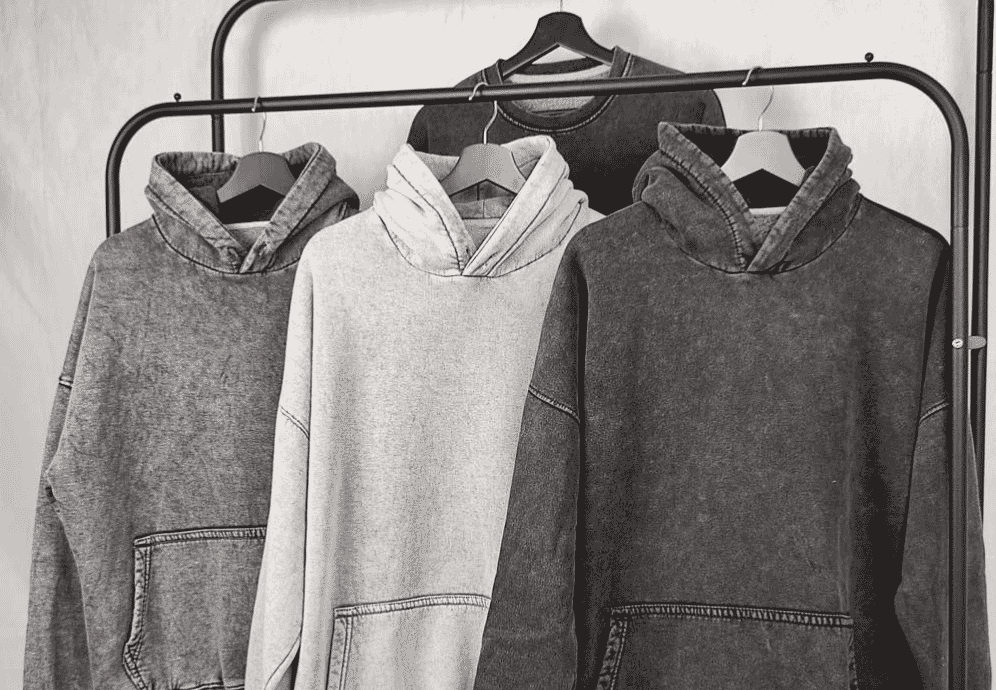
A pullover hoodie is a hooded sweatshirt with no front opening: you pull it over your head. It's the default because it's the simplest garment in the category. Fewer pattern pieces, no zipper, no placket, no separate front panels, and no zipper-alignment risk on the sewing line. That simplicity is exactly why it's usually the cheapest hoodie a factory can make.
Structurally, a pullover is a body, two sleeves, a hood, a pocket, and ribbing at the cuffs and hem. Most carry a kangaroo pocket and a drawcord hood. The pullover suits merch programs, streetwear drops, campus and team wear, and any brand whose first production run needs to keep unit cost and quality risk low. If you're launching one hoodie, this is almost always the one to launch.
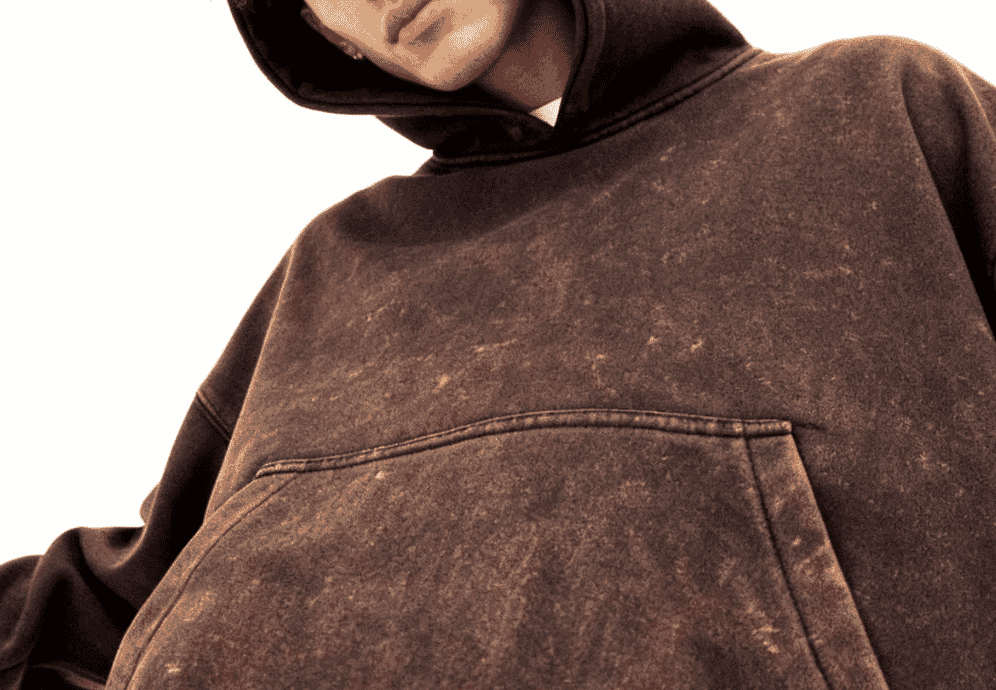
The trade-off is versatility. A pullover can't be opened. It doesn't layer over a shirt the way a zip hoodie does, and it can't come off without disturbing a hairstyle or a cap. That's a real reason some customers prefer zips, and a real reason most brands end up carrying both.
How does a full-zip hoodie differ from a pullover?
A full-zip hoodie opens from hem to hood collar, with a zipper running the length of the centre front. That single change does four things. It splits the front body into two panels. It adds a placket and a zipper. It forces the hood to finish cleanly at the neck on both sides. And it replaces the kangaroo pocket with two split pockets, because a continuous front pouch cannot survive a front cut in half.
In relative cost terms, a full-zip always costs more to make than the same pullover. You buy a zipper as a trim, you pay for the placket, and you pay for more operations on the line. One of those is the zipper-setting operation, which is where quality problems most often show up. A cheap zipper on an expensive hoodie is the most common false economy in this category.
The full-zip earns its cost by being a layering piece. It works over a tee or a shirt, it comes off without pulling, and it reads slightly more like outerwear than loungewear. Track jackets, gym layers, uniform programs, and anything a wearer needs to remove quickly all point toward the full-zip.
What is a half-zip hoodie for?
A half-zip hoodie has a zipper running from the hood collar down to roughly mid-chest, and no further. It sits between the pullover and the full-zip: you still pull it over your head, but you can open the neck for ventilation or to change how the collar sits. It's the quietest of the three closures and often the most premium-looking.
Cost-wise it lands between the two. You add a zipper and a placket, but a shorter one than a full-zip, and you keep a single continuous front body, so you can keep a kangaroo pocket if you want one. Half-zips read as elevated casual rather than gym wear, which is why they're common in premium knitwear-adjacent collections, golf and outdoor lines, and brands that want a hoodie without a streetwear signal.
Watch the collar. A half-zip lives or dies on how the placket terminates at the chest and how the hood or funnel neck sits when the zip is open. That's a pattern problem, not a fabric problem, and it's worth resolving in sampling rather than in bulk.
What are cropped, oversized, and athletic-fit hoodies?
These are fit types rather than closure types, and any of them can be a pullover, a full-zip, or a half-zip. Fit is the second decision after closure, and it changes the pattern, the fabric consumption, and often the fabric weight itself.
Cropped. A cropped hoodie ends above the natural waist, usually between the top of the hip and just below the ribcage. It uses less fabric than a standard body. That makes it one of the very few construction changes that actually lowers cost.
Cropped is strongly associated with womenswear and athleisure, and that is not a niche. Fortune Business Insights projects women's end-users at 52.13% of the hoodies and sweatshirts category in 2026 (Fortune Business Insights, 2025).
Oversized or boxy. An oversized hoodie is cut wide and short in the body with a dropped shoulder. The sleeve seam falls partway down the upper arm rather than at the shoulder point. It uses more fabric than a standard fit, and it needs a heavier fabric, because a lightweight oversized hoodie collapses and looks cheap.
Streetwear lives here, and so does most of the premium heavyweight market. If that's your lane, the factories in our streetwear manufacturers directory are the ones tooled for it.
Athletic or fitted. An athletic hoodie is cut close to the body with a set-in sleeve, a shorter body, and often a lighter, more technical fabric. It's built to move rather than to drape. Performance brands and gym labels use it, and it's frequently where you find raglan sleeves and moisture-managing blends.
Which fit are you actually building? The honest answer changes your fabric order, so it's worth settling before you brief a factory.
What is the difference between French terry, fleece, and brushed-back fabric?

French terry is a knit fabric with flat loops on the inside face and a smooth outside face. Fleece is French terry whose inside loops have been brushed or napped open into a soft pile, the same principle behind polar fleece. Brushed-back fleece is that same idea described from the finishing side. The three names describe a spectrum, not three unrelated materials, and the difference is simply what happens to the loops.
That difference matters in wear. French terry is lighter, breathes better, dries faster, and drapes with more structure, which is why it's the standard for spring hoodies, layering pieces, and anything worn indoors. Fleece traps air in the brushed pile, so it's warmer, softer, and bulkier, and it's what most people picture when they picture a hoodie.
Loopback terry, a heavier unbrushed construction, is the premium middle path. It's substantial, it still breathes, and it holds a garment-dyed finish beautifully. If a factory can't tell you which of the three it's quoting, it's quoting a fabric it hasn't sourced yet.
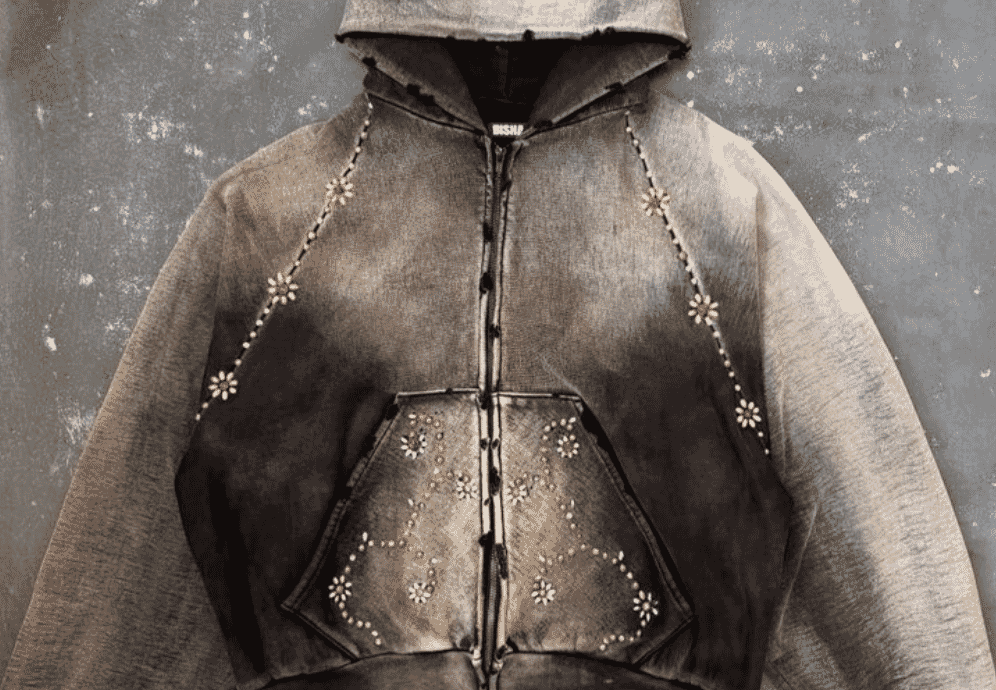
Fibre content sits on top of the knit construction. Cotton and cotton-rich blends feel better and print well. Polyester and poly-cotton blends resist shrinkage, hold colour, and cost less. Fortune Business Insights projects the synthetic-material segment at 56.80% of the category in 2026, which tells you how thoroughly blends dominate the shelf even when the marketing says "cotton hoodie" (Fortune Business Insights, 2025).
Chemical compliance is a separate axis from feel and weight. If you sell into the EU or to retailers with a restricted-substance list, ask early whether the mill can supply fabric certified to OEKO-TEX Standard 100, because retrofitting certification onto a fabric you've already approved is slow. Our fabric sourcing guide for clothing brands walks through how to qualify a mill before you commit to a knit.
Citation capsule: French terry has flat loops on the inside face and breathes well. Fleece is terry whose loops have been brushed into a soft pile, making it warmer and bulkier. Loopback terry is a heavier unbrushed construction used in premium hoodies. All three are the same family of knit, distinguished by how the interior loops are finished.
What GSM weight should a hoodie be?
GSM, grams per square metre, is the single most useful number on a hoodie spec, and most brands under-specify it. As a working rule, a midweight hoodie sits around 280 to 350 GSM, and a heavyweight hoodie sits around 400 to 500 GSM. Below roughly 260 GSM you're in lightweight and performance territory. Above roughly 500 GSM you're usually looking at a lined or sherpa construction.
The measurement itself is standardised even though the marketing language isn't. Fabric mass per unit area is a defined textile measurement, and ASTM International publishes ASTM D3776/D3776M, the standard test methods for mass per unit area of fabric. So you can hold a mill to a tested number.
What is not standardised is the vocabulary. No authority certifies what "heavyweight" means, which is precisely why brands and factories argue about it. Write the number, not the adjective. The chart below plots typical ranges by hoodie type so you can see where a style usually lands, but read it as a map of common practice rather than a rule.
Two practical warnings. First, GSM is measured on the fabric, not the finished garment, so a 400 GSM sherpa shell plus a lining is a much heavier product than the number alone suggests. Second, a high GSM does not automatically mean quality. A heavy fabric knitted from short-staple, low-twist yarn will pill fast and feel dead. Weight and quality are separate variables, and a factory that only ever talks about GSM is telling you half the story.
What are technical, sleeveless, sherpa-lined, and flannel hoodies?
These four are the specialist end of the category, each solving a problem the standard hoodie doesn't.
Technical or performance hoodies use lightweight synthetic or blended knits, typically well under 300 GSM, built for moisture management, stretch, and quick drying. They often use raglan sleeves for shoulder mobility, flatlock seams to prevent chafing, and thumbholes. They're made for training, running, and outdoor layering, not for warmth as comfort.
This is where polyester earns its place rather than merely saving money. These hoodies run on activewear lines, so the factory shortlist overlaps with our activewear manufacturers directory rather than with a fleece house.
Sleeveless hoodies, sometimes called hoodie vests or cut-off hoodies, remove the sleeves entirely and finish the armhole with binding, ribbing, or a raw edge. They're a gym and streetwear piece. From a production view they're simpler than a standard hoodie in one respect, no sleeve setting, but the armhole finish becomes the make-or-break detail. A poorly finished armhole ruins an otherwise clean garment.
Sherpa-lined hoodies add a high-pile synthetic fleece lining, usually to the hood and body and sometimes the sleeves, over a knit or woven shell. This is the most expensive construction in the category by a clear margin: you're buying a second fabric, cutting a second set of panels, and putting the garment through an extra construction pass. It's a winter product, and it should be priced like one.
Hooded flannels are the odd one out. Instead of a knit body, they use a woven flannel shirt body with a knit or jersey hood attached. Technically it's closer to a shirt than a sweatshirt, and it's produced on a shirt line rather than a knitwear line, which is why some hoodie factories can't make one. If you're briefing a hooded flannel, confirm the factory actually runs wovens before you go further.
Which construction details actually change the garment?
More than most brands expect. The hoodie is a simple silhouette carrying a lot of small decisions, and these are the ones that show up in the sample and in the quote.
- Kangaroo pocket versus split pockets. A kangaroo pocket is a single continuous front pouch, possible only on a pullover or half-zip. Split pockets are two separate welt or patch pockets, required on any full-zip. The kangaroo is fewer operations; splits are two of everything.
- Raglan versus set-in sleeve. A raglan sleeve runs in one piece from the underarm to the neckline, giving a diagonal seam and freer shoulder movement. A set-in sleeve joins at the shoulder point in a standard armhole and gives a cleaner, more structured shoulder. Raglan suits athletic hoodies; set-in suits everything else.
- Drop shoulder. The shoulder seam falls below the shoulder point, deliberately. It's the defining feature of oversized and boxy fits and it changes the entire body pattern, not just the sleeve.
- Double-lined hood. A hood cut from two layers of fabric rather than one, so no raw seam shows inside and the hood holds its shape when down. It doubles the hood's fabric consumption and adds an operation. Most premium hoodies have it. Most cheap ones don't, and you can tell in three seconds by turning the hood inside out.
- Drawcord and eyelets. Flat versus round cord, metal versus embroidered eyelets, tipped versus untipped ends. Trims are cheap individually and very visible collectively.
- Ribbed cuffs and hem. Rib knit at the wrists and waist that holds shape and keeps the silhouette. Quality here is about the elastane content and the rib gauge. A cuff that goes slack after five washes is the most common complaint on a low-cost hoodie.
- Stitch density and seam type. Coverstitch, flatlock, and overlock all appear on hoodies. Higher stitch density costs more machine time and lasts longer.
Not one of these details is expensive on its own. Together they are the whole distance between a cheap hoodie and a premium one, and they are where a tech pack either does its job or doesn't.
Which hoodie types cost the most to make?
In relative terms, and holding fabric quality constant, the order runs roughly like this from cheapest to most expensive: cropped pullover, standard pullover, half-zip, athletic or technical, full-zip, oversized heavyweight, hooded flannel, sherpa-lined. Cropped is cheapest because it uses less fabric. Sherpa is dearest because it uses two fabrics and a second construction pass.
The drivers are simple once you see them, and there are only three.
| Cost driver | What moves it | Which hoodie types it hits hardest |
|---|---|---|
| Fabric consumption | Body size, sleeve length, fabric weight | Oversized, heavyweight, sherpa-lined |
| Sewing operations | Zippers, plackets, linings, pocket count | Full-zip, sherpa-lined, hooded flannel |
| Trims and hardware | Zipper spec, drawcord, eyelets, labels | Full-zip, half-zip, technical |
Source: see in-text citations in this section.
Fabric consumption rises with body size and weight together, so an oversized 450 GSM hoodie can consume well over twice the fabric of a cropped 300 GSM one. Operations rise with closures and linings, because every zipper, placket, and lining layer adds machine time. Trims rise with specification, because metal hardware, custom drawcords, woven labels, and custom zipper pullers are each a line item on the bill of materials.
We're deliberately not putting dollar figures on any style here. A per-unit price without a fabric, a quantity, a country, and an Incoterm is a fiction. Quoting one would only hand you a number to be wrong with.
If you want real figures, the hoodie manufacturing cost guide breaks the cost stack down properly. The calculator above turns a factory quote into a landed cost you can price against. Where you make it matters as much as what you make, and our guide to where to manufacture clothing compares the country options behind these numbers.
How big is the hoodie market, and where is it?
Large, and concentrated in the West. Fortune Business Insights values the global hoodies and sweatshirts market at USD 241.11 billion in 2025 and USD 256.08 billion in 2026, projecting USD 442.64 billion by 2034 at a 7.08% CAGR (Fortune Business Insights, 2025).
That is one firm's scope, and scope is everything in this category. Research houses publish wildly different figures for "hoodies" depending on whether they count sweatshirts, activewear, and private-label volume. Cite the source, not just the number.
Within that scope, North America is the biggest single region at USD 97.46 billion, a 40.42% share. Europe follows at USD 76.98 billion, then Asia Pacific at USD 40.52 billion, then the Middle East and Africa at USD 9.82 billion. Those are the four regions the report publishes. They don't sum to the global total, because the remainder isn't broken out.
For a brand, the useful read isn't the headline number. It's that demand is heaviest where the weather makes a heavyweight hoodie a nine-month product. And it's that the women's segment is the larger half of the market, projected at 52.13% of the category in 2026. That is frequently the half a new streetwear brand ignores.
How do you brief a factory on a hoodie?
Specify five things, in this order: style, fit, fabric, construction, and trims. Style is the closure, pullover, full-zip, or half-zip. Fit is standard, oversized, cropped, or athletic, with a drop-shoulder call if it's oversized. Fabric is the construction, French terry or brushed fleece or loopback, the fibre blend, and the GSM. Then construction and trims are everything from the hood lining to the zipper.
Send that as a tech pack, not an email. A hoodie tech pack carries five things: a spec sheet with graded measurements, a bill of materials naming every trim, a stitch and seam call-out, a colour and print or embroidery placement, and a labelling and packing spec.
Factories quote what they read. Anything you leave blank, they will fill in with their cheapest standard option, and you will find it in the sample. If you don't have a tech pack yet, start with our guide to tech pack generation for clothing brands.
Then sample before you commit. Ask for a fit sample first, a pre-production sample second, and approve both physically. A hoodie is a forgiving garment to wear and an unforgiving one to get wrong at scale. The mistakes, a slack cuff, a single-layer hood, a zipper that catches, only reveal themselves after a few washes. Our clothing sample rounds playbook sets out how many rounds to budget for.
If you're at the stage of choosing where to make it, our directory of the best hoodie manufacturers globally is the next step, and the knitwear manufacturers directory covers the mills behind the fabric. If you'd rather hand the build off entirely, our custom hoodie manufacturing service routes your brief to the factory in our group built for it.
Frequently Asked Questions About Types of Hoodie
What are the different types of hoodies?
The main types are pullover, full-zip, half-zip, cropped, oversized or boxy, athletic or fitted, sleeveless, technical or performance, sherpa-lined, and hooded flannel. They differ by closure, fit, sleeve, and lining, and each carries its own pattern and cost. The category they sit in is worth USD 241.11 billion globally in 2025 by Fortune Business Insights' scope.
What GSM is a good hoodie?
A midweight hoodie typically sits around 280 to 350 GSM, and a heavyweight around 400 to 500 GSM, though these are industry conventions rather than a certified standard. Lighter performance hoodies run under 260 GSM. Weight alone doesn't equal quality: yarn staple length and twist matter as much, and a heavy hoodie from poor yarn will still pill.
What's the difference between French terry and fleece?
French terry has flat loops on the inside face and a smooth outer face. Fleece is French terry whose interior loops have been brushed into a soft pile, making it warmer, softer, and bulkier. Terry breathes better and dries faster; fleece insulates better. Both are knits from the same family, distinguished by how the interior loops are finished.
Is a pullover or a zip-up hoodie better?
Neither is better, they solve different problems. A pullover is simpler, warmer through the chest, and cheaper to manufacture, since it has no zipper or placket. A full-zip is a layering piece: it opens, it comes off easily, and it works over a shirt. Zip hoodies always cost more to make because of the zipper, the placket, and the extra sewing operations.
Why are oversized hoodies so heavy?
Because a lightweight fabric can't hold an oversized shape. Boxy and drop-shoulder patterns need enough fabric weight to drape rather than collapse, so streetwear oversized hoodies usually sit at 380 to 450 GSM or higher. The heavier fabric plus the larger pattern means an oversized hoodie can consume well over twice the fabric of a cropped one.
What is a kangaroo pocket?
A kangaroo pocket is the single continuous front pouch on a pullover hoodie, open at both sides. It's only possible when the front body is one piece, so a full-zip hoodie can't have one and uses two split pockets instead. The kangaroo requires fewer sewing operations than split pockets, which is one reason pullovers cost less to make.
Which hoodie type is cheapest to manufacture?
Holding fabric quality constant, the cropped pullover is usually cheapest, because it uses the least fabric and has no zipper. A standard pullover follows. The most expensive is the sherpa-lined hoodie, which needs a second fabric, a second set of cut panels, and an extra construction pass. Absolute costs depend on fabric, quantity, and country.
What is a sherpa-lined hoodie?
A sherpa-lined hoodie has a high-pile synthetic fleece lining bonded or sewn inside the hood and body, and sometimes the sleeves, over a knit or woven shell. It's the warmest and the most expensive construction in the category, because it uses two fabrics, two sets of cut panels, and an extra construction pass. Combined shell-plus-lining weight commonly runs from 500 GSM upward.
Is a hooded flannel actually a hoodie?
Not in production terms. A hooded flannel uses a woven flannel shirt body with a knit or jersey hood attached, so it's sewn on a shirt line rather than a knitwear line. Many hoodie factories cannot make one at all. If you're briefing a hooded flannel, confirm the factory runs woven production before you send a tech pack.
How is hoodie GSM actually measured?
GSM is grams per square metre of fabric, measured on the fabric itself rather than the finished garment. ASTM International publishes ASTM D3776/D3776M, the standard test methods for mass per unit area of fabric, so a mill can be held to a tested number. Note that a lined hoodie weighs far more than its shell GSM alone suggests.
We're a group of 100+ documented clothing manufacturers across 15+ countries. Tell us your product, volume, and timeline. We'll route your brief to the factory in our group built for it, usually within 24 hours. You produce directly with the factory. Flat fees, no markups, no pitch.
Get in contact Download the directory ($39)Need a tech pack? Get a factory-ready single-style tech pack for $79. See what's included.
Sources used in this article
- Fortune Business Insights, Hoodies & Sweatshirts Market Report, 2025. Global market size USD 241.11 billion in 2025, USD 256.08 billion in 2026, projected USD 442.64 billion by 2034 at 7.08% CAGR; regional split North America USD 97.46 billion (40.42%), Europe USD 76.98 billion (31.93%), Asia Pacific USD 40.52 billion (16.81%), Middle East & Africa USD 9.82 billion (4.07%); women's end-user segment projected at 52.13% in 2026; synthetic-material segment projected at 56.80% in 2026. Market-size estimates for this category vary widely by scope between research firms.
- ASTM International, ASTM D3776/D3776M, Standard Test Methods for Mass Per Unit Area (Weight) of Fabric. Cited as the test method behind a GSM figure. No statistic is drawn from this standard.
- OEKO-TEX Standard 100. Cited as the chemical-compliance certification brands commonly request from knit mills. No statistic is drawn from it.
- Units of textile measurement and polar fleece, Wikipedia. Cited for definitional background on fabric weight and brushed-pile knits only.
- GSM weight bands by hoodie type, including the GSM column of the hoodie-type comparison table: illustrative ranges reflecting common apparel-industry fabric-weight conventions. Not a published dataset or certified standard, and labelled as illustrative wherever used.
- OneAim Apparel internal sourcing, tech pack, and production data, 2024 to 2026. Basis for the relative-cost ordering, the cost-driver table, and the two first-hand findings in this article. Relative, not absolute, and not a published dataset.