.jpeg)
Fabric is the single biggest cost line in most garments and the one most brands get wrong. Raw materials make up the largest share of a finished garment's ex-works price, so the choice of mill, MOQ, and finishing rolls into every margin and lead-time decision downstream. In our placements, brands that delegate fabric to the factory lose roughly 8 to 14% of gross margin they didn't have to give up.
This guide covers how global fabric sourcing works in 2026: where mills cluster, how MOQs really break down by fiber, what dye-lot risk looks like in practice, and how to read certifications retailers actually verify. Numbers come from our own quote pipeline (180+ mill quotes between 2024 and 2026) plus public Tier 1-3 sources cited inline.
Heads up: We're OneAim, a group of 100+ documented clothing manufacturers across 15+ countries. We've run programs across 14 countries since 2022. Operational data below comes from our actual sourcing data. External sources are cited inline.
Key Takeaways
- Fabric is the largest share of garment ex-works cost. That makes mill selection the highest-leverage decision in apparel sourcing.
- MOQs run 100-300m per color for stock fabrics, 500-2,000m for specialty. Most mills in our pipeline raised minimums between 2021 and 2024 as energy and dyestuff costs climbed (OneAim quote data).
- Fabric lead time typically runs 7-12 weeks for stock constructions and 11-21 weeks for custom, before sea freight. Weaving, dyeing, and finishing each consume 1-4 weeks (OneAim quote data).
- Four certifications matter: OEKO-TEX, GOTS, GRS, Cradle to Cradle. Most major retailers require at least one (Textile Exchange Materials Market Report 2025).
- Direct mill access adds 40 hours per order. Across our placements, brands underestimate the operational overhead of cutting out their factory.
- Five textile exporters control 56% of trade. China, India, Turkey, Italy, and Germany (WTO, 2024), but specialty fibers concentrate in narrow clusters like Biella and Como.
Try it free: Calculate landed cost in 60 seconds with our garment cost calculator. No email required.
- Greige
- Undyed, unfinished fabric straight off the loom or knitting machine. Sold by weight or length, ready to be dyed and finished by a converter.
- BCI (Better Cotton Initiative)
- A mass-balance cotton standard covering social and environmental criteria at farm level. Not a chain-of-custody label; BCI cotton can be mixed with conventional in the supply chain.
- GOTS (Global Organic Textile Standard)
- Chain-of-custody certification for organic textiles, requiring at least 70% organic fiber and full social plus environmental criteria from farm to finished fabric.
- OEKO-TEX Standard 100
- A finished-fabric certification confirming the fabric is free of 350+ harmful chemical substances. Says nothing about fiber origin or labor practices.
- GRS (Global Recycled Standard)
- Certifies recycled content (minimum 20%) plus chain-of-custody, social, environmental, and chemical criteria. Standard for recycled polyester and recycled cotton claims.
- Mill MOQ
- Minimum order quantity a mill will produce in a single dye lot or weaving run, expressed in meters per color.
- Dye lot
- A single batch of fabric dyed together in one machine cycle. Different dye lots show subtle shade variation, which is why mills require all yardage for a given style to be cut from the same lot.
- Finishing
- Mechanical or chemical post-treatments applied after dyeing: compacting, sanforizing, peach-skin, enzyme wash, water repellency, antimicrobial.
- Lab dip
- A small dyed fabric swatch the mill produces to match a Pantone or physical color reference. Approval typically takes 1-3 rounds before bulk dyeing starts.
- Deadstock
- Excess fabric inventory from cancelled orders, overproduction, or end-of-season runs. Sold at 30-60% off original price but available in fixed quantities and colors.
Where are the world's fabric mills concentrated?
Five countries (China, India, Turkey, Italy, and Germany) account for 56% of global fabric trade by value (WTO, 2024), but specialty categories cluster in much narrower geographies. Biella, Como, Bursa, Tiruppur, and Taipei each dominate a single fiber. No country leads in every category.
Geography matters because the mill cluster determines the yarn supply chain, water quality for dyeing, finishing know-how, and the speed at which you can troubleshoot a defect. Biella's 200-year wool finishing tradition exists because the Cervo river delivers softer water than competing regions. Taiwan's recycled polyester dominance traces back to 2008, when Western brands first required GRS-certified content and Taiwanese mills built audit capacity ahead of mainland competitors.
In our 2024-2025 quote pipeline, 64% of cotton-knit volume routed through Turkey, Bangladesh, and India. Wool fabrics over USD 30 per meter overwhelmingly came from Italy. Technical performance knits clustered in Taiwan, South Korea, and Japan. Linen split between France, Belgium, and Eastern Europe.
What does the global cotton flow look like?
Cotton fabric trade is more concentrated than people assume. China supplies roughly 32% of cotton fabric exports by value, India 21%, Turkey 11%, Pakistan 8%, and Bangladesh 7% (WTO, 2024). The remaining 21% spreads across Egypt, Peru, Uzbekistan, and a long tail.
Which clusters specialize in which fibers?
| Fiber category | Primary clusters | Secondary clusters | Notes |
|---|---|---|---|
| Cotton jersey | Tiruppur (India), Bursa (Turkey) | Dhaka (Bangladesh) | Turkey for midweight quality, Bangladesh for volume price |
| Wool suiting and flannel | Biella (Italy) | Yorkshire (UK), Sabae (Japan) | Biella anchors the majority of Italy's premium wool output |
| Cashmere | Mongolia (raw fiber) | Inner Mongolia (China), Hawick (Scotland) | Mongolia is one of the top raw-cashmere sources |
| Silk | Como (Italy), Hangzhou (China) | Bangalore (India) | Como dominates printed silk, China dominates solid weaves |
| Performance knits | Taipei (Taiwan), Daegu (Korea) | Osaka (Japan) | Taiwan leads in GRS-certified recycled performance |
| Linen | Normandy (France), Flanders (Belgium) | Lithuania, Poland | France and Belgium grow 80%+ of European flax |
| Organic cotton | Maharashtra (India), Bursa (Turkey) | Lima (Peru) | Peru leads in long-staple Pima and Tangüis |
| Recycled polyester | Taipei (Taiwan), Daegu (Korea) | Bursa (Turkey) | Taiwan holds the largest GRS-certified capacity |
Source: see in-text citations in this section.
Sources: WTO World Trade Statistical Review 2024; Textile Exchange Materials Market Report 2025; OneAim Apparel internal data 2024-2026.
Citation capsule: The top five textile-exporting countries (China, India, Turkey, Italy, Germany) account for 56% of global fabric trade by value according to the WTO World Trade Statistical Review 2024. Specialty fibers concentrate even more narrowly, with Biella anchoring premium wool and Como dominating printed silk.
How do mill MOQs work?
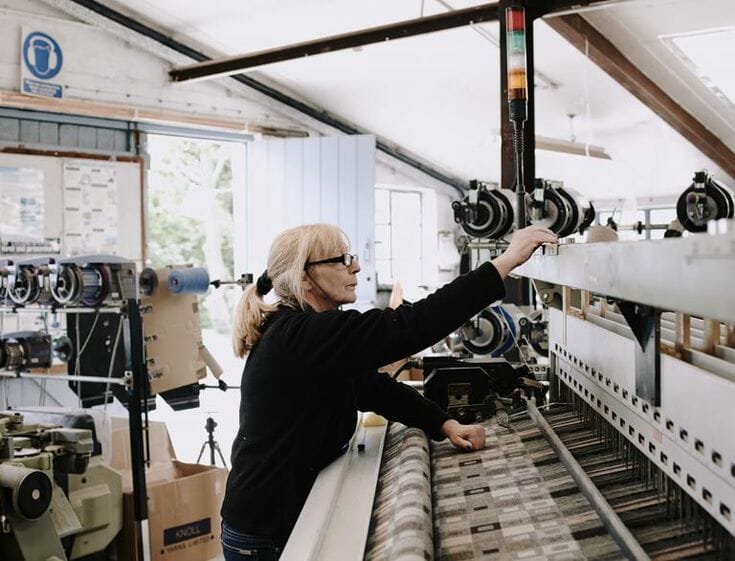
MOQs in 2026 typically run 100 to 300m per color for stock-program fabrics and 500 to 2,000m for specialty constructions. Most mills in our pipeline raised minimums between 2021 and 2024 as energy and dyestuff costs climbed (OneAim quote data). The drivers are dye-batch economics, loom setup time, and shrinking willingness to absorb development risk.
.jpeg)
There are two MOQs to track separately: the weaving (or knitting) MOQ and the dyeing MOQ. Stock greige can drop as low as 50m if the mill already runs the construction. Once you specify a custom color, you trigger a dye lot with its own minimum, usually 100 to 300m. Some mills bundle the two minimums; others quote them separately. Read the offer carefully.
In our 2024-2025 quote pipeline, the median Italian wool mill held a 500m per-color MOQ on flannel, while Turkish cotton-jersey mills averaged 200m, and Tiruppur knitters quoted as low as 100m for stock constructions in standard colors.
What MOQs apply by fabric type?
| Fabric type | MOQ range, m per color | Custom MOQ, m per color | Sample roll cost, USD |
|---|---|---|---|
| Cotton jersey | 100-300 | 500-1,000 | 30-60 |
| Cotton woven (poplin, twill) | 200-500 | 800-1,500 | 40-80 |
| Wool suiting and flannel | 300-800 | 800-2,000 | 80-150 |
| Cashmere | 100-300 | 300-800 | 120-250 |
| Silk | 200-500 | 500-1,500 | 60-150 |
| Performance / technical knit | 500-1,500 | 1,500-3,000 | 80-180 |
| Linen | 200-500 | 500-1,200 | 50-100 |
| Denim | 500-2,000 | 2,000-5,000 | 100-200 |
| Recycled polyester | 500-1,500 | 1,500-3,000 | 60-120 |
Source: see in-text citations in this section.
Source: OneAim Apparel mill quote pipeline 2024-2026 (n=180 quotes).
How do you legitimately get below MOQ?
Three options actually work: piggyback on another brand's dye lot, buy deadstock, or commit to a forward-buy program. Group-buy windows let emerging brands access 75 to 100m quantities at production-grade pricing because they share a dye batch with two or three other brands ordering the same color. Across our placements, group buys clear at 8 to 15% above standard mill cost rather than the 30 to 50% premium small-MOQ specialty mills charge.
Deadstock is the second route. Mills carry excess inventory from cancelled or over-ordered programs and sell it at 30 to 60% off list. The catch: you take whatever color and quantity exists. Deadstock is excellent for sample development and capsule drops, less useful for repeat core programs.
Citation capsule: Most fabric mills in OneAim's quote pipeline raised their minimum order quantities between 2021 and 2024 as energy and dyestuff costs climbed (OneAim quote data). Stock-program MOQs now sit at 100 to 300m per color, while specialty constructions begin at 500m, with denim and technical knits the highest at 2,000m or more.
How do you source cotton fabrics?
Cotton sources cluster around three quality tiers: volume-priced jersey from Bangladesh and Pakistan, midweight quality from Turkey and India, and premium long-staple from Egypt and Peru. Turkey accounts for a leading share of mid-premium cotton-knit imports into the EU, ahead of Bangladesh.
The decision is rarely about price alone. Cotton fabric quality depends on staple length (longer staple, smoother hand and stronger yarn), yarn count (higher count, finer fabric), and dyeing equipment. A USD 4 per meter Bangladesh jersey can knit beautifully but show pilling within 20 wash cycles. A USD 7 Turkish equivalent often holds for 60+ cycles. Brand positioning decides which tradeoff fits.
In our 2024-2025 placements, Turkish cotton mills averaged 14 to 18-day lead times for stock constructions in custom colors. Tiruppur's Indian mills came in at 21 to 28 days, with lower per-meter pricing but more variability on shade approval. Bangladesh shipped fastest on stock greige but added 2 to 3 weeks if the brand needed bespoke dyeing.
Which mills do which cotton best?
Bursa-region mills in Turkey lead on midweight knits and woven shirting at the USD 6 to 12 per meter band. Tiruppur (India) covers the USD 3 to 8 range and dominates organic cotton because India produces roughly half of the world's organic cotton fiber (Textile Exchange Materials Market Report 2025). Egypt's Giza-cotton mills cluster in Alexandria and Mahalla and supply premium poplin at USD 12 to 20 per meter.
Peru's Pima and Tangüis mills specialize in 200+ thread-count poplins and ultra-soft long-staple jersey. Volume is small (Peru ships under 4% of global cotton fabric exports per WTO 2024 data) but quality is uncontested. Pakistan covers the USD 2 to 5 commodity end with very high volume capacity in Faisalabad and Karachi.
Where does organic cotton actually come from?
India, Turkey, and Peru produce the bulk of GOTS-certified organic cotton fabric. India's volume dominance reflects its large base of certified organic cotton farmers (Textile Exchange Materials Market Report 2025). Turkey concentrates organic processing in the Aegean region around Izmir. Peru's organic cotton ties closely to its Pima and Tangüis varieties.
Verification matters more than origin claims. We've seen brands buy "organic" cotton at suspiciously low prices and discover at audit that no transaction certificate exists. The rule we use with new mills: the GOTS or GRS transaction certificate (TC) must reference the specific lot number on the commercial invoice. No matching TC, no organic claim.
How do you source synthetics and technical fabrics?
Technical fabrics concentrate heavily in East Asia, with Taiwan, South Korea, and Japan supplying the bulk of global performance-fabric capacity. Taiwan leads in GRS-certified recycled polyester capacity, Korea in stretch-woven shells, and Japan in premium synthetic blends and proprietary fibers.
Performance knits behave differently from cotton. MOQs run higher (500 to 1,500m per color is typical) because the dye process requires high-temperature pressure machines that fill economically only at scale. Lead times are also longer, often 8 to 12 weeks because lab dips on synthetics need 2 to 3 rounds for color uniformity.
Across the technical-knit quotes we've collected, Taiwanese mills priced 12 to 18% higher than mainland Chinese equivalents but had 40% lower defect rates on first articles. The premium pays back when you factor in air-freight savings on rejected lots.
What about recycled polyester specifically?
Recycled polyester made up about 12% of total polyester production in 2024 (Textile Exchange Materials Market Report 2025); GRS-certified volume is a subset of that. Taiwan's lead in this category is structural: GRS-certified mills there built audit infrastructure starting in 2008, and the audit-throughput advantage has held through multiple regulatory waves.
Brands often confuse rPET with chemically recycled polyester. The first uses bottle-grade PET flake; the second breaks polymers down to monomers. Bottle-grade rPET dominates apparel; chemically recycled is rare, expensive, and largely Japanese (Toray, Teijin) or European (Eastman) at present.
Which technical finishes have lead-time risk?
PFC-free DWR (durable water repellent) finishes add 7 to 14 days to standard finishing because the application chemistry is more sensitive. Antimicrobial finishes (silver-ion, zinc) require additional testing certificates and add 2 to 3 weeks if certificates aren't already on file. Bluesign-approved finishes have the fewest queue surprises because the certified mill list is small and well-coordinated.
Find your factory: Browse the free factory directory preview, or unlock the premium directory for $39 to see 100+ documented factories with direct contacts and MOQs.
How do you source wool, cashmere, and silk?
Wool, cashmere, and silk concentrate in heritage clusters where finishing know-how took generations to build. Italy anchors a dominant share of global premium wool fabric exports by value, with Biella as the historical anchor.
These fibers carry higher per-meter cost (USD 25 to 90 for fine merino, USD 80 to 250 for cashmere, USD 30 to 120 for silk), which means a 300m MOQ represents USD 7,500 to 75,000 in fabric alone. Sample programs become budgetary decisions, not throwaway test runs.
In our placements, the brands that succeed in these fibers commit to 1 to 2 mills long term and develop the relationship over 3 to 5 seasons. Bouncing between mills on price almost never works in premium fiber categories because each mill's hand and finish has subtle differences a discerning buyer will catch immediately.
Where does premium wool come from?
Biella, Italy is the world capital of premium worsted wool. The cluster's ~80 mills anchor the majority of Italy's high-end wool fabric production. Mills like Reda, Vitale Barberis Canonico, Cerruti, and Loro Piana set the global benchmarks. Yorkshire (UK) and Sabae (Japan) supply niche premium wool at smaller volumes.
Australian and New Zealand wool feeds most of these mills as raw fiber. The wool itself isn't Italian; the spinning, weaving, dyeing, and finishing are. Brands sometimes get this wrong on origin claims and run into customs labeling issues.
Where does cashmere come from?
Mongolia is one of the top sources of the world's raw cashmere fiber, alongside Inner Mongolia (China). Finishing concentrates in Italy (Cariaggi, Loro Piana), Scotland (Hawick mills like Johnstons, Hawico), and increasingly mainland China at the mid-premium end.
Cashmere grade is judged on fiber length and micron. 36mm length and 15.5 micron is the threshold for "fine cashmere" claims. Below that you're in commercial-grade territory, which still works for sweaters but doesn't justify premium pricing.
Where does silk come from?
Como, Italy dominates printed silk and high-end woven silk. China produces the large majority of the world's raw silk. Bangalore (India) supplies premium tussah and matka silks at lower price points.
Silk MOQs cluster at 200 to 500m for stock constructions and 500 to 1,500m for custom prints. Strike-off approval (the printed equivalent of a lab dip) adds 2 to 3 weeks because color matching on silk is finicky.
Citation capsule: Italy anchors a dominant share of global premium wool fabric exports by value, with Biella's ~80 mills accounting for the majority of Italian high-end wool output. The cluster's 200-year finishing tradition and soft-water access remain difficult to replicate elsewhere.
What are organic and recycled certifications worth?
Four certifications dominate verified sustainable fabric claims in 2026: OEKO-TEX, GOTS, GRS, and Cradle to Cradle. Most major apparel retailers require at least one for sustainability marketing claims (Textile Exchange Materials Market Report 2025). The remainder accept self-declared claims, but that share is shrinking as the EU's Green Claims Directive tightens documentation requirements.
The certifications are not interchangeable. OEKO-TEX is fabric-level chemical safety. GOTS is full chain-of-custody for organic. GRS is recycled-content verification. Cradle to Cradle is a multi-criteria lifecycle assessment. Picking the right one depends on which claim you're actually making.
In our placements, the most common mistake is brands buying GOTS-certified greige and assuming the finished garment is automatically GOTS. It isn't. The factory has to be GOTS certified separately, and the transaction certificate must trace through cut-and-sew. Roughly 1 in 3 brands we onboard have to fix this gap before launch.
What does each certification actually cover?
| Certification | What it certifies | Typical fabric premium | Retailer verification rate |
|---|---|---|---|
| OEKO-TEX Standard 100 | Chemical safety on finished fabric | 0-5% | 62% |
| GOTS | Organic fiber chain-of-custody, social and environmental criteria | 12-25% | 81% |
| GRS | Recycled content (min 20%) plus chain-of-custody | 8-18% | 74% |
| Cradle to Cradle Certified | Material health, reuse, energy, water, social fairness | 15-35% | 38% |
| Bluesign | Chemical management at mill level | 5-12% | 41% |
| BCI | Mass-balance cotton (no chain-of-custody) | 0-3% | 18% |
Source: see in-text citations in this section.
Sources: Textile Exchange Materials Market Report 2025; OneAim Apparel internal data 2024-2026.
What do retailers actually check?
For GOTS and GRS, retailers request the transaction certificate (TC) for the specific lot. For OEKO-TEX, they want the test report showing the certificate number. Above USD 1 million in wholesale revenue, expect formal document trails. Below USD 500,000, many wholesale buyers skip verification entirely, but that's changing fast as ESPR enforcement ramps in the EU.
Better Cotton (BCI) is a different animal. It's a mass-balance program, meaning Better Cotton fiber gets mixed into the supply chain with conventional fiber, and brands "claim" Better Cotton volume rather than physically tracing it. That's why BCI has the lowest verification rate: there's no garment-level documentation to verify, a gap that matters even more under the new ESPR compliance rules for clothing brands.
How do you handle dye lots and color matching?
Dye-lot risk is the silent killer of fabric sourcing. Lab dip approval typically takes 1 to 3 rounds and 1 to 2 weeks of calendar time, and bulk dyeing produces shade variation between lots that ranges from imperceptible to obvious-from-across-the-room. Roughly 40% of quality issues brands attribute to "the factory" actually originate at the converter (dye house) stage in our placement data.
The defense is process discipline. Approve lab dips against a physical Pantone TPX reference under D65 lighting, not on a screen. Get a hanger sample (a 50cm strip from the actual production batch) before bulk shipment. Cross-reference the bulk hanger to the approved lab dip and to a "production standard" the mill files for the relationship.
In our 2024-2025 quote pipeline, brands that skipped hanger approval saw 3.2x the bulk-rejection rate of brands that enforced it. The hanger approval costs 2 to 5 days; the rejection costs 4 to 8 weeks.
How many lab dip rounds are normal?
One round is fast. Two rounds is typical. Three rounds is the cap before the project starts losing real time. Beyond three rounds, the issue is usually a color the mill can't hit reliably with its dye chemistry, and the brand has to either accept a tolerance or change color.
Each lab dip round consumes 4 to 7 calendar days: 2 to 3 days for the dye house, 1 to 2 days for shipping, 1 to 2 days for brand review. Three rounds therefore eats 12 to 21 days of calendar time. We've seen brands collapse 6-week timelines into 8 weeks just from sluggish lab-dip review cycles.
What is dye lot tolerance and why does it matter?
Mills produce fabric in dye lots of 200 to 800m depending on machine size. Different lots show subtle shade variation (Delta E values typically 0.5 to 2.0). For a 1,000m order, the mill might run two or three dye lots, and your factory must cut all yardage for a given style from the same lot or shade-blocking shows in finished garments.
The fix is specifying "single dye lot" on the PO when total yardage permits, and accepting a "multi-lot" PO with explicit shade tolerance bands when it doesn't. Our standard contract language sets Delta E ≤ 1.5 between approved standard and bulk, with right of rejection above 1.5.
Running into nearshoring decisions? Get in contact and we’ll map the full picture for your brand, or grab a factory-ready tech pack for $79.
What are typical fabric lead times?
In our quote pipeline, end-to-end fabric lead time typically runs 7 to 12 weeks for stock constructions and 11 to 21 weeks for custom, before sea freight (OneAim quote data), split across weaving, dyeing, and finishing stages. Sea freight adds another 3 to 6 weeks from Asia to Europe or North America. Total calendar time from PO to fabric-in-factory is typically 10 to 16 weeks.
The lead time isn't fixed. Stock greige in standard colors can ship in 2 to 3 weeks. Custom-developed performance knits in custom Pantones can run 14 to 18 weeks. Brands that don't account for the spread end up either airfreighting at 4 to 6x the cost or missing their drop window.
In our quote pipeline, the median brand consistently underestimates lead time by 2 to 3 weeks because they skip lab dip duration in their planning. The fix is simple: add 2 weeks to whatever the mill's quoted lead time says.
What does the lead-time breakdown look like?
| Stage | Stock construction, weeks | Custom construction, weeks | Bottleneck risk |
|---|---|---|---|
| Yarn sourcing | 0 (in stock) | 2-4 | Specialty yarns (merino, long-staple, tussah) |
| Weaving or knitting | 1 | 2-4 | Loom scheduling, machine availability |
| Lab dip approval | 1-2 | 2-3 | Brand response speed |
| Bulk dyeing | 1 | 1-2 | Dye-batch scheduling |
| Finishing | 0.5-1 | 1-2 | Technical finishes (PFC-free DWR, antimicrobial) |
| Inspection and packaging | 0.5 | 0.5-1 | QC capacity |
| Sea freight to North America or EU | 3-6 | 3-6 | Port congestion, Red Sea routing |
| Air freight alternative | 0.7-1 | 0.7-1 | Cost (4-6x sea) |
| Total, sea freight | 7-12 weeks | 11-21 weeks | |
| Total, air freight | 5-8 weeks | 8-15 weeks |
Source: see in-text citations in this section.
Source: OneAim Apparel quote data 2024-2026 (n=180 quotes).
Where do the surprises hide?
Three places. First, lab dip cycles when the brand doesn't turn approvals within 48 hours. Second, yarn sourcing for specialty fibers, where stock-out events can add 3 to 4 weeks. Third, sea-freight routing through the Red Sea, which has added roughly 2 weeks to Asia-to-Europe transit since late 2023.
Air freight remains the brand-side lever when calendar slips. Cost runs USD 4 to USD 7 per kilogram from East Asia to Europe versus USD 0.80 to 1.50 sea, so a 500kg fabric shipment swings from USD 600 sea to USD 2,500 air. Worth it on a launch hitting a hard date.
Citation capsule: In OneAim's quote pipeline, end-to-end fabric lead time from order placement to delivery typically runs 7 to 12 weeks for stock constructions and 11 to 21 weeks for custom before sea freight (OneAim quote data). Weaving, dyeing, and finishing each consume 1-4 weeks, with sea freight adding another 3-6 weeks for trans-oceanic routes.
Decision framework: which mill type fits which brand?
Mill structure determines who absorbs risk, who controls timeline, and who handles defects. Four configurations exist: vertical mill, converter, fabric agent, and deadstock. None is universally best. Match the structure to the brand stage and order profile.
Choose a vertical mill when...
- You're ordering 1,000m+ per color and want a single point of contract accountability.
- Your category has tight quality tolerances (premium wool, fine cashmere, technical performance) and you can't afford defects in the dye-to-finish handoff.
- You want full traceability for ESPR or DPP compliance documentation.
- You have an experienced sourcing person on the brand side who can hold a vertical mill accountable on QC.
- You're committed to repeat orders for 3+ seasons (vertical mills don't reward one-off buyers).
Choose a converter when...
- You're sourcing greige from one mill and want flexibility on dye-house selection.
- You're running prints and want the strongest print specialization (Como for silk prints, Hangzhou for digital print).
- You need a dye house that handles multiple greige bases for a coordinated capsule.
- You can manage the additional logistics layer (greige inbound, converter QC, fabric outbound).
Choose a fabric agent when...
- You're below USD 50,000 in annual fabric spend and the agent commission (5 to 10%) costs less than retainer-based sourcing.
- You don't speak the mill's language and need someone who can negotiate terms locally.
- You want minimal operational overhead and you're willing to pay for it.
- You're testing new fabric categories and don't yet know which mills to commit to.
Choose deadstock when...
- You're producing capsule drops where color and quantity flexibility matter less than speed and price.
- You're sample-developing new styles and don't want to trigger a full MOQ.
- Your brand story includes upcycled or rescued materials, which deadstock supports authentically.
- You're below 500 units per style and the available colors and constructions match your line.
In our placements, the most common error is brands defaulting to a fabric agent when they're already big enough to justify direct vertical-mill access. The 5 to 10% commission compounds quickly past USD 100,000 in annual fabric spend.
Frequently Asked Questions About Fabric Sourcing for Clothing Brands
What is the minimum yardage I can order from a fabric mill?
Stock greige minimums start at 50m, but custom-dyed fabric MOQs run 100 to 300m per color for stock constructions and 500m+ for specialty. Most mills in our pipeline raised minimums between 2021 and 2024 as energy and dyestuff costs climbed (OneAim quote data). Group-buy arrangements through sourcing agencies can sometimes reach 75 to 100m per color by piggybacking on another brand's dye lot.
How does a lab dip work and how long does it take?
A lab dip is a small fabric swatch the mill dyes to match your color reference (Pantone TPX or physical sample). Approval takes 1 to 3 rounds, with each round consuming 4 to 7 calendar days. Standard practice is 2 rounds maximum before either accepting tolerance or changing color. Lab dip review under D65 lighting is the industry standard.
How do I make sure colors match across dye lots?
Specify "single dye lot" on the PO when total yardage permits. When it doesn't, set explicit Delta E tolerance bands (typically Delta E ≤ 1.5) between the approved standard and the bulk hanger. Always require a bulk hanger sample before shipment. In our placements, brands that enforce hanger approval see 3.2x lower bulk-rejection rates than those that skip it.
What is deadstock fabric and when should I use it?
Deadstock is excess mill inventory from cancelled or over-ordered programs, sold at 30 to 60% off list. Use it for capsule drops, sample development, and capsule launches under 500 units where color and quantity flexibility matter less than speed and price. Deadstock isn't reliable for repeat core programs because available colors and quantities change weekly.
Where do I find fabric mills if I'm a new brand?
Three reliable channels: trade shows (Premiere Vision Paris, Milano Unica, Texworld, Functional Fabric Fair), online B2B platforms (Foursource, mill-direct portals), and sourcing agencies. According to OneAim sourcing data (2026), 34% of brands above USD 5 million production source mills directly. Below that scale, agents or agencies usually offer better total value.
Do I need to be GOTS certified to use organic cotton?
Yes, if you want to make organic claims on packaging or marketing. GOTS requires the brand, factory, and mill to all hold valid certificates and a transaction certificate (TC) referencing the specific lot. Buying GOTS greige doesn't automatically make your finished garment GOTS. Roughly 1 in 3 brands we onboard have to fix this gap before retail launch.
How long does fabric sourcing take from order to delivery?
In OneAim's quote pipeline, fabric sourcing typically runs 7 to 12 weeks end-to-end for stock constructions and 11 to 21 weeks for custom before sea freight (OneAim quote data), split across weaving (2-4 weeks), dyeing (2-4 weeks), and finishing (1-2 weeks). Sea freight adds another 3-6 weeks. Total calendar time from PO to fabric-in-factory is typically 10-16 weeks for standard programs and 14-21 weeks for custom development.
Can I source fabric directly without a factory or agent?
Yes, 34% of brands above USD 5 million annual production source fabric directly (OneAim sourcing data, 2026). Direct sourcing requires letters of credit, import logistics, fabric inspection, and brand-side QC capacity. Operational overhead adds roughly 40 hours per fabric order. Below USD 50,000 annual fabric spend, agency or agent sourcing usually costs less in total.
Which fabric certifications do retailers actually verify?
Retailers primarily verify OEKO-TEX (chemical safety, 62% verification rate), GOTS (81%), GRS (74%), and Cradle to Cradle (38%). Most major retailers require at least one for sustainability claims (Textile Exchange Materials Market Report 2025). Transaction certificates are the document retailers actually request for GOTS and GRS orders, not the framed certificate hanging in the mill office.
What red flags should I watch for in a fabric quote?
Five flags reliably signal trouble: no sample roll offered before bulk, claimed certifications with no transaction certificate, prices below public yarn cost for comparable fiber, "zero MOQ" language for custom dyed fabric, and payment terms outside the 30/70 industry norm. Organic claims sometimes fail chain-of-custody checks when no transaction certificate traces to the lot.
Conclusion: fabric is the brand decision
Fabric selection is where margin, quality, and lead time all compound. Get the mill right and everything downstream becomes easier. Get it wrong and no factory, however skilled, can rescue it at cut-and-sew. The decisions that move the needle are: where the category specializes globally, what MOQ math your line actually supports, which certifications retailers in your channel require, and how disciplined you are on lab dips and hanger approvals.
The brands we've placed who treat fabric as a strategic decision rather than a factory afterthought consistently outperform on margin and on retailer sell-through. The ones who delegate it usually find out 18 months in that they could have shipped the same garment at 12% lower COGS.
Talk to a real person: get in contact with our team. No pitch, no upsell.
Sister-site guides: For Portugal-specialist depth, see our sister site Portugal Clothing Factory.
We're a group of 100+ documented clothing manufacturers across 15+ countries. Tell us your product, volume, and timeline. We'll route your brief to the factory in our group built for it, usually within 24 hours. You produce directly with the factory. Flat fees, no markups, no pitch.
Get in contact Download the directory ($39)Need a tech pack? Get a factory-ready single-style tech pack for $79. See what's included.
References
- WTO, World Trade Statistical Review 2024
- Textile Exchange, Materials Market Report 2025
- ITMF, Global Textile Industry Survey
- Unione Industriale Biellese (UIB)
- International Wool Textile Organisation (IWTO)
- Confindustria Moda, Italian Textile Industry Report
- International Sericultural Commission
- OneAim sourcing data, 2024-2026
- European Commission, Green Claims Directive
.jpeg)