Trims are the smallest line items on a clothing bill of materials and the single biggest cause of delayed shipments. In our placements, a large share of production delays trace back to components costing under 3% of garment value: zippers, buttons, woven labels, hangtags, and packaging. A missing care label can hold a 12,000-unit order in a Vietnam warehouse for six weeks while you wait for an air-freight replacement.
This guide walks through the seven trim categories every garment needs, what they really cost as a share of FOB, where to source each one, and the care label rules in your three biggest export markets. We'll keep it concrete: tables, MOQs, USD pricing from our actual quote pipeline, and the mistakes brands keep repeating in our 2024-2026 placements.
Heads up: We're OneAim, a group of 100+ documented clothing manufacturers across 15+ countries. We've run programs in 14 countries since 2022 and pulled trim quotes from 60+ mills across Asia, Europe, and the Americas. Operational data below comes from our actual production pipeline. External sources are cited inline.
Key Takeaways
- Trims are 8-15% of FOB on average garments, climbing to 18-22% on outerwear and denim (OneAim quote data, 2024-2025).
- Branded zippers run 3,000-piece MOQs per color-length combination. YKK still leads on reliability; SBS undercuts by 30-40% with acceptable quality on mid-market goods.
- Care labels are legally mandated in 40+ countries with incompatible rules. The US needs English, the EU needs every official language of the destination country, Canada needs English plus French.
- Trims are a leading cause of apparel production delays (OneAim production data, 2024-2026).
- Factory-sourced trims add 15-30% markup but cut your logistics workload roughly in half versus brand-sourced.
- Trim hubs cluster by category: Japan and China for zippers, Italy and Turkey for buttons, Hong Kong, India, and Portugal for labels.
- Across 47 OneAim placements in 2024-2025, average trim lead time was 32 days versus 45 days for fabric.
Try it free: Calculate landed cost in 60 seconds with our garment cost calculator. No email required.
- Woven label
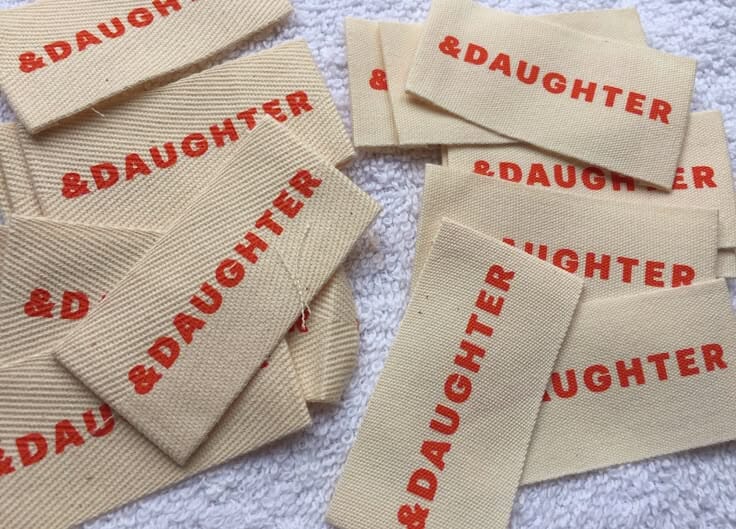
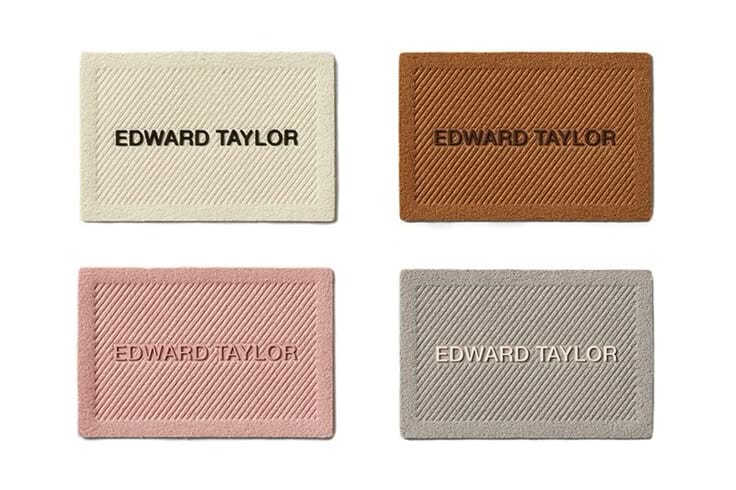
- A label produced on a needle loom using polyester or cotton yarn, common constructions are damask, satin, and taffeta. Woven labels read as premium and hold fine logo detail down to 4 mm tall.
- Printed label
- A label printed (usually screen or thermal-transfer) onto a satin, cotton, or Tyvek substrate. Cheaper than woven, softer against skin, and the default for care and size labels.
- RPET hangtag
- A hangtag made from recycled PET bottles, increasingly required by retailers under their sustainability programs. Costs roughly 10-20% more than virgin paperboard but lets you make a verifiable recycled-content claim.
- YKK
- A Japanese zipper manufacturer, YKK Group, founded 1934, producing zippers in more than 70 countries. The de-facto reliability benchmark for branded zippers across denim, outerwear, and luggage.
- Drawstring
- A cord or flat tape threaded through a casing on hoodies, joggers, and shorts to cinch the garment. Common materials: braided polyester, twisted cotton, flat woven tape with metal aglets.
- Twill tape
- A flat woven tape (cotton or polyester) used as a hanger loop, internal seam reinforcement, or branding strip. The tape inside the back neck of most T-shirts is usually printed twill.
- RFID
- Radio-frequency identification tag, increasingly embedded in hangtags or care labels for inventory tracking. Required by Walmart, Inditex, and several luxury houses on inbound goods from 2024 onward.
- Hangtag
- The detachable card or tag hung from the garment at point of sale, typically carrying brand identity, price, barcode, and care or fiber information.
- Neck label
- The main brand label sewn or printed at the inside back neck of a top. Either a woven label or a heat-transferred print on the inside of the garment.
- Care label
- The legally mandated label listing fiber content, country of origin, washing instructions, and the manufacturer's RN or CA number. Usually printed on satin or cotton, sewn into the side seam.
What are the 7 trim categories every garment needs?
Trims are every non-fabric component attached to or packaged with a finished garment. Across 47 OneAim factory quotes pulled in 2024-2025, the average tech pack listed 18 trim SKUs per style spread across seven functional categories. Miss any one of them and the sewing line stops, even when fabric is sitting on the cutting table ready to go.
The categories below cover what we see on more than 90% of bills of materials we review. The exact mix changes by garment type: a T-shirt has four trim SKUs, a technical parka can hit 35.
Closures and hardware
Zippers, buttons, snaps, rivets, hooks, D-rings, cord locks, and drawcord stoppers. Zippers alone come in coil, molded plastic, and metal-tooth types, each with sub-categories for pull style, tape color, gauge, and slider lock. A standard men's chino uses four closure SKUs: a YKK metal zipper, a tack button, a shank button for the waistband, and bar-tack thread.
Labels and tags
Main brand label, care label, size label, country-of-origin label, hangtag, and price ticket. Each one has a legal or branding job. The legally mandated set in most markets is care, size, fiber content, and country-of-origin, sometimes combined into one printed label.
Body-contact trims
Elastic, drawcords, twill tape, bra cups, shoulder pads, interlining, and fusible tape. These ride against skin and face tougher compliance testing for AZO dyes, lead content, and nickel release under EU REACH Annex XVII.
Threads
Sewing thread is technically a trim, not a fabric. Spun polyester is the workhorse, core-spun for stretch and durability, cotton-wrapped for vintage look. Coats, A&E, and Gutermann are the named global brands; Vietnam and India host their largest mills.
Packaging and finishing
Polybags, tissue paper, size stickers, hangers, master cartons, and barcode labels. Retailer-specific packaging (Nordstrom, Zalando, Amazon FBA) often has stricter specs than the garment itself.
Embellishment trims
Patches, embroidery thread, sequins, beading, screen-print plastisol, heat-transfer films, and rhinestones. These are usually applied at the factory but sourced separately from specialist mills.
Branding extras
Custom-printed tissue, branded polybags, shoulder ribbon, hanger loops, and pocket flashers. Optional, but most premium brands insist on at least three of them.
Citation capsule: A typical apparel tech pack lists 18 trim SKUs across seven categories: closures, labels, body-contact trims, threads, packaging, embellishment, and branding extras. Trims average 11% of FOB cost yet drive a disproportionate share of production delays per OneAim production data, 2024-2026.
What do trims cost as % of garment?
Trims account for 8-15% of FOB garment cost on a typical style, climbing to 18-22% on technical outerwear and denim. On a $30 FOB shirt, trims usually clock $2.40 to $4.50.
The share rises with two factors: how visible the trim is to the customer (logo zippers, horn buttons), and how much hardware the garment carries. A T-shirt has three trims; a parka has 30. Premium positioning compounds this. The horn button on a $400 blazer is the same SKU as on the $4,000 version, but the buyer expects it.
Trim cost by garment category
| Garment | Typical trim count | Trim cost USD | % of FOB |
|---|---|---|---|
| Basic T-shirt | 3-5 SKUs | $0.30 - $0.70 | 6-9% |
| Polo shirt | 6-9 SKUs | $0.80 - $1.60 | 8-12% |
| Button-down shirt | 10-14 SKUs | $1.20 - $2.80 | 9-13% |
| Hoodie | 8-12 SKUs | $1.50 - $3.20 | 9-14% |
| Joggers | 6-9 SKUs | $0.90 - $2.00 | 8-12% |
| Jeans | 12-16 SKUs | $2.00 - $4.20 | 14-18% |
| Tailored blazer | 15-20 SKUs | $4.50 - $11.00 | 12-18% |
| Technical parka | 25-35 SKUs | $8.00 - $22.00 | 18-22% |
Source: see in-text citations in this section.
Sources: OneAim Apparel client quote data, 2024-2025.
In our 2024-2025 quote sample, brands routinely under-budget trims by 30-40% on first-time tech packs because they price the obvious components (zipper, label) and forget the rest (interlining, fusing, shoulder ribbon, polybag, hanger loop, hangtag, RFID chip). Always pad trim budget by 25% on a first style.
Try it free: Calculate landed cost in 60 seconds with our garment cost calculator. Trim line items are pre-built into the model. No email required.
Citation capsule: Trims represent 8-15% of FOB garment cost on most styles, rising to 18-22% on outerwear and denim. On a $30 FOB shirt, expect $2.40 to $4.50 in trims.
Where do you source labels and hangtags?
Label and hangtag sourcing clusters around four hubs: Hong Kong and mainland China for branded label programs at scale, India (Tiruppur and Delhi) for low-MOQ woven labels, Turkey and Portugal for European-market boutique runs, and Vietnam for factories that prefer in-region trim integration. The large majority of global apparel-label production remains concentrated in Asia, led by Hong Kong, mainland China, India, and Turkey.
The right answer depends on your annual volume, your factory's location, and how branded the label needs to be. Below is the working table we use when nominating label suppliers in 2026 placements.
Label and hangtag sourcing matrix
| Type | Primary supplier hubs | MOQ | Lead time | Indicative price |
|---|---|---|---|---|
| Woven main label, damask | Hong Kong, China, Turkey | 1,000 pcs | 12-18 days | $0.04 - $0.09 |
| Woven main label, satin | China, India, Portugal | 1,000 pcs | 12-18 days | $0.05 - $0.11 |
| Woven main label, low-MOQ | India (Tiruppur), Portugal | 300-500 pcs | 14-21 days | $0.08 - $0.18 |
| Printed care label, satin | China, Vietnam, Portugal | 500 pcs | 7-12 days | $0.02 - $0.04 |
| Heat-transfer neck print | China, Turkey | 1,000 pcs | 10-15 days | $0.03 - $0.08 |
| Paperboard hangtag | Local + China | 500 pcs | 7-15 days | $0.06 - $0.20 |
| RPET hangtag | China, Vietnam, Portugal | 1,000 pcs | 12-18 days | $0.09 - $0.25 |
| RFID-embedded hangtag | China, Hong Kong | 5,000 pcs | 18-25 days | $0.20 - $0.45 |
Source: see in-text citations in this section.
Sources: OneAim Apparel quote data, 2024-2025; supplier published rate cards from Avery Dennison, SML Group, regional Indian and Turkish mills.
Hong Kong and China for branded programs
Avery Dennison, SML Group, and Trimco run multi-country label programs for big retail. They handle artwork, RFID encoding, regional substitution, and just-in-time delivery to factories in 30+ countries. MOQs are higher (3,000-5,000 pieces per design), but the per-unit cost is the lowest in the market once you cross 50,000 units a year.
India and Turkey for boutique runs
For brands at 5,000-50,000 units a year, Indian mills around Tiruppur and Turkish suppliers in Istanbul beat the big trade companies on flexibility. We've seen 300-piece MOQs from Indian mills and 500 pieces from Turkish ones, with two-week lead times and acceptable quality.
Portugal for EU-shipped programs
For brands producing in Portugal, Spain, Italy, or Turkey, local label printers in northern Portugal (Guimaraes, Famalicao) offer 200-500 piece MOQs at competitive pricing once you remove freight and duty. For Portugal-specialist depth, see our sister site Portugal Clothing Factory.
Find your factory: Browse the free factory directory preview, or unlock the premium directory for $39 to see 100+ documented factories with direct contacts and MOQs.
Citation capsule: The large majority of global apparel-label production remains concentrated in Asia, with Hong Kong, mainland China, India, and Turkey accounting for the bulk. MOQs run 1,000 pieces for branded labels, dropping to 300 pieces from Indian and Portuguese boutique mills.
Where do you source zippers, buttons, drawstrings?
Hardware sourcing is even more concentrated than labels: YKK is the clear global leader, reporting more than 10 billion zippers sold in its 2024 fiscal year, with SBS, Ideal, and RIRI the next names down. Italian button mills around Bergamo and Como dominate premium horn, corozo, and mother-of-pearl. Turkish suppliers around Istanbul handle mid-market metal and plastic at 40-50% of Italian pricing.
The three rules we apply in 2026 placements: pick branded zippers for anything above $50 retail, source horn or corozo buttons from Italy or specialist mills only, and consolidate drawstring SKUs across styles to clear MOQ floors without dead stock.
Zippers: YKK, SBS, RIRI, Ideal
YKK, founded 1934 in Tokyo, manufactures in more than 70 countries and sets the reliability benchmark. Their #5 metal zipper is the de-facto standard for denim and outerwear. SBS Zipper, the largest Chinese maker, sells at roughly 30-40% lower cost with quality acceptable on mid-market goods. Ideal (German-Spanish) is popular with Iberian factories. RIRI is the Swiss premium option, used on luxury bags and jackets above $1,500 retail.
MOQs across all four: 3,000 pieces per color-length combination for branded customs, 1,000 pieces for stock items in standard colors. Lead time runs 25-45 days for branded customs, 10-20 days for stock. Color-matching to a Pantone TPX adds two weeks to the schedule.
Buttons: Italy, Turkey, China
Italian button mills around Bergamo, Como, and Brescia (Bottoni Italiani, Cogolo, Inter Bottoni) own premium horn, corozo, and mother-of-pearl. MOQs run 500 pieces at $0.20 to $1.20 per button. Turkish mills in Istanbul produce mid-market metal, plastic, and shell buttons at $0.05 to $0.40. Chinese mills in Yiwu and Wenzhou cover everything else from $0.02 per piece. Custom tooling for a logo button adds $300-800 one-time and bumps MOQ to 5,000-10,000 pieces.
Drawstrings, twill tape, elastic
Drawstrings, twill tape, and woven elastic come from the same mills that make narrow-fabric trims. China and Vietnam dominate by volume, Taiwan handles technical elastic, and Italian mills handle premium braided cord. MOQs run 5,000 yards for standard colors, 10,000 yards for custom dye lots. Lead times: 15-30 days from China, 25-40 days from Italy.
Worked example: hoodie hardware bill
Here is the trim hardware list for a 5,000-unit hoodie program we sourced in late 2025:
- 5,000 metal aglets (drawcord ends) from Yiwu, China: $0.04 each
- 10,000 yards braided polyester drawcord, 8 mm: $0.08 per yard
- 10,000 cord locks, custom logo: $0.12 each, 5,000-piece MOQ cleared
- 15,000 woven main labels (one design, three sizes): $0.06 each
- 20,000 printed care labels (US, EU-DE, EU-FR variants): $0.03 each
- 5,000 RPET hangtags: $0.14 each, custom string $0.02 each
- Total for these line items: $0.90 per unit on a $24 FOB hoodie, or about 3.8% of FOB (hardware, labels, and hangtags only; thread, elastic, and packaging carry the hoodie into the 9-14% band in the table above)
What care label compliance does each market require?
Care label rules diverge enough that a US-compliant label is illegal in France. The European Commission notes that non-compliant textile labeling is a recurring cause of customs rejections at EU borders. The fines per violation can run up to $53,088 under the FTC's 2025-adjusted civil penalty schedule.
.jpeg)
Below is the working compliance table our brands use when shipping into all three North American and European markets simultaneously.
Care label requirements: US, EU, Canada
| Requirement | United States (16 CFR 423) | European Union (Reg 1007/2011) | Canada (Textile Labelling Act) |
|---|---|---|---|
| Fiber content | Required, % by weight, English | Required, % by weight, all official languages of country of sale | Required, % by weight, English plus French |
| Care instructions | Required (text or symbols) | Voluntary, GINETEX symbols recommended | Voluntary, CAN/CGSB-86.1 symbols if used |
| Country of origin | Required (US Customs 19 CFR 134) | Required for imports under EU Customs Code | Required, English plus French |
| Manufacturer ID | RN, WPL, or company name | Manufacturer or importer name | CA number or full dealer name |
| Permanence | Required (must survive useful life) | Required | Required |
| Language | English mandatory | Every official language of destination market | English plus French mandatory |
Source: see in-text citations in this section.
Sources: FTC Care Labeling Rule, 16 CFR 423; EU Regulation 1007/2011; Canadian Textile Labelling Act, Competition Bureau guidance, 2024.
United States: 16 CFR Part 423
The FTC Care Labeling Rule requires a permanent label with washing, bleaching, drying, ironing, and professional-care instructions. Text, symbols, or both are allowed. English is mandatory. Fiber content must comply with the Textile Fiber Products Identification Act and list percentages by weight in descending order.
European Union: Regulation 1007/2011
Fiber content must appear in every official language of the country of sale. A garment sold in Belgium needs Dutch, French, and German on the label. Symbols are recommended (GINETEX) but not mandatory. Country of origin is not mandatory EU-wide for garment labels but is required for customs declarations under the EU Customs Code.
Canada: Textile Labelling Act
The Competition Bureau requires bilingual (English and French) labels with fiber content and a CA number or the full name and address of a Canadian dealer. Care instructions are voluntary, but if included must follow CAN/CGSB-86.1 symbols.
In our 2024-2025 placements, around 30% of US-only brands selling into Canada through Shopify or Amazon CA had non-compliant labels and didn't know it. The fix is one extra printed care label SKU (English plus French, with CA number) at roughly $0.04 per unit, swapped in at the factory before the Canada-bound cartons are sealed.
Citation capsule: US 16 CFR 423 requires English text, EU Regulation 1007/2011 requires every official language of the destination country, and the Canadian Textile Labelling Act mandates English plus French with a CA number. Non-compliant textile labels are a recurring cause of EU customs rejections per European Commission guidance.
How do you handle brand-specific trim packaging?
Brand-specific trim packaging covers everything that touches the customer outside the garment itself: custom hangtags, tissue paper, polybags, hanger ribbons, swing-tag string, even branded shipping cartons. Brands above $5M in annual revenue typically run 4-6 custom packaging SKUs per style. Average cost: $0.30 to $0.90 per unit, or 1-3% of FOB depending on retail positioning.
The non-obvious trap is retailer compliance. Nordstrom, Zalando, El Corte Ingles, Amazon FBA, and Walmart each publish multi-page packaging spec documents that override brand preference. Miss a barcode placement spec and a 5,000-unit order gets refused at the DC.
Custom polybag specs
Standard polybags run 1.5 mil thickness, clear, with a self-seal flap and a suffocation warning printed on the bag. Branded polybags add a 1-2 color print, recycled (LDPE-R) substrate, or biodegradable additives. MOQs run 5,000 pieces per size for plain, 10,000 for printed. Lead time 15-25 days from China.
Hangtags, swing tags, and string
Custom hangtags are the most visible branding moment after the garment itself. Spec the substrate (paperboard weight in gsm, FSC or RPET), print method (offset for runs above 5,000, digital below), finishes (foil stamp, emboss, spot UV), and string (cotton, jute, elastic loop, or plastic kimble). Foil and emboss add $0.05-0.15 per unit.
Retailer compliance packs
If you're selling into a major retailer, request their inbound packaging guide before the trim PO. Common requirements: GS1-128 barcode at specific carton placement, polybag size limits, hanger style, RFID encoding, and master carton dimensions. We maintain a working file of the top 25 retailer specs to pre-empt these issues during sourcing.
Running into nearshoring decisions? Get in contact and we’ll map the full picture for your brand, or grab a factory-ready tech pack for $79.
What's the timeline for trim production?
Trim production typically runs 25-45 days from PO to factory delivery for branded customs, 15-25 days for generic items, and 5-10 days for stock components. Across 47 OneAim placements in 2024-2025, the average trim lead time was 32 days versus 45 days for fabric. Trims rarely hold up fabric on the calendar, but they frequently arrive after fabric has been cut, blocking the sewing line by days or weeks.
The pattern we see most often is brands ordering fabric on day one, then placing trim POs three to four weeks later. By then, branded zipper lead times have eaten the buffer. The fix is simple: place trim POs the same day as fabric, or earlier if branded components are involved.
Trim timeline by category
| Trim | Order placement | Sample approval | Bulk production | Total lead time |
|---|---|---|---|---|
| Stock printed care labels | Day 0 | n/a | 5-10 days | 5-10 days |
| Stock zippers | Day 0 | n/a | 10-20 days | 10-20 days |
| Custom woven labels | Day 0 | 7-10 days | 12-18 days | 19-28 days |
| Custom hangtags | Day 0 | 5-7 days | 12-18 days | 17-25 days |
| Branded YKK zippers | Day 0 | 14-21 days | 25-45 days | 39-66 days |
| Custom horn buttons | Day 0 | 14-21 days | 30-50 days | 44-71 days |
| RFID-embedded hangtags | Day 0 | 10-14 days | 18-25 days | 28-39 days |
Source: see in-text citations in this section.
Source: OneAim Apparel production pipeline data, 2024-2025.
Critical-path planning
The right way to plan trim is to back-schedule from the cutting date. Cutting starts when fabric arrives and approves QC. Sewing starts when cut panels reach the line and all trims are present. If your branded zippers run 50-day lead times and your fabric runs 60 days, you're fine. If fabric is 35 days and zippers are 50, you have a problem.
Across our 2024-2025 pipeline, the three most common timeline failures were: branded zipper PO placed 2-3 weeks after fabric (recovered with air freight at $4-8 per zipper), care label artwork approved late (recovered with rush printing), and Italian horn button delivery missed by 2 weeks (recovered with stock plastic substitute and a customer apology).
Decision framework: Choose your trim sourcing approach
Choose factory-sourced trims when:
- Order quantity is under 3,000 units per style.
- You're working with a new factory partner and want them to own quality.
- Your trim list is generic (no branded zippers, no custom horn buttons).
- You don't have an in-house production manager to handle PO chasing.
- Your factory is in Vietnam, Bangladesh, or India where local trim networks are strong.
Choose nominated trim sourcing when:
- Annual production runs above 30,000 units.
- You want consistent specs across multiple factories or seasons.
- You have signature branded components (custom YKK pulls, branded buttons, RPET hangtags).
- Your trims need to clear a retailer compliance pack (Nordstrom, Zalando, FBA).
- You're producing in two or more countries and need supplier consistency.
Choose brand-supplied (free-issue) trims when:
- A signature trim cannot be sourced locally by the factory at acceptable cost (Italian horn buttons in Bangladesh, RIRI zippers in Vietnam).
- You're running a recurring program with 6+ months of forecast visibility.
- You have an in-house production team with logistics capacity.
- You want maximum cost transparency on the trim line.
- The trim is a regulatory or IP-sensitive component (custom anti-counterfeit RFID, encoded care label).
Talk to a real person: get in contact with our team. No pitch, no upsell. We'll review your trim list and flag any MOQ or compliance traps before they cost you a shipment.
Frequently Asked Questions About Trims and Labels for Clothing Brands
Do I need a different care label for every country I sell in?
Usually yes. The US requires English, the EU requires every official language of the country of sale, Canada requires English and French with a CA number, and Japan requires Japanese with JIS L 0001 symbols. The FTC and EU rules are mutually incompatible, so one master label cannot serve both markets legally. Budget $0.04-0.08 per unit for region-specific care label packs.
What's the MOQ for custom woven labels?
Industry-standard woven label MOQ is 1,000 pieces per design from Asian mills, 500 pieces from Turkish and Portuguese boutique suppliers, and 300 pieces from some Indian mills around Tiruppur. Setup tooling is included in the first order; re-orders ship without tooling fees. Digital woven label technology now offers 100-piece MOQs at 2-3x the per-unit cost, useful for sample collections and runway pieces.
Can my factory use generic zippers instead of YKK to save money?
Yes, but audit the decision. SBS Zipper and Ideal are solid YKK alternatives at 30-40% lower cost on mid-market goods. Truly generic no-brand Chinese zippers fail noticeably more often than branded ones in our QC inspections. For denim, outerwear, and anything above $50 retail, stay with branded YKK, SBS, or RIRI.
What does FTC enforcement actually cost?
Textile labeling violations are enforced as unfair or deceptive acts under Section 5 of the FTC Act, which carries a maximum civil penalty of $53,088 per violation as of 2025 on the FTC's adjusted civil penalty schedule, per the Federal Register inflation adjustment notice effective January 17, 2025. Each non-compliant label can count as a separate violation. A 5,000-unit run with one mislabeled SKU has theoretical exposure in the millions, though in practice the FTC negotiates settlements based on intent and scale.
How early should I order trims relative to fabric?
Order trims the same day you order fabric, or earlier if branded components are involved. Branded zippers and custom buttons run 6-8 weeks; custom labels 2-4 weeks; stock components 5-15 days. Most sewing lines stop on missing trims, not missing fabric. In our 47-placement 2024-2025 pipeline, average trim lead time was 32 days versus fabric at 45 days. Treat trims as the critical path.
What's the difference between woven and printed labels?
Woven labels are produced on a needle loom using polyester yarn, and they read as premium with sharp logo detail. Printed labels are screen or thermal-transfer printed onto satin or cotton substrate, and they're cheaper and softer. We recommend woven for the main brand label at the inside neck, printed satin for the care label, and either for size labels. Avoid woven care labels: they scratch the neck and drive return rates up.
Are sustainable trim alternatives worth it?
For most brands selling to EU, US, or Japanese consumers, yes. RPET hangtags cost roughly 10-20% more than virgin paperboard but enable verifiable recycled-content claims under the EU Green Claims Directive. Recycled polyester woven labels run 5-15% premium. FSC-certified paperboard is now within 5% of conventional pricing. The aggregate uplift is around 0.3-0.6% of FOB on most styles.
What's a pre-production trim card and do I need one?
Yes. A pre-production trim card is a physical board with one approved sample of every trim component, labeled, dated, and signed by the brand and the factory. It's the reference the cutting and sewing teams work from. Without it, disputes over "this isn't the right button" become unresolvable. We require a signed trim card before cutting on every placement we manage.
Can I source all my trims locally instead of importing?
For brands manufacturing in Portugal, Italy, Turkey, or the US, partial local sourcing makes sense. Labels and hangtags are usually cost-competitive locally. Hardware (branded zippers, premium buttons) almost always still imports from Asia or Italy because volume hubs win on price. Local trim sourcing typically covers 40-60% of trim SKUs in Portugal-based programs we manage.
Who pays the duty on trims?
Trims that ship inside the finished garment carton clear customs at the garment's HS code and duty rate. Free-issue trims shipped separately from brand to factory clear at the trim's own HS code, which can be higher than the garment's. Always confirm duty implications before choosing a free-issue strategy. Our garment cost calculator builds trim line items into the landed cost model by default.
Conclusion: trims are 11% of cost and an outsized share of risk
Trims sit at the intersection of cost, compliance, and calendar. Get them wrong and a $300,000 production run sits in a Hai Phong warehouse for a month while you wait on replacement YKK zippers. Get them right and they fade into the background where they belong, accounting for their 8-15% of FOB and their share of brand identity at the inside neck.
Three rules carry most of the load. First, treat trims as the critical path, not the afterthought, and place trim POs the same day you place fabric. Second, source by hub: Japan and China for zippers, Italy and Turkey for buttons, Hong Kong, India, and Portugal for labels. Third, build region-specific care label packs from day one, the marginal cost is $0.04-0.08 per unit and the upside is not having a 12,000-unit order seized at Antwerp customs.
For most brands under $5M in annual revenue, factory-sourced trims net out cheaper once you price in logistics and risk. Above $5M, hybrid nominated sourcing becomes the gold standard. Either way, document everything on a signed pre-production trim card, and audit your care labels in every market you ship to.
We're a group of 100+ documented clothing manufacturers across 15+ countries. Tell us your product, volume, and timeline. We'll route your brief to the factory in our group built for it, usually within 24 hours. You produce directly with the factory. Flat fees, no markups, no pitch.
Get in contact Download the directory ($39)Need a tech pack? Get a factory-ready single-style tech pack for $79. See what's included.
References
- US Federal Trade Commission, Care Labeling Rule, 16 CFR Part 423. https://www.ftc.gov/legal-library/browse/rules/care-labeling-rule
- US Federal Trade Commission, Textile Fiber Products Identification Act. https://www.ftc.gov/legal-library/browse/statutes/textile-fiber-products-identification-act
- European Commission, Textile Labelling Regulation 1007/2011. https://eur-lex.europa.eu/legal-content/EN/TXT/?uri=CELEX%3A32011R1007
- Competition Bureau Canada, Textile Labelling and Advertising Act guidance. https://competition-bureau.canada.ca/en/how-we-foster-competition/education-and-outreach/publications/textile-labelling-and-advertising-act
- Japanese Consumer Affairs Agency, JIS L 0001 care symbol guidance. https://www.caa.go.jp/en/
- ACCC Australia, Country of Origin labelling guidance. https://www.accc.gov.au/business/advertising-and-promotions/country-of-origin-claims
- YKK Corporation, global manufacturing footprint and product range. https://www.ykk.com/
- Avery Dennison RBIS, label and RFID solutions. https://rbis.averydennison.com/
- International Trade Centre (UN), apparel trims trade data 2024. https://www.intracen.org/
- US International Trade Commission, harmonized tariff schedule and trade data 2024. https://www.usitc.gov/
- ECHA, REACH Annex XVII restrictions on textiles and components. https://echa.europa.eu/substances-restricted-under-reach
- GINETEX, European care symbol system. https://www.ginetex.net/
- US Customs and Border Protection, country of origin marking under 19 CFR 134. https://www.ecfr.gov/current/title-19/chapter-I/part-134