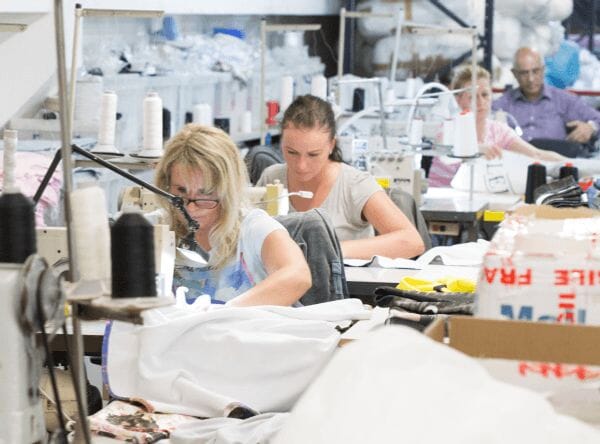
Socks aren't sewn, they're knitted, and that one fact reorders how you source them. The Datang subdistrict of Zhuji in Zhejiang, the world's largest sock manufacturing base, turns out roughly 25 billion pairs a year, more than 70% of China's output and about a third of every sock made on earth (Xinhua, 2024).
This directory profiles 10 sock manufacturers across the US, Pakistan, Turkey, Portugal, and Italy, and explains the machinery that decides what your sock can be. It's an editorial map built from company disclosures, not a roster of factories OneAim owns.
Heads up: We're OneAim, a group of 100+ documented clothing manufacturers across 15+ countries. The companies below are independent hosiery businesses listed on public sources, not members of our group. OneAim's role is separate: route your brief to a documented factory in our group built for your product.
Key Takeaways
- Sock manufacturing is a knitting business. A sock is knitted as a tube from cuff to toe on a circular machine, then the toe is closed. Cut-and-sew logic doesn't apply.
- Datang, China makes about a third of the world's socks, roughly 25 billion pairs a year (Xinhua, 2024).
- Single-cylinder and double-cylinder machines make different products. Bolero Socks says its Istanbul plant runs both.
- Needle count is your gauge. Interloop states its machines run 84 to 168 needles.
- None of these ten publishes an MOQ. Ask in writing, and check the yarn minimum first.
Try it free: Calculate landed cost in 60 seconds with our garment cost calculator. No email required.
Why is sock manufacturing a knitting business, not a cut-and-sew one?
Because there's no pattern, no marker, and no cutting. A sock is knitted in one continuous piece on a small circular machine: yarn feeds in, the machine builds the cuff, then the leg, heel, foot, and toe, all as a single tube. The only assembly step is closing the toe.
That changes everything downstream. The machine and the yarn create the fabric and the garment in the same pass. So your design decisions live inside machine settings: cylinder type, needle count, and where the cushioning loops sit. You don't hand a sock factory a fabric. You hand it a knitting program. Isn't that an awkward thing to learn after you've picked a supplier?

What do single-cylinder and double-cylinder machines actually do?
They make two different families of sock. A single-cylinder machine holds its needles in one rotating cylinder and knits the standard, fast, high-volume sock most brands sell. A double-cylinder machine adds a second cylinder above the first and transfers needles between them. That allows true rib structures and reversible stitch effects a single cylinder can't form.
The clearest public evidence of that split comes from Turkey. Bolero Socks says its Istanbul plant runs more than 40 Bentley Komet double-cylinder machines alongside 250 computerized Lonati machines. Lonati, of Brescia, Italy, is the dominant builder of circular hosiery machines. When a factory tells you what's on its floor, it's telling you what it can knit for you.
Citation capsule: A sock is knitted, not cut and sewn. Circular hosiery machines build it as a single tube from cuff to toe, and the toe is closed afterwards. Single-cylinder machines knit standard high-volume socks; double-cylinder machines transfer needles between two cylinders to form true ribs and reversible structures. Bolero Socks states its Istanbul plant runs both types.
How does needle count change what your sock can be?
Needle count is gauge, and gauge is resolution. More needles means finer stitches, a smoother hand, and more detail in a knitted logo. Fewer needles means a chunkier fabric, which a heavy boot sock wants and a dress sock does not.
Interloop states on its own site that its machines run needle counts from 84 to 168. That's the practical range you'll be quoted against: work and hiking socks sit low, fine dress socks sit high. Italy's Bresciani built a luxury business at the top of that spectrum. Ask a factory for its needle counts before you ask for a price.
How is a sock's toe closed?
At the end of the tube, one way or another. The toe is the sock's only real seam and the quality difference a customer feels first. Most modern production uses automated seamless toe closure, either knitted closed on the machine or joined by an inline or offline linking unit so no bulky ridge sits against the toes.
The counterpoint sits in Bergamo. Bresciani's signature is a hand-linked toe, closed by an operator rather than a machine. Neither method is universally right. A running sock needs a flat automated closure repeated identically across tens of thousands of pairs, while a luxury dress sock can justify a person doing it by hand.
What is terry loop cushioning?
Padding knitted into the sock rather than added to it. A second yarn is plated in and pulled into raised loops on the inside face, making a springy layer exactly where the foot needs it. Placement is precise: heel only, forefoot only, full cushion, or zoned.
Zoned padding is the whole basis of activity-specific socks. Thorlo, now operated under New American Hosiery Company following a 2025 asset sale, built its reputation on padding placed by activity. So don't brief a factory with the word "cushioned." Say where, how deep, and on which face.
How did we choose these manufacturers?
We built this list from public sources: company websites, stock-exchange and trade-agency records where they exist, and industry reporting. Every company here is real and operating. We've separated brands that own their mills from manufacturers that take on outside production, because confusing the two wastes a brand's time.
We didn't rank one to ten, because "best" depends on your volume, yarn, and market. None of these ten publishes a minimum order quantity, so we don't print one. Where a figure is self-reported rather than audited, we flag it.
Who are the leading US sock manufacturers?
Darn Tough Vermont, Cabot Hosiery Mills (Northfield and Waterbury, Vermont, USA)
The best-known American sock name, founded as Cabot Hosiery Mills in 1978 by Marc Cabot. It knits merino performance socks in company-owned Vermont mills and backs them with the unconditional lifetime guarantee it introduced in 2004. Important: this is a brand that owns its mills, not a contract manufacturer you can book, and those details are its own claims.
Nester Hosiery, maker of Farm to Feet (Mount Airy, North Carolina, USA)
The contract manufacturer behind Farm to Feet, and the name to actually approach. Founded in 1993 by Marty Nester, it does contract and private-label merino knitting alongside its own brand and states it employs more than 200 people. Farm to Feet's wool is described as US-grown, processed by Chargeurs Wool and spun by Kent Wool and National Spinning. Those claims are self-reported.
Crescent Sock Company (Niota, Tennessee, USA)
Founded in 1902, Crescent says it's the oldest continuously operating hosiery mill in the United States, fourth-generation family owned with around 100 jobs in Niota. It runs private-label production alongside its own brands, including World's Softest and Omni-Wool. The "oldest" claim is the company's own. Best for cushioned and casual private-label programs.
Thorlo, TH Hosiery Mills (Statesville, North Carolina, USA)
The engineered-padding specialist, with the technology credited to Jim Throneburg and Thorlo Inc. founded in 1980. Ownership changed recently: TH Hosiery Mills' assets were reported acquired in July 2025 by New American Hosiery Company, a joint venture of Wilson Brown Sock Company and Circufiber Inc., with manufacturing continuing in Statesville. Confirm current ownership and terms directly.
Who are the leading sock manufacturers outside the US?
Interloop Limited (Faisalabad, Pakistan)
The industrial giant of this list. Listed on the Pakistan Stock Exchange as ILP after a March 2019 IPO, Interloop reported 37,786 employees as of June 2025 and FY2025 revenue of Rs 173.381 billion, roughly USD 620 million (Interloop corporate reporting, 2025). It runs five vertically integrated plants in Pakistan plus sites in Sri Lanka and China, states needle counts of 84 to 168, and lists Nike, adidas, Puma, H&M, Target, Uniqlo, and M&S as customers on its own hosiery site. Its widely cited capacity of about 700 million pairs a year is self-reported.
Şimşek Socks, Şimşek Çorap ve Tekstil (Esenyurt, Istanbul, Turkey)
A fully export-oriented Turkish manufacturer supplying European retail chains and licensees since 1998. It states capacity of 30 million pairs a year, all exported, from a roughly 7,000 square metre factory with knitting, toe closing, washing, boarding, and packing in-house, and says it's BSCI and Sedex audited. Figures are self-reported. Best for nearshore European retail volume.
Bolero Socks (Arnavutköy, Istanbul, Turkey)
A private-label socks and legwear manufacturer covering socks, tights, and leggings, with a wide yarn range including bamboo, wool, Tencel, Modal, and Coolmax. Bolero says its plant runs 40-plus Bentley Komet double-cylinder machines and 250 computerized Lonati machines, with export capacity over 25 million pairs a year. Best for brands needing both cylinder types from one factory.
A. Fiúza & Irmão, AFI Socks (Barcelos, northern Portugal)
A 100% export, private-label-only manufacturer founded in 1983 by brothers António and João Fiúza, both circular-knit technicians, now second-generation run. AFI covers fashion, everyday, medical, compression, outdoor, and technical sport socks, from R&D and design through prototyping to production. It publishes no capacity, machine count, or minimum, so ask.
Império das Meias (Portugal)
A Portuguese knitter of socks, tights, and underwear, operating since 1992 per the company, with socks engineered for what it calls extreme and specific conditions. It states a facility of more than 8,000 square metres, around 100 machines, and over 200,000 pairs a month. Self-reported. Best for technical and compression programs sourced inside the EU.
Calzificio M. Bresciani (Spirano, Bergamo, Italy)
The luxury end. Founded in 1970 by Mario Bresciani and registered with the Italian Trade Agency as Calzificio M. Bresciani Srl, it knits dress and sport socks at very high gauge in Egyptian cotton, merino, cashmere, and silk, finished with a hand-linked toe. It supplies luxury menswear retailers but publishes no client list and no minimum.
Here's how the ten compare at a glance.
| Company | Location | Type | Specialty | Stated capacity |
|---|---|---|---|---|
| Darn Tough (Cabot Hosiery) | Vermont, USA | Brand, owns mills | Merino performance, lifetime guarantee | Not published |
| Nester Hosiery | Mount Airy, NC, USA | Contract + own brand | Merino performance, private label | Not published |
| Crescent Sock Company | Niota, TN, USA | Contract + own brands | Cushioned and casual socks | Not published |
| Thorlo (TH Hosiery Mills) | Statesville, NC, USA | Brand, owns mill | Activity-zoned terry padding | Not published |
| Interloop Limited | Faisalabad, Pakistan | Manufacturer (PSX: ILP) | Industrial-scale hosiery | ~700m pairs/yr (self-reported) |
| Şimşek Socks | Istanbul, Turkey | Manufacturer, export only | European retail and licensee socks | 30m pairs/yr (self-reported) |
| Bolero Socks | Istanbul, Turkey | Manufacturer, private label | Socks, tights, wide yarn range | 25m+ pairs/yr (self-reported) |
| A. Fiúza & Irmão (AFI) | Barcelos, Portugal | Manufacturer, private label | Technical, medical, compression | Not published |
| Império das Meias | Portugal | Manufacturer | Technical and compression socks | 200k+ pairs/month (self-reported) |
| Calzificio M. Bresciani | Bergamo, Italy | Manufacturer | Luxury high-gauge, hand-linked toe | Not published |
Source: company websites, Pakistan Stock Exchange filings for Interloop, and the Italian Trade Agency listing for Bresciani, 2024 to 2026. Capacities are self-reported. None of these companies publishes a minimum order quantity.
The chart below puts those self-reported capacities on one scale. Three orders of magnitude separate a Pakistani vertical group from a European private-label knitter.
Where in the world are socks actually made?
In clusters, and they're extraordinarily concentrated. China dominates, and within China a single subdistrict does most of the work: Datang in Zhuji produces roughly 25 billion pairs a year, more than 70% of China's output and about a third of global production (Xinhua, 2024). No other apparel category concentrates like that.
Turkey clusters too. Trade press has reported it as the world's second-largest sock exporter with roughly 85% of its sock factories in Istanbul (Knitting Industry), though that reporting dates to around 2018 and is background rather than current fact. Pakistan supplies industrial scale, Portugal and Italy hold the technical and luxury ends, and the US keeps a real merino niche.
How big is the sock market?
Big enough that specialists have room, and growing steadily rather than dramatically. According to Grand View Research, the global socks market was valued at USD 49.5 billion in 2025 and is projected to reach USD 73.83 billion by 2033, a 5.2% CAGR from 2026 to 2033 (Grand View Research, 2025). The same firm puts Asia Pacific at 38.5% of 2025 revenue and cotton at 49.09% of the material split.
Treat those as one research house's estimate, not an official statistic. Hosiery scopes differ between reports. What the figure is useful for is direction: mid-single-digit growth in a category where a third of world output comes from one Chinese subdistrict tells you competition happens on product, not on discovery.
What is the MOQ reality for socks?
Nobody in this directory publishes one, so treat any number you find online with suspicion. What you can reason about is tier: the European private-label knitters, AFI and Império das Meias, are built to serve European brands from prototype through production, while Interloop and the Datang cluster are built for volume.
So ask directly, in writing, for your specific sock. The real floor is rarely the knitting. It's the yarn: a specialty merino, a Coolmax blend, or a custom dye lot carries its own supplier minimum. That usually sets the smallest order you can place.
Citation capsule: None of the ten sock manufacturers profiled here publishes a minimum order quantity. In practice the binding constraint is often yarn rather than knitting: specialty merino, performance blends, and custom dye lots carry their own supplier minimums, which typically set the real order floor above anything the knitting line itself requires.
What actually drives the cost of a sock?
Yarn and machine time, in that order. A sock has almost no labour content compared with a cut-and-sew garment, because there is no cutting, no bundling, and one seam. What you are really buying is the fibre in the tube and the minutes the knitting head spends building it.
That reframes every design decision as a cost decision. A higher needle count means more stitches per pair and slower machine time. Terry cushioning plates in a second yarn. So a full-cushion sock consumes materially more fibre than a flat-knit dress sock of the same size. Merino, cashmere, and performance blends sit far above commodity cotton per kilo, and a hand-linked toe replaces a machine second with a human minute.
The practical consequence: the cheapest lever on a sock quote is almost never the factory. It is the specification. Dropping a cushion zone you do not need, or accepting a standard yarn count instead of a custom dye lot, moves your price more than moving countries does.

What should you check in a sock sample?
Fit after washing, not fit out of the bag. A sock is elastic by design, so a fresh sample flatters itself. The failures that generate returns show up after repeated laundering, when the cuff relaxes, the leg twists, or the toe seam starts to abrade.
Use a fixed check sequence on every paid sample.
| Check | What you are testing | Why it fails in market |
|---|---|---|
| Cuff recovery | Elastic holds after 20 wash cycles | The sock slides down the leg |
| Toe seam profile | Flat closure, no bulky ridge | Rubbing and blistering complaints |
| Terry depth and placement | Cushion sits where you specified | Padding in the wrong zone feels wrong underfoot |
| Shrinkage and length | Dimensional change after laundering | Size runs short, sizing complaints |
| Colour fastness | Dye holds and does not crock | Dye transfer onto shoes and skin |
| Pilling and abrasion | Surface after wear cycles | Sock looks old within weeks |
Source: OneAim Apparel internal sourcing and sample-review practice, 2024 to 2026. This is our own working checklist, not an industry standard.
How do you work with a sock factory?
Brief the machine, not the mood board. A usable sock brief names cylinder type, needle count or gauge target, yarn composition, cushioning zones and terry depth, cuff structure, toe closure method, and sizing. Send a photo alone and you'll get a knitter's interpretation of it.
| Brief line | What to specify | Why the knitter needs it |
|---|---|---|
| Cylinder type | Single or double cylinder | Decides whether true rib is even possible |
| Needle count | A number or a gauge target | Sets stitch fineness and pattern detail |
| Yarn | Fibre, blend ratio, count, colour | Sets the real minimum and most of the cost |
| Cushioning | Zone and terry depth, which face | "Cushioned" alone is not a specification |
| Cuff | Rib structure, elastane, height | Decides whether the sock stays up |
| Toe closure | Automated seamless or hand-linked | Changes cost, feel, and factory shortlist |
| Sizing | Size run and target dimensions | Knitted-in, not adjustable after the fact |
Source: see in-text citations in this section.
Then commercialize it properly. Confirm the yarn minimum, buy a paid sample before bulk, and wash-test it. Socks live and die on how they behave after 20 cycles. Verify the company too: Interloop's numbers can be checked against stock-exchange filings. But most capacity claims in this category stay unproven until a sample lands. The same discipline applies across knit categories, and it is why our leggings manufacturers directory and underwear manufacturers directory lead with machinery rather than with logos.
Frequently Asked Questions About Sock Manufacturers
Who are the biggest sock manufacturers in the world?
Interloop Limited of Faisalabad, Pakistan is among the largest, listed on the Pakistan Stock Exchange with 37,786 employees as of June 2025 and FY2025 revenue of about USD 620 million. At cluster level China dominates: Datang in Zhuji produces roughly 25 billion pairs a year, about a third of global output, per Xinhua.
Are socks knitted or sewn?
Knitted. A sock is produced on a circular knitting machine as a single tube running from cuff to leg to heel to foot to toe. The only assembly operation is closing the toe, either by automated seamless closure on or off the machine, or by hand-linking. Hand-linking is Bresciani's signature method in Bergamo, Italy.
What is the difference between single-cylinder and double-cylinder sock machines?
A single-cylinder machine knits standard, high-volume socks from one rotating needle cylinder. A double-cylinder machine adds a second cylinder and transfers needles between them, enabling true ribs and reversible structures. Bolero Socks says its Istanbul plant runs both, with 40-plus Bentley Komet double-cylinder machines and 250 computerized Lonati machines.
What needle count should my sock be?
It depends how fine you want the fabric. Interloop states its hosiery machines run needle counts from 84 to 168. Lower counts give a chunkier knit suited to boot and work socks. Higher counts give finer stitches and more pattern detail, which dress and luxury socks need. Ask a factory which counts it actually has.
What is the minimum order quantity for custom socks?
None of the ten manufacturers in this directory publishes one, so ask in writing for your specific sock. The practical constraint is usually yarn rather than knitting: specialty merino, performance blends, and custom dye lots carry their own supplier minimums. Those normally set the real floor for a first order.
What drives the cost of manufacturing a sock?
Yarn and machine time. A sock carries almost no assembly labour, since there is no cutting and only one seam. So the fibre in the tube and the minutes of knitting-head time dominate the quote. Higher needle counts, deeper terry cushioning, premium fibres like merino or cashmere, and a hand-linked toe each add cost. The specification moves a sock price more than the country does.
Can I get socks made by Darn Tough or Thorlo?
No. Darn Tough, which knits in its own Vermont mills, and Thorlo, now operated under New American Hosiery Company following a 2025 asset sale, are brands that own their production rather than contract manufacturers taking outside work. For US contract and private-label knitting, Nester Hosiery and Crescent Sock Company are the names to approach.
We're a group of 100+ documented clothing manufacturers across 15+ countries. Tell us your product, volume, and timeline. We'll route your brief to the factory in our group built for it, usually within 24 hours. You produce directly with the factory. Flat fees, no markups, no pitch.
Get in contact Download the directory ($39)Need a tech pack? Get a factory-ready single-style tech pack for $79. See what's included.
Sources used in this article
- Xinhua, Datang sock manufacturing base, Zhuji, Zhejiang, 2024.
- Grand View Research, Socks Market Size, Share & Trends Report, 2025.
- Knitting Industry, Turkey and world socks demand, c. 2018.
- Darn Tough Vermont (Cabot Hosiery Mills), Made in Vermont USA, 2024 to 2026.
- Nester Hosiery / Farm to Feet, US manufacturing, 2024 to 2026.
- Crescent Sock Company, heritage, 2024 to 2026.
- Thorlo (TH Hosiery Mills), our story, 2024 to 2026; 2025 asset acquisition by New American Hosiery Company as publicly reported.
- Interloop Limited, hosiery division, 2026, and Interloop corporate and PSX filing summary, 2025.
- Şimşek Socks, about us, 2024 to 2026.
- Bolero Socks, about us, 2024 to 2026.
- A. Fiúza & Irmão (AFI Socks), about us, 2024 to 2026.
- Império das Meias, company website, 2024 to 2026.
- Calzificio M. Bresciani, company website, 2024 to 2026; entity confirmed via the Italian Trade Agency (ICE) listing.
- OneAim Apparel internal sourcing, sample-review, and pipeline data, 2024 to 2026.
- Machine builders named in this article, Lonati of Brescia, Italy and the Bentley Komet double-cylinder machines, appear in Bolero Socks' own plant disclosure, source 10.
- Yarn and processing partners named for Farm to Feet, Chargeurs Wool, Kent Wool, and National Spinning, are Nester Hosiery's self-reported claims, source 5.
- Brand customers named for Interloop, Nike, adidas, Puma, H&M, Target, Uniqlo, and M&S, are listed on Interloop's own hosiery site, source 8.
- People and sub-brands named in this article, Marc Cabot of Cabot Hosiery Mills, Marty Nester of Nester Hosiery, Jim Throneburg of Thorlo, Mario Bresciani of Calzificio M. Bresciani, António and João Fiúza of AFI, and Crescent's World's Softest and Omni-Wool lines, are drawn from the respective company sources above.
- Companies named in the 2025 Thorlo asset acquisition, New American Hosiery Company, Wilson Brown Sock Company, and Circufiber Inc., are named in the publicly reported transaction, source 7.
.jpeg)