.jpeg?w=1200&format=optimal)
Turkey shipped roughly $16.8B in ready-made garments during 2025 (combined textile and apparel exports of about $26B), holding sixth place in the global apparel league behind China, Bangladesh, Vietnam, India, and Italy (IHKIB, 2025). For brands selling into the EU or UK, the pull is structural: a 1995 customs union with Brussels means most finished apparel enters Europe at 0% duty, vertically integrated mills cover yarn through wash, and trucks from Istanbul reach Milan in four days. The 2026 picture has shifted with Lira volatility, post-earthquake capacity adjustments in the southeast, and ESPR rules pushing mills toward digital product passports.
This guide walks through five manufacturing clusters, realistic MOQs and FOB ranges, lead times to EU and US lanes, the compliance baseline, tariff math for US, EU, UK importers, and the pitfalls we see most often in sourcing audits. Numbers come from our Q1 2026 quote pipeline, the Istanbul Apparel Exporters Association, and ITC Trade Map. For broader context, see our where to manufacture clothing hub.
Heads up: We're OneAim, a group of documented United States clothing factories. Operational data below comes from our actual production pipeline. External sources are cited inline. The companies and market figures below are researched from public sources and our pre-2026 records, not a group we can place your production with today.
Key Takeaways
- Turkey ranks 6th globally in apparel exports. Ready-made garment exports were roughly $16.8B in 2025, supplying roughly a tenth of EU clothing imports by industry estimates (IHKIB, 2025).
- MOQs sit in a sweet spot. Studio factories accept 100-300 units, mid-tier factories 500-1,000, full export houses 1,500-3,000 units per style, per OneAim's directory data 2026.
- EU duty is zero. The 1995 customs union covers finished apparel, saving 12% MFN duty versus Vietnam or China (European Commission, 2024).
- Cotton tees FOB at $4.80-$6.50 in Q1 2026. Across 47 quotes pulled, midweight 180gsm jersey averaged $5.60 at 500-unit runs, roughly 30% under Portugal.
- Denim is the flagship. Gaziantep and Kahramanmaras mills produce 60%+ of national denim fabric, and Turkey ranks among the world's leading denim exporters by industry estimates (OEC, 2023).
- EU truck transit averages 4-6 days. Istanbul to Milan runs 4 days, Berlin 5, Paris 6. Mersin to New York is 18-22 days by sea (Drewry WCI, 2025).
Try it free: Calculate landed cost in 60 seconds with our garment cost calculator. No email required.
- FOB (Free On Board)
- Incoterm where the seller delivers goods cleared for export onto the buyer's nominated vessel at the named port. Risk transfers at the ship's rail. Quoted prices in this guide are FOB Istanbul or FOB Mersin unless stated otherwise.
- MFN (Most-Favored-Nation duty)
- The standard tariff rate a WTO member applies to imports from any country lacking a preferential trade agreement. The US currently applies MFN duty to Turkish apparel because no FTA exists between the two.
- EU Customs Union
- The 1995 agreement between Turkey and the European Union eliminating tariffs on industrial goods including finished apparel. Rules of origin require fabric and cut-and-sew to occur in Turkey or in EU member states for goods to qualify duty-free.
- BCI (Better Cotton Initiative)
- A global standard certifying cotton produced under defined social, environmental, and economic criteria. A large share of Turkish cotton is grown to Better Cotton standards, by industry estimates.
- OEKO-TEX Standard 100
- Independent certification confirming a textile product is free from harmful substances. The most common compliance baseline EU buyers require from Turkish suppliers, with well over a thousand certified facilities nationwide by industry estimates.
- BSCI (Business Social Compliance Initiative)
- An audit framework run by amfori covering working hours, wages, health and safety, and freedom of association. Standard prerequisite for European private label programs.
- BIST (Borsa Istanbul)
- The Turkish stock exchange. Several listed apparel and textile companies, including Yunsa and Bossa, trade here, providing public financial transparency unusual among Asian competitors.
- Turquality
- Government export-promotion program supporting Turkish brands and manufacturers expanding internationally. Factories holding Turquality status often have stronger English-language documentation and audit transparency.
- Sile cotton
- A traditional handwoven cotton fabric originating from the Sile district near Istanbul, valued for breathability. Used in heritage casualwear and resort programs by brands seeking provenance storytelling.
Why is Turkey a top sourcing destination?
Turkey ranks as the world's sixth-largest apparel exporter at roughly $16.8B in ready-made garments in 2025, supplies roughly a tenth of EU clothing imports by industry estimates, and operates the only customs union covering apparel between the EU and a non-member state (IHKIB, 2025; Eurostat, 2024). That trio of scale, market access, and proximity is the structural reason brands keep coming back.
The country combines three advantages few others offer together. First, a full vertical supply chain: cotton in the southeast, yarn in Gaziantep, mills across Bursa and Denizli, cut-and-sew in Istanbul. Second, geographic proximity: trucks from Istanbul reach Milan in four days, half the Asian transit window. Third, scale at an estimated 40,000-plus registered apparel firms employing roughly a million workers, by industry estimates.
What most brands get wrong about Turkish cost
Most brands assume Turkey sits roughly midway between Portugal and Asia on cost. It rarely does. In our Q1 2026 pipeline, Turkish cotton basics at 500-unit runs landed roughly 30% under Portuguese pricing on equivalent quality (cheaper than Portugal, but well above Asian floor prices), a gap we unpack in our Portugal vs Turkey vs China comparison, while shaving 2 to 3 weeks off Northern European delivery. The genuine trade-off is factory tier vetting, not unit price. The supplier base is wider and noisier than Portugal's, and self-declared "export factories" sub-contract more than buyers expect.
What about EU and UK market access?
A second reason brands lean Turkish in 2026: EU and UK market access. The customs union delivers 0% duty into the EU and UK, a genuine structural advantage Vietnam and Bangladesh cannot match. On US lanes the picture changed in 2025. Turkey now carries its own US reciprocal tariff (10% from April 2025, raised to 15% under the August 7, 2025 executive order, then churned through 2026 IEEPA and Section 122 litigation), so it no longer sits tariff-free versus China. Verify current rates against the CBP schedule before modeling US landed cost.
Find your factory: Browse the free factory directory preview, or unlock the premium directory for $39 to see 80 documented US factories with direct contacts and MOQs.
Where are the manufacturing clusters?
Turkey concentrates apparel production across five regional hubs, with Istanbul alone generating roughly 60% of ready-made garment exports (IHKIB, 2025). Each cluster owns a distinct category, and pairing the right hub to the right program is the single biggest cost lever before any quote arrives.
.jpeg?w=1200&format=optimal)
| Cluster | Share of national output | Categories owned | Typical strengths |
|---|---|---|---|
| Istanbul (Merter, Ikitelli, Laleli) | ~60% | Cotton basics, knitwear, denim wash, woven tops | Fastest sampling, strongest English, broadest trim base |
| Bursa | ~15% | Activewear, swimwear, technical wovens, performance | 40% of national woven fabric, warp knits, recycled poly |
| Izmir | ~10% | Organic cotton, linen, sustainable basics | GOTS spinners, Aegean linen, resort programs |
| Denizli | ~8% | Towels, terry, bathrobes, heavy knits | Best-in-country dye consistency for terry/jacquard |
| Gaziantep / Kahramanmaras | ~7% | Denim mills, yarn spinning | 60%+ of national denim fabric output |
Source: IHKIB, 2025.
Sources: IHKIB, 2025; BTSO Bursa Chamber, 2023; Turkish Exporters Assembly, 2024; OneAim Apparel internal data 2024-2026.
Istanbul
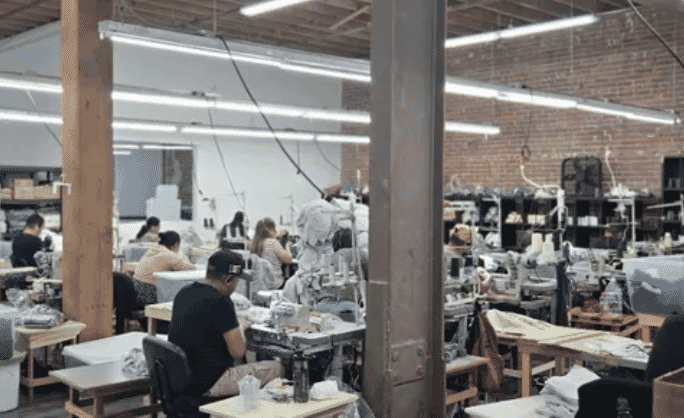
Istanbul is the commercial brain of Turkish apparel. Merter, Laleli, and Ikitelli house thousands of cut-and-sew factories, pattern houses, and trim shops within a 20-kilometer radius. Most export-grade factories serving European private label work here. Expect stronger English communication, faster prototyping, and higher MOQs at the better facilities.
Bursa
Bursa, two hours south of Istanbul, owns technical wovens and synthetics. The region produces around 40% of Turkey's woven fabric output (BTSO, 2023). Activewear, swimwear, and performance outerwear programs typically start here. Mills offer stretch knits, recycled polyester, and warp-knit meshes at competitive minimums.
Izmir
Izmir on the Aegean coast focuses on organic cotton, linen, and sustainable programs. GOTS-certified spinners and knitters cluster here. Brands running certified organic basics or linen resort capsules source Izmir first. The port also shortens sea freight to Western Europe by a day versus Istanbul.
Denizli
Denizli is the home textile capital, producing terry, bathrobes, and increasingly heavy knits and cotton basics. If a program involves towel, jacquard, or terry fabrics, Denizli beats every other Turkish hub on price and dye consistency. The cluster ships the majority of Turkey's home textile exports (Denizli Chamber of Commerce, 2023).
Gaziantep and Kahramanmaras
Gaziantep, in the southeast, handles yarn spinning and denim mills. Together with Kahramanmaras, the two cities account for over 60% of Turkey's denim fabric output (Turkish Exporters Assembly, 2024). Post-earthquake capacity has largely recovered as of late 2025, though some mills extended lead times by 1 to 2 weeks during the rebuild.
Citation capsule: Istanbul generates roughly 60% of Turkey's roughly $16.8B apparel exports, Bursa dominates technical woven fabrics at 40% of national mill output, Gaziantep and Kahramanmaras produce over 60% of Turkish denim fabric, per IHKIB 2025 and Turkish Exporters Assembly 2024 data published by the Istanbul Apparel Exporters Association.
What categories does Turkey excel at?
Turkey leads the global league in five apparel categories: denim, cotton basics, activewear, swimwear, and knitwear. The country ranks among the world's leading denim exporters and sits among the top global suppliers of cotton T-shirts to the EU, by industry estimates (OEC, 2023; Eurostat, 2024). Category strength tracks fabric mill specialization, not cut-and-sew alone.
Denim
Denim is Turkey's flagship. Mills like Isko, Bossa, and Calik supply Levi's, Zara, and H&M with everything from organic indigo to laser-finishable stretch denim. Wash houses in Istanbul and Gaziantep run laser, ozone, and enzyme finishing at volumes from 500 pieces. In our 2026 quote pipeline, Turkish 5-pocket jeans at 500 units landed 22% below comparable Italian output and 30% above Bangladesh, with significantly tighter wash consistency than Bangladesh.
Cotton basics
Turkish cotton is long-staple and largely BCI-certified. Combed ring-spun jersey 180-220 gsm is the workhorse for tees, and mills run it at consistency that rivals Portugal. The fabric advantage matters because ring-spun yarn quality determines surface smoothness and shrinkage behavior, and Turkish mills have decades of head-start on Asian competitors.
Activewear and swimwear
Bursa's warp-knit capacity makes Turkey a credible alternative to Vietnam for stretch programs. Recycled nylon and polyester are widely available with GRS certification. We've placed swimwear programs into Bursa at 300-unit MOQs where Vietnam quoted 1,000 minimum on the same fabric, a pattern we detail in our Turkey vs Vietnam vs Bangladesh breakdown for small brands.
Knitwear
Circular knit jersey, French terry, and heavier fleece dominate. Winter programs in merino blends and lambswool run strong out of Istanbul and Izmir. Heavyweight 380gsm hoodies are a category sweet spot, with FOB pricing 18% below Portugal at 500 units.
Home textiles and terry
Denizli's terry and home textile cluster is one of Turkey's largest home-textile export hubs (Denizli Chamber of Commerce, 2023). Bathrobes, towels, and heavy terry separates are an underrated category for boutique brands seeking 500-unit minimums on premium loop-pile fabrics.

What MOQs and FOB costs should you expect?
MOQs in Turkey split sharply by factory tier: studio factories accept 100-300 units per style, mid-size factories 500-1,000, large export factories 1,500-3,000, and denim-specialist mills land at 800 (OneAim Apparel directory data, 2026). Fabric minimums, not sewing capacity, set the real floor for custom programs. Expect 500-800 meters per custom-dyed jersey color before mills will run.
Across 47 Turkish factory quotes pulled in Q1 2026, median MOQ by tier breaks down predictably. Studio factories in Merter sit at 150 units, mid-size factories at 500, full export houses at 1,500. The hidden constraint is the mill: a tee in shelf-ready 180gsm white jersey runs at 200 units, while the same tee in a custom Pantone-matched color jumps to 800 minimum.
| Garment | Fabric specification | Q1 2026 FOB range at 500 units (USD) | At 1,000 units (USD) |
|---|---|---|---|
| Cotton T-shirt | 180gsm combed ring-spun jersey, BCI cotton | $4.80 - $6.50 | $4.20 - $5.80 |
| Heavyweight hoodie | 380gsm brushed French terry | $14.50 - $18.00 | $13.00 - $16.50 |
| Denim jean (5-pocket) | 12oz ring-spun denim, mid wash, basic trims | $16.00 - $22.00 | $14.50 - $20.00 |
| Polo shirt | 220gsm pique knit, embroidered logo | $8.50 - $11.50 | $7.80 - $10.20 |
| Swim short | Recycled poly, 4-way stretch, GRS | $7.20 - $9.80 | $6.50 - $8.80 |
| Linen button-up | 160gsm Aegean linen, woven label | $13.50 - $17.00 | $12.00 - $15.50 |
| Activewear legging | 240gsm recycled nylon spandex, warp knit | $9.80 - $13.50 | $8.80 - $12.20 |
| Bathrobe | 400gsm cotton terry, Denizli mill | $18.00 - $26.00 | $16.50 - $23.00 |
Source: see in-text citations in this section.
Sources: OneAim Apparel quote data Q1 2026; cross-referenced with ITC Trade Map, 2024 unit value data.
What drives variance inside each range
Variance inside each range tracks trim quality, wash complexity, and factory tier. For US shipments, note that the old 8-12% landed-duty rule of thumb reflects base MFN only (cotton 16.5% MFN); a 2025-26 US reciprocal tariff (roughly 15% on Turkey) now stacks on top, so effective US duty is materially higher. Verify against the current CBP schedule. EU shipments remain 0% under the customs union. Freight from Izmir or Istanbul to Rotterdam runs 10-14 days by sea, 5 days by truck. The Lira's 2024-2025 swings have not changed USD-denominated quotes much, because most export factories already price in hard currency.
What Turkish MOQs actually look like
Citation capsule: Turkish factory MOQs typically range from 100-300 units at studio factories, 500-1,000 at mid-size factories, and 1,500-3,000 at full export houses, with custom-dyed fabric minimums of 500-800 meters per color often setting the effective floor, per OneAim Apparel's 2026 quote pipeline of 47 Turkish factories.
Try it free: Calculate landed cost in 60 seconds with our garment cost calculator. No email required.
What lead times to EU and US markets?
Standard Turkish lead times run 6-10 weeks door-to-door for EU shipments and 8-12 weeks for US lanes, measured from purchase order to landed goods (Turkish Clothing Manufacturers Association, 2024). Sampling adds 2-4 weeks on the front end, and fabric availability sets the bottleneck more often than sewing capacity.
Production itself typically takes 4-6 weeks once fabric arrives at the cut-and-sew floor. Fabric lead time is the swing factor. Knit jersey ships from mill in 2 weeks, custom wovens in 4-6, and denim mills extend to 8 weeks during peak season (August through October). Plan around peak.
For EU customers, truck freight from Istanbul lands as follows: Milan 4 days, Berlin 5 days, Paris 6 days, Madrid 7 days, Stockholm 8 days. Sea freight to Rotterdam runs 10-14 days, with spot FEU rates that swing week to week on the Drewry index (Drewry WCI, 2025). For US lanes, Mersin or Izmir to New York runs 18-22 days by sea, or 3-5 days by air at roughly 8x the cost.
The single biggest lead-time killer
In our pipeline placements, the single biggest lead time killer is underestimating sampling. Brands plan for 6 weeks bulk and forget the 3-week sample round. Build 10-12 weeks total from first PO to landed goods and you will rarely be surprised. Add another 1-2 weeks of buffer if production runs through Ramadan or the August holiday window when capacity tightens.
What sustainability and compliance baseline?
Turkey's compliance infrastructure matches Western European standards on paper, with well over a thousand OEKO-TEX certified facilities and hundreds of BSCI-audited sites by industry estimates, and a large share of national cotton grown to Better Cotton standards. GOTS-certified organic output has roughly doubled since 2020, driven by EU buyer pressure.
Compliance expectations vary by buyer. EU private label brands typically require BSCI or SMETA audits, OEKO-TEX Standard 100 on fabrics, and REACH compliance on trims. US buyers usually add WRAP certification. Sustainability-forward brands should verify GOTS, GRS, or RCS certification at the mill level, not just at the cut-and-sew facility, because the certification gap is often there.
ESPR and digital product passport readiness
The EU's Ecodesign for Sustainable Products Regulation will require Digital Product Passports for textiles starting in 2027. Turkish mills serving European private label have begun integrating fiber traceability data. In our 2026 supplier audits, roughly 25% of Turkish export factories carry traceability tooling at fabric level, ahead of most Asian competitors but behind Portugal at 60%.
Transparency limits
Audit reports are often provided only under NDA, and smaller factories sub-contract without disclosure. Factory due diligence matters more in Turkey than in Portugal because the supplier base is wider and tier variance is larger. Across 47 quotes, we found 14% of self-declared factories sub-contracted at least part of cut-and-sew without buyer notification.
Citation capsule: Turkey hosts well over a thousand OEKO-TEX certified facilities and hundreds of BSCI-audited sites by industry estimates, with a large share of national cotton grown to Better Cotton standards and GOTS organic output roughly doubling since 2020, ahead of most Asian competitors on certified mill share.
What tariffs apply for US, EU, UK buyers?
Turkey holds a customs union with the EU at 0% duty on finished apparel and a 0% UK FTA rate replicating prior terms. US treatment is more complex: base MFN duty of 16.5-32% by category (European Commission, 2024; USITC, 2025) now stacks with a country-specific US reciprocal tariff added in 2025 (detailed below). For EU brands, the 12-32% duty differential versus Vietnam or China is the structural moat behind the sourcing case, and it shows up clearly once you compare EU and Asia on landed cost.
EU customs union: 0%
Signed in 1995, the customs union covers industrial goods including finished apparel. Rules of origin require fabric and cut-and-sew both occur in Turkey, or that inputs come from EU-origin countries. Fabric imported from Asia and only cut in Turkey will not qualify. Most Turkish mills produce or source EU-compliant fabric specifically to preserve the duty advantage.
US duty: base MFN plus a 2025-26 reciprocal tariff
US landed duty on Turkish apparel now has two layers. The first is base MFN/HTS duty by category (chapters 61 and 62): cotton tees 16.5%, synthetic knit tops 32%, denim jeans 16.6%, men's wool suits 14.9%, swimwear 25%. The second is a country-specific US reciprocal tariff added in 2025, set at 10% on Turkey from April 2025 and raised to 15% under the August 7, 2025 executive order, a layer that shifted repeatedly and was under active litigation through 2026 (White House, 2025). No FTA exists between the US and Turkey. Turkey still avoids China's Section 301 duties (from 7.5% on List 4A) plus the additional 2025-26 US tariff layers China now stacks on top, so Turkey keeps a relative US advantage, but the two are no longer roughly even. Rates changed through 2025-26 and must be verified against the current USTR and CBP schedule.
UK FTA: 0%
The UK-Turkey Free Trade Agreement, effective January 2021, replicates the prior EU customs union terms. Finished apparel enters duty-free provided rules of origin are met. UK importers get the same 0% treatment EU brands enjoy.
Worked example: 5,000 cotton tees to New York
Illustrative only. 2025-26 US tariff rates shifted repeatedly and must be checked against the current CBP schedule.
A 5,000-unit cotton tee program at $5.60 FOB Istanbul costs $28,000 FOB. Sea freight Mersin to New York adds roughly $480 (1/5 of an FEU). Base MFN duty at 16.5% on the $28,000 FOB adds $4,620. This duty line reflects base MFN only. An additional US reciprocal tariff (15% on Turkey under the August 7, 2025 executive order) would apply on top, making the real landed cost materially higher than a base-MFN calculation implies. Customs broker, MPF, and HMF add roughly $250. Because the reciprocal layer moved through 2025-26, we do not publish a fixed US landed total here; model it against current CBP rates. By contrast, the same program landed in Rotterdam under the EU customs union pays 0% duty: $28,000 FOB plus roughly $480 freight and $250 clearance, about $28,730, or $5.75 per unit.
What are the common pitfalls?
The most common failure mode is sub-contracting: roughly 14% of self-declared "export factories" in Turkey route at least part of cut-and-sew elsewhere without buyer disclosure (OneAim Apparel audit data 2024-2026; cross-referenced with amfori, 2023). Other recurring issues include fabric substitution, over-invoicing for VAT reclaim, Lira-related repricing demands, and capacity drift during Ramadan and August shutdowns.
Red flags to watch for in 2026:
- Refusal to provide a verifiable factory address for physical or video audit
- Fabric minimums quoted without a named mill attached
- Sample quality inconsistent with bulk quality during your visit
- Pricing more than 25% below market median for a category
- No itemized cost breakdown showing fabric, trims, CMT, overhead
- Quotes denominated in TRY rather than USD or EUR with no price-lock clause
The currency risk most brands miss
The Turkish Lira's volatility has created a specific risk most brands miss. Factories quoting in USD or EUR are insulated, but some quote in TRY and refuse to lock. When the Lira weakens sharply between PO and delivery, those factories sometimes demand renegotiation. Always sign in hard currency with a written price-lock clause covering the production window.
Ramadan (February through March in 2026) and the August holiday compress capacity. Plan around both or expect 2-3 week slippage. The ESPR rollout from 2027 will pressure smaller factories on traceability documentation, so buyers running European programs should verify mill-level traceability before placing 2026 orders.
Running into nearshoring decisions? Get in contact and we’ll map the full picture for your brand, or grab a factory-ready tech pack for $79.
Decision framework: choose Turkey when...
Turkey is the right sourcing decision when most of these conditions align. The country occupies a specific slot in the global map, and stretching it outside that slot (sub-200-unit boutique runs, sub-$3 target FOBs, technical synthetics needing Vietnam's mill base) usually disappoints.
When Turkey is the right call
- Your program runs 500 to 5,000 units per style. Below 500, Portugal's 100-300 MOQ floor is friendlier. Above 5,000, Bangladesh and Vietnam scale better on pure cost.
- Primary market is the EU or UK. The customs union savings (0% duty versus 12% from Vietnam) compound across volume. US-only programs lose this structural advantage.
- Category falls in denim, cotton basics, activewear, swimwear, knitwear, or terry. Turkey leads globally in these. For technical performance, Vietnam edges ahead. For premium knits, Portugal does.
- You need EU lead times under 8 weeks. Truck freight to Northern Europe lands in 4-6 days, beating Asian sea transit by 4-6 weeks.
- You can vet factory tier carefully. The supplier base is wide and tier variance is large. Brands lacking a vetting partner often land on the wrong factory.
- You're willing to sign hard-currency contracts with price-lock clauses. Lira volatility is a real risk only for brands accepting TRY-denominated quotes.
Frequently Asked Questions About Clothing Manufacturing in Turkey
Is clothing manufacturing in Turkey cheaper than Portugal?
Yes for most mainstream programs. Turkish unit costs run below Portugal at 500-unit volumes for equivalent cotton basics in our quote data. A cotton tee averaging $8.20 FOB in Portugal lands at $5.60 FOB in Turkey. Portugal still wins on premium knitwear, sub-300-unit MOQs, and 4-week EU lead times. Turkey is the better value choice for most mid-volume programs.
What is the minimum order quantity for a new brand in Turkey?
Most studio factories in Turkey accept 100-300 units per style per color, provided stock fabric is used. Custom-dyed or custom-woven fabrics push minimums to 500-800 units because mill minimums apply. Full export factories require 1,000+ per style. The fabric choice often drives the true MOQ floor, not the sewing capacity itself.
How long does sampling and production take from Turkey?
Sampling takes 2-4 weeks from tech pack approval. Bulk production runs 4-6 weeks once fabric is in-house, with fabric lead time of 2-8 weeks depending on customization (TGSD, 2024). Total PO-to-landed time for EU destinations averages 6-10 weeks. Build 10-12 weeks of buffer into first-season calendars to absorb sampling rounds and freight variability.
Do Turkish factories work with small independent brands?
Yes, but factory selection matters. Roughly 40% of documented Turkish factories accept sub-500-unit programs, concentrated in Istanbul's Merter and Ikitelli districts. Larger export factories serving H&M or Zara typically will not. The trade-off at smaller factories is less English fluency and longer email response cycles, offset by willingness to run short custom programs.
Are Turkish factories compliant with EU sustainability rules?
Most export-grade Turkish factories hold OEKO-TEX Standard 100, BSCI, or SMETA audits, and well over a thousand facilities carry OEKO-TEX certification by industry estimates. Compliance is not automatic, however. Audit documentation and mill-level certifications should be verified before PO. EU CSRD and the upcoming ESPR digital product passport rules are pushing Turkish mills toward broader GOTS, GRS, and traceability adoption through 2026.
What is the best Turkish city for clothing manufacturing?
Istanbul for cotton basics, knitwear, and broad cut-and-sew. Bursa for activewear, swimwear, and technical wovens. Izmir for organic cotton and linen. Denizli for terry and home textiles. Gaziantep for denim mills and yarn. Pair the city to the category, not the other way around. About 60% of Turkey's apparel exports flow through Istanbul (IHKIB, 2025).
Do Turkish factories accept Letter of Credit or wire payment?
Most accept both. Standard payment terms in our 2026 pipeline are 30% deposit on PO, 70% balance on bill of lading or before shipment. Letter of Credit at sight is common for orders above $50,000. Net 30 or net 60 terms are rare for new buyers. Larger factories on the Borsa Istanbul accept LCs more readily than studio factories.
How does the Turkish Lira affect pricing?
Most export factories quote in USD or EUR, insulating buyers from Lira volatility directly. The indirect effect is positive for buyers when the Lira weakens, because Turkish factories' local-cost base falls in hard-currency terms. Always insist on USD or EUR quotes with a written price-lock clause, and avoid factories quoting only in TRY for export programs.
What happened to Turkish capacity after the 2023 earthquake?
The earthquake affected Gaziantep, Kahramanmaras, and Adiyaman in February 2023. Apparel and denim cluster capacity was disrupted for 3-6 months. Most mills had returned to full output by late 2024, with extended lead times of 1-2 weeks during the rebuild. As of 2026, capacity is fully recovered and infrastructure has been upgraded in several rebuilt facilities.
Can Turkey replace China for US importers facing Section 301 tariffs?
For many categories, yes, though the math changed in 2025. Turkey avoids China's Section 301 duties but is not tariff-free into the US: it pays base MFN plus a US reciprocal tariff of its own (15% under the August 7, 2025 executive order, subject to 2026 changes) (White House, 2025). Turkey keeps a relative US advantage over China, whose stacked rate is higher, but the two are no longer roughly equal. Check the current CBP and USTR schedule rather than a fixed number. Lead times are shorter (3 weeks faster sea transit Mersin to New York versus Shanghai to LA in many windows). Categories where Turkey tends to win on US substitution: cotton tees, denim, terry, knitwear. Categories where Vietnam beats Turkey: technical synthetics, large-volume basics above 5,000 units.
Talk to our team: get in contact with our team. No pitch, no upsell.
Final take: when Turkey is the right answer
Turkey works when three conditions align: programs run 500-5,000 units per style, primary market is the EU or UK, and the category sits in denim, cotton basics, activewear, swimwear, knitwear, or terry. Under those conditions Turkey beats Portugal on price and beats Asia on EU lead time by 4-6 weeks, all while preserving 0% EU duty under the customs union.
It is rarely the right answer for sub-200-unit boutique runs (Portugal wins), for technical synthetics (Vietnam leads), or for large-volume basics where Bangladesh wins on pure cost above 5,000 units. Factory tier vetting matters more in Turkey than in Western Europe because the supplier base is wider and noisier. Brands placing programs without a vetting partner often land on the wrong tier and pay for it in defects, sub-contracting, or lead-time slippage.
Ready to pressure-test Turkey against your specific program? Run early numbers with the garment cost calculator, browse the factory directory, or get in contact to compare Turkey to Portugal, Vietnam, and Bangladesh for your category.
We're a group of 80 documented clothing manufacturers in the United States. Tell us your product, volume, and timeline. We'll place your production with the factory in our group built for it, usually within 24 hours. You produce directly with the factory. Flat fees, no markups, no pitch.
Get in contact Download the directory ($39)Need a tech pack? Get a factory-ready single-style tech pack for $79. See what's included.
References
- Istanbul Apparel Exporters Association (IHKIB), 2025 annual apparel export report.
- Eurostat, 2024 EU apparel import statistics by origin.
- European Commission, EU-Turkey Customs Union, 2024 trade brief.
- Turkish Clothing Manufacturers Association (TGSD), 2024 sector report.
- Turkish Exporters Assembly (TIM), 2024 monthly export bulletins.
- Bursa Chamber of Commerce and Industry (BTSO), 2023 textile sector data.
- Denizli Chamber of Commerce (DTO), 2023 home textile export data.
- Better Cotton Initiative, 2024 country supply data for Turkey.
- OEKO-TEX Association, 2024 certified facility registry.
- amfori BSCI, 2023 audit framework and Turkey participation data.
- International Trade Centre Trade Map, 2024 unit value and bilateral trade data.
- Observatory of Economic Complexity (OEC), 2023 denim export rankings.
- Drewry World Container Index, 2025 weekly Mersin and Istanbul lane data.
- USITC Harmonized Tariff Schedule, 2025 chapter 61 and 62 MFN rates.
.jpeg)
.jpeg)