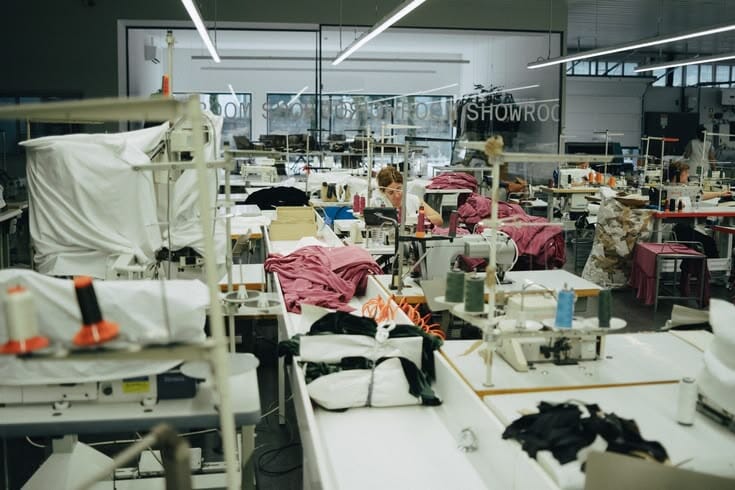
A polo is a knit garment, not a shirt, and that one fact decides which factory can build yours. The best polo shirt manufacturers are knitters and knit cut-and-sew shops, not dress shirtmakers. Most polos sold in the United States are imported, so the domestic field is small, and a lot of pages that rank for "polo shirt manufacturers USA" are storefronts that never say where the sewing happens. For the wider domestic picture, see our guide to US clothing manufacturers.
This directory profiles 4 US manufacturers that make polo shirts for other brands, in Los Angeles, New York City and Jacksonville, Florida. Each one was checked on its own website. Then it explains the construction that separates a good polo from a cheap one. It's an editorial map built from company websites, not a roster of factories OneAim owns.
Heads up: We're OneAim, a group of documented United States clothing factories. The companies below are independent manufacturers listed on public sources, not members of our group. OneAim's role is separate: we place your production with a documented factory in our group built for your product.
Key Takeaways
- A polo is a T-shirt with a collar, a placket and vents. Same knit body, three extra operations, which is why polo factories are knit factories. See our US T-shirt manufacturing page.
- A knit polo and a woven shirt are not two products from one supplier. Different machinery, different factories. For woven, see our shirt manufacturers directory.
- We found 4 US polo makers we could verify, and stopped at 4. Two well-known US knit names were left out because their own catalogs no longer show a polo.
- Published minimums run from 12 to 200 pieces. MFG Merch states 12 per design, Argus Apparel around 100 per style, Apparel Production Inc. 200 per style for domestic orders.
- The collar is the hardest part. It's flat-knit on a machine the body never touches, and it still has to dye and shrink to match.
Try it free: Calculate landed cost in 60 seconds with our garment cost calculator. No email required.
Why is a polo a knit garment, not a shirt?
Because it starts as yarn. A woven Oxford begins with cloth off a loom, cut into pattern pieces and sewn with a fused collar. A polo begins on a circular knitting machine, where loops of yarn build a tube of piqué, jersey or interlock. The body is then cut and sewn like a T-shirt, with a collar, placket and side vents added.
That's a sourcing decision, not a technicality. Knit factories own circular knitting machines, flat-knit collar machines, overlock and coverstitch lines. Woven shirt factories own fusing presses and lockstitch lines. Few do both well. Ask a woven shirt maker to run a piqué polo and you'll get a quote, plus a collar that doesn't roll and a hem that curls.
Why is the collar the hardest part of a polo?
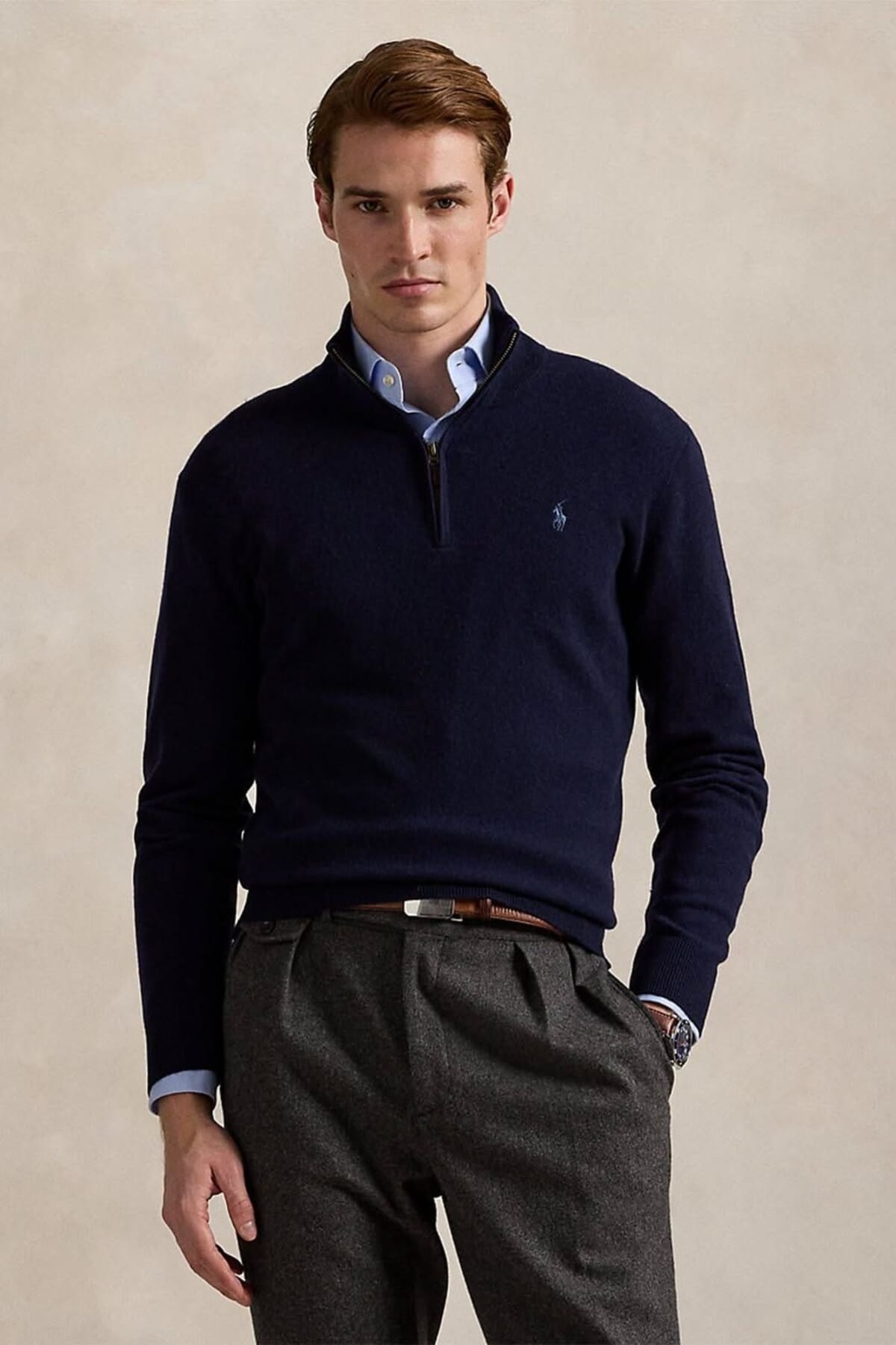
Because it's made on a different machine, in a different construction, and it still has to match the body. A polo body is circular-knit piqué cut from yardage. The collar and cuffs are flat-knit, fully fashioned on a flat or V-bed machine, knitted to size as separate 1x1 rib pieces rather than cut from cloth. A plain T-shirt line doesn't own that machine, so many cut-and-sew shops buy collars from a collar knitter. That is fine, as long as the shop controls the shade match.
What goes wrong on a collar
Four things go wrong. Shade match: rib and piqué take dye differently, so the classic failure is a collar reading a half-tone off after wash. Differential shrinkage: two constructions shrink at different rates, and a collar that shrinks harder than the body puckers the neckline. Roll and stand: rib tension and tipping decide how the collar sits; a slack one flops within ten wears. The placket: two-ply self-fabric, topstitched, buttonholes worked through a knit that stretches under the needle. That's where cheap polos fail visibly.
Citation capsule: In a polo shirt, the body is circular-knit piqué cut from yardage, but the collar and cuffs are flat-knit, fully fashioned on a flat or V-bed machine as separate 1x1 rib pieces knitted to size. Because those are two different constructions, they dye and shrink differently, which is why collar shade match and differential shrinkage are the two most common polo defects.
How did we choose these polo shirt manufacturers?
Every company here had to pass three checks on its own website: it makes polo shirts, it makes them in the United States, and it makes them for other brands, whether as blanks for decoration, private label or custom cut-and-sew. Directory listings and "top 10" articles did not count as evidence, because the polo search space is full of storefronts that never say where the sewing happens.
That left 4, and we left it at 4. We also rejected names. Bayside Apparel and Royal Apparel are genuine US knitwear makers, but neither catalog showed a polo when we checked. Several "polo manufacturer USA" pages named no city, no state and no factory, so they are not here. We didn't rank the four, because the right one depends on whether you need a blank to decorate or your own pattern.
Which US polo shirt manufacturers are worth knowing?
Los Angeles Apparel (South Central Los Angeles, California)
The most vertical option on this list. Los Angeles Apparel says it knits, dyes, cuts and sews its own fabric in a 300,000 square foot factory in South Central Los Angeles, with "No offshore subcontracting" (Los Angeles Apparel). Its wholesale catalog for decorators includes a 6.5 oz cotton jersey short-sleeve polo T-shirt with a two-button placket, marked "Made in Los Angeles" (style 18412GD). Two caveats: it is a jersey polo, not piqué, and it is a finished blank, so the fit and the body are Los Angeles Apparel's, not yours. Best for decorated programs that want a fully domestic blank.
Apparel Production Inc. (Garment District, New York, New York)
A family-run private-label house "Established in 1947", working from 270 W 39th St. Its domestic production page lists polo shirts, T-shirts and knit tops among the products it makes, with a "domestic team of 75 skilled sewing operators" and patterns, samples and production managed in-house in NYC (Apparel Production Inc.). It states "low minimums of 200 per style for domestic orders". The company also runs overseas production, so state in writing that you want your order made in NYC. Best for a custom polo with your own pattern and a Manhattan sample room.
Argus Apparel (Downtown Los Angeles, California)
A downtown LA manufacturer at 200 W 8th St with a dedicated polo service. Its polo page says "We provide full made in USA polo shirts production", offers piqué cotton, poly-cotton blends and performance fabrics, covers custom labels, tags and packaging, and gives a standard MOQ of "around 100 units per style" (Argus Apparel). Read one thing carefully: the site doesn't describe its own sewing floor, and it says it sources materials in the USA and worldwide. Ask where your polos will be cut and sewn, and which mill knits the piqué. Best for a private-label piqué polo at a lower minimum than a full-package house.
MFG Merch (Jacksonville, Florida)
A Jacksonville manufacturer at 240 Talleyrand Ave that says every project is "manufactured in-house at our Jacksonville, FL facility" with no outsourcing (MFG Merch). Its polo page combines "embroidery, tailored design, and cut and sew production", offers private label, and states a minimum of "12 per design" (MFG Merch, polos). The page doesn't say which polos are cut and sewn from scratch and which are decorated blanks, so ask that before you compare its price with a cut-and-sew quote. Best for small branded and team polo runs.
Here's how the four compare at a glance.
| Company | Location | Type | Polo offer | MOQ (published) |
|---|---|---|---|---|
| Los Angeles Apparel | South Central Los Angeles, CA | Own-label blanks, wholesale | 6.5 oz jersey polo T-shirt, knitted and sewn in LA | Not published |
| Apparel Production Inc. | Garment District, New York, NY | Private-label cut-and-sew | Polos, tees and knit tops, in-house NYC sewing | 200 per style (domestic) |
| Argus Apparel | Downtown Los Angeles, CA | Custom and private label | Piqué, blends and performance polos | About 100 per style |
| MFG Merch | Jacksonville, FL | Cut-and-sew plus decoration | Embroidered and private-label polos | 12 per design |
Source: each company's own website, checked October 2026. Minimums are the figures each company publishes; confirm them against your own fabric and trims before you commit.
Piqué, jersey or interlock: which knit should your polo be?
Piqué, in most cases. It's a single knit with a raised honeycomb face, and it's the classic polo hand: breathable, textured enough to hide creases, and the reason a polo doesn't read as a tee with a collar. It curls at a raw edge, so hems and vents need proper finishing.
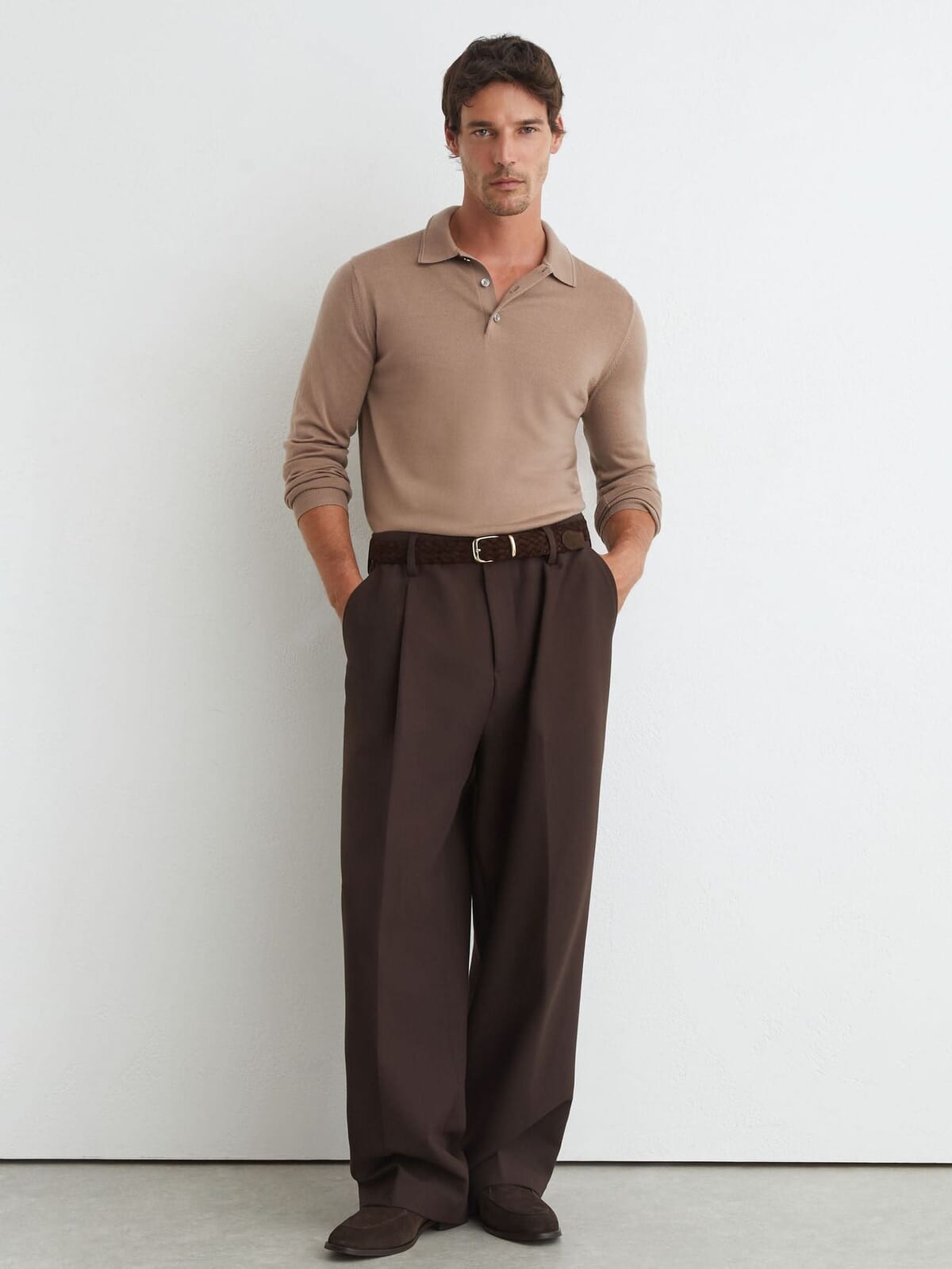
Jersey is the softest and drapiest, a single knit with a flat face. It makes a lovely relaxed polo, which is the knit Los Angeles Apparel uses for its polo T-shirt, but it shows every mark, curls badly, and demands a well-engineered placket.
What interlock is, and when to use it
Interlock is a double knit, identical on both faces, heavier and dimensionally stable. It doesn't curl, it holds a crisp placket, and it costs the most per kilo. For a premium pima polo with budget behind it, interlock is the grown-up answer. Ask any maker on this list which of the three knits it can source in your colour before you fall in love with one.
How the three knits compare on weight
What has to be in a polo tech pack?
Everything a T-shirt tech pack carries, plus four things. Start with the body: fibre, yarn count, knit structure, gsm, finish. Then spec the collar as its own component, because it is one: flat-knit 1x1 rib, knitted to a stated length and depth, tipping called out, and a note that collar and body must be shade-matched and shrinkage-matched after wash.
Then the placket: button count, length and width, two-ply self-fabric, topstitch margin, buttonhole orientation. Then the neck: a taped or self-fabric back-neck seam stops the neckline stretching out over its life and costs almost nothing. Then the finish: side vents with a bar-tack or taped slit, and a drop tail if it needs to stay tucked. If you don't have a spec yet, our tech pack service builds one factory-ready.
Citation capsule: A polo shirt tech pack must specify four things a T-shirt tech pack does not: a flat-knit rib collar knitted to size with a shade-match and shrinkage-match note, a two-ply self-fabric placket with buttonhole orientation, a taped or self-fabric back-neck seam to stop the neckline stretching, and side vents finished with a bar-tack or taped slit.
What should you expect on minimums and lead times?
Lower minimums than most founders expect, but read what each number buys. MFG Merch states 12 per design, Argus Apparel around 100 per style, and Apparel Production Inc. 200 per style for domestic orders. Los Angeles Apparel sells finished blanks, so there's no production minimum at all, only the fact that the garment isn't yours. None of the four publishes a lead time for polos, so get it in writing at your quantity.
A low published minimum often assumes stock fabric and stock collars. If you need a custom colour, a tipped collar dyed to match, or your own piqué weight, expect the real floor to rise to the knitter's and the dyer's minimums, not the sewing room's. Whatever the size, insist on a pre-production sample and wash-test it. A polo's failures show up after laundry, not on the table.
Frequently Asked Questions About Polo Shirt Manufacturers
Who makes polo shirts in the USA for other brands?
We verified four on their own websites: Los Angeles Apparel (blank polo T-shirts knitted, dyed, cut and sewn in South Central Los Angeles), Apparel Production Inc. (private-label cut-and-sew in New York's Garment District), Argus Apparel (custom and private-label polos, Los Angeles) and MFG Merch (polos with embroidery and private label, Jacksonville, Florida).
Are polo shirts made in knit or woven factories?
Knit factories. A polo body is circular-knit piqué, jersey or interlock, cut and sewn like a T-shirt, with a flat-knit rib collar. Woven shirt factories run fusing presses and lockstitch lines, which is different machinery entirely. That is why a polo brief belongs with a knit or cut-and-sew specialist, not with a dress shirt maker.
What is the minimum order for US-made polo shirts?
It depends on the type of order. Of the four makers in this directory, MFG Merch states 12 pieces per design, Argus Apparel states a standard MOQ of around 100 units per style, and Apparel Production Inc. states 200 per style for domestic orders. Los Angeles Apparel sells finished blanks, so there is no cut-and-sew minimum, but the label and fit are its own.
What is piqué fabric and why is it used for polos?
Piqué is a single knit with a raised honeycomb face, typically around 180 to 240 gsm in polos. It's breathable, its texture hides creases better than flat jersey, and its body is what stops a polo reading as a tee with a collar sewn on. It curls at a raw edge, so hems need finishing.
Should I start with a blank polo or a custom cut-and-sew polo?
Start with a blank if your brand value is the decoration: a logo, an embroidery, a team program. Go custom cut-and-sew if your value is the garment itself: your own fit, your own collar spec, your own fabric. Blanks cost less and ship faster, but every other brand can buy the same body.
What makes a cheap polo look cheap?
The collar and the placket. A collar that goes off-shade after wash, shrinks differently to the body, or loses its stand and flops is the fastest tell. Second is a thin, single-ply placket with a puckered buttonhole. Both come from a factory that doesn't control its rib or its dyeing.
We're a group of 80 documented clothing manufacturers in the United States. Tell us your product, volume, and timeline. We'll place your production with the factory in our group built for it, usually within 24 hours. You produce directly with the factory. Flat fees, no markups, no pitch.
Get in contact Download the directory ($39)Need a tech pack? Get a factory-ready single-style tech pack for $79. See what's included.
Sources
- Los Angeles Apparel, Made in America, accessed October 2026. Source of the knit, dye, cut and sew claim, the 300,000 sq ft South Central Los Angeles factory and "No offshore subcontracting".
- Los Angeles Apparel wholesale, style 18412GD polo T-shirt, accessed October 2026. Source of the 6.5 oz cotton jersey polo and "Made in Los Angeles" marking.
- Apparel Production Inc., domestic production, accessed October 2026. Source of the polo and knit-top product list, the 75 sewing operators, in-house NYC production and the 200 per style domestic minimum. Founding year from the company home page.
- Argus Apparel, polo shirt manufacturers, accessed October 2026. Source of the made in USA polo claim, fabric options, private-label services and the MOQ of about 100 units per style.
- MFG Merch, polo shirt manufacturer and home page, accessed October 2026. Source of the Jacksonville in-house production claim, cut-and-sew and private-label wording, and the 12 per design minimum.
- OneAim Apparel internal sourcing and pipeline observations, 2024 to 2026.
Every company named in the directory appears in this source list. Founding dates, staff numbers, facility sizes and minimums are the companies' own published statements, and we did not independently audit them. The knit weight bands in the chart are illustrative, not a measured statistic. No factory here is a OneAim group member, and none paid to appear. Reviewed 12 October 2026 by Will Godax.