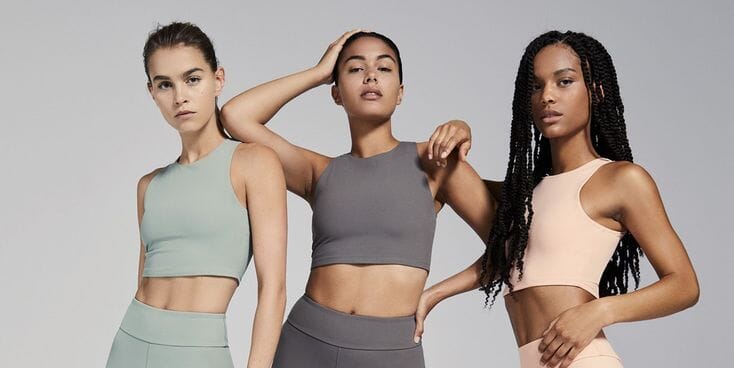
The best tank top manufacturers fall into three groups, and picking the wrong group costs more than picking the wrong factory. A tank looks like the simplest garment a brand can make, which is exactly why the sourcing decision gets rushed. Grand View Research estimates the global activewear market, the category tanks sit in commercially, at $440.39 billion in 2025, heading for $919.98 billion by 2033 at a 9.0% CAGR (Grand View Research, 2025). No credible standalone "tank top market" figure exists, so treat activewear as the category around the tank.
This directory profiles 10 tank top manufacturers making tanks, singlets and sleeveless knit tops, split into three routes: blank suppliers, US cut-and-sew factories, and offshore full-package producers built for volume. It's an editorial map built from company disclosures and public filings, not a roster of factories OneAim owns. Tanks share a supply base with tees, so read it alongside our t-shirt manufacturer directory if you're building a basics line rather than a single style.
Heads up: We're OneAim, a group of 100+ documented clothing manufacturers across 15+ countries. The companies below are independent manufacturers and blank suppliers listed on public sources, not members of our group. OneAim's role is separate: route your brief to a documented factory in our group built for your product.
Key Takeaways
- Tank sourcing splits three ways. Buy blanks and decorate, commission custom cut-and-sew, or place a volume programme with an offshore full-package factory.
- Grand View Research estimates the activewear market at $440.39 billion in 2025, heading for $919.98 billion by 2033 (Grand View Research, 2025). No reliable tank-only figure exists.
- GSM is the spec that decides how a tank feels. Stanley/Stella publishes 120 GSM for the Stella Dreamer, 155 GSM for the Stella Mia and 180 GSM for the Stella Ava, all 100% organic cotton with 1x1 rib binding.
- Only one company on this list has verified vertical integration. Gildan's yarn-to-sewing structure appears in its regulatory filings; every other scale claim here is self-reported.
- Opportunity Threads publishes a real MOQ: 250 units per style, or 500 when the price point is low. Almost nobody else on this list publishes one at all.
Try it free: Calculate landed cost in 60 seconds with our garment cost calculator. No email required.
Blanks or custom cut-and-sew: which route fits your tank brand?
Pick the route before you shortlist a factory. Blanks means buying a finished, proven tank from a supplier like BELLA+CANVAS, Next Level or Stanley/Stella and adding your print. Custom cut-and-sew means a factory builds the tank from your own pattern, fabric and armhole spec. Most tank brands start with blanks and move to custom once a style sells consistently.
The reason is economics. A blank carries no per-design minimum, so you can test ten designs on stock bodies and pay only for screens. Custom gives you a proprietary fit and better margin at scale, but it carries a real minimum and a real pattern cost. Minimums are where most first-time briefs stall. Our minimum order quantity guide covers how factories set them. So which are you building right now, a decorated stock body or a tank shape that's yours?
How did we choose these tank top manufacturers?
We built this list from public sources: company websites, published product specifications and, in Gildan's case, a filing with the US Securities and Exchange Commission. Every company here is a real, operating business that makes or supplies tanks, singlets or sleeveless knit tops. We left out companies whose only evidence was an SEO listicle, because a listing is not a factory.
We didn't rank one to ten, because "best" depends on your route and your volume. Where a number is self-reported, we attribute it rather than state it as fact. Where no minimum is public, we leave it blank instead of guessing.
Who are the leading blank tank and singlet suppliers?
These are the companies whose tanks get decorated by the million. None are private-label cut-and-sew shops, so treat them as products you buy, not factories you commission.
BELLA+CANVAS (Los Angeles, California, USA)
A blank knit specialist with unisex, women's, men's and kids tanks in cotton jersey, tri-blend and CVC. The company says it dyes and cuts most garments in Los Angeles and employs hundreds of people there, with sewing partly offshore. So the finished tanks aren't fully US-sewn. Best for a broad, decoration-friendly tank range. Route: blank.
Next Level Apparel (Southern California, USA; production offshore)
Founded in 2003 and describing itself as a leading wholesale producer of premium blanks, Next Level offers tanks across men's, women's and youth. Its fabric menu includes tri-blend jersey, cotton jersey, CVC and sueded jersey, the classic tank set. The HQ is Californian but production is international, so this isn't a US-made blank. Best for soft tri-blend tanks. Route: blank.
Gildan Activewear (Montreal, Canada; plants across the Americas and Asia)
The volume backbone of the blanks trade, and the only company here whose vertical integration is confirmed in a regulatory filing rather than on a marketing page. Gildan's SEC filings describe owned facilities covering yarn spinning, knitting, dyeing, cutting and sewing. It's a blanks manufacturer, not a bespoke cut-and-sew partner. Best for high-volume cotton jersey tanks. Route: blank.
AS Colour (Auckland, New Zealand; production offshore)
A New Zealand-owned blanks brand with dedicated "Tanks & Singlets" categories for men and women, cut in combed cotton jersey in standard and heavy weights chosen to print cleanly under screen and DTG. It's a brand and wholesaler, not a New Zealand factory, and production sits offshore. Best for a premium, print-ready singlet. Route: blank.
Stanley/Stella (Brussels, Belgium)
The most transparent spec sheet in this group. Stanley/Stella publishes exact fabric weights: the Stella Dreamer at 120 GSM, the Stella Mia at 155 GSM (4.6 oz), and the Stella Ava and Stanley Stancer at 180 GSM, all organic cotton with 1x1 rib binding at neck and armholes. Production countries aren't confirmed on the pages we used, so verify origin if it matters. Best for organic cotton tanks with a published GSM. Route: blank.

Which factories cut and sew custom tanks in the USA?
These are the ones you commission. They take a pattern, a fabric and a spec, and give you a tank that belongs to your brand. Minimums are lower than offshore, unit prices higher, lead times shorter. The three below are knit-capable; our broader USA apparel manufacturer directory covers domestic factories across other categories.
Opportunity Threads (Morganton, North Carolina, USA)
The clearest published numbers on this list, and the best first stop for a brand moving from blanks to custom. This worker-owned cut-and-sew factory states a minimum of 250 units per style, rising to 500 when the price point is low, with smaller runs possible at an hourly operator rate. Its FAQ publishes $75/hr for pattern and prototype work and $50/hr for sew samples. It's a general knit factory, not a tank specialist. Best for a first custom run. Route: custom cut-and-sew (USA).
Los Angeles Apparel (Los Angeles, California, USA)
A domestic LA cut-and-sew knitwear manufacturer producing men's and women's tanks, with a separate wholesale and imprintable division for blank programmes. The company says its workers earn no less than $17.25 an hour and up to $25, a claim from its own site rather than an audited figure. Best for LA-sewn knit tanks. Route: custom cut-and-sew plus blanks (USA).
Royal Apparel (New York, USA)
Founded in Manhattan's Garment District with Southern factory operations, Royal Apparel positions itself as holding the largest collection of USA-made premium knitwear, including tanks in organic cotton and blends. It cites the widely quoted claim that only about 3% of fashion is made in the USA, a figure taken from its own page rather than a government source. No minimum is published. Best for a US-made organic knit tank. Route: private-label knitwear (USA).
Who manufactures tank tops at volume offshore?
Once a style is proven and you're ordering in the thousands, the economics move offshore. Both companies below are full-package knit manufacturers, and both publish their scale on their own websites, which means every number here is self-reported. For a wider view of each country's knit base, see our directories of clothing manufacturers in India and clothing manufacturers in Bangladesh.
Shahi Exports (Faridabad, Haryana, India)
India's large-scale option for a high-volume tank programme. Shahi says it runs 50 factories across eight Indian states, employs more than 100,000 people, operates five textile mills, and produces over 150 million garments a year with roughly 85% vertical integration. Those figures are the company's own. This isn't the place for a start-up's first 300 tanks. Best for large full-package knit orders. Route: offshore full-package.
Fakir Fashion (Narayanganj, Bangladesh)
A vertically integrated knit manufacturer covering knitting, dyeing, cutting, sewing and printing, exactly the profile a jersey tank programme wants. Fakir Fashion says it has 300,000 pieces a day of sewing capacity, 65-plus tons a day of knitting, a 180-acre site and 4.5 MWp of solar, and that its customers include H&M, Zara, C&A, COS and NEXT. Those figures and that customer list are self-reported and aren't confirmed by the brands named. Best for large jersey programmes. Route: offshore full-package.
Here's how the ten manufacturers compare at a glance.
| Company | Location | Route | Tank specialty | MOQ (published) |
|---|---|---|---|---|
| BELLA+CANVAS | Los Angeles, CA, USA | Blank | Cotton jersey, tri-blend, CVC tanks | Not published |
| Next Level Apparel | Southern California, USA | Blank | Tri-blend and sueded jersey tanks | Not published |
| Gildan Activewear | Montreal, Canada | Blank | Cotton jersey tanks at volume | Not published |
| AS Colour | Auckland, New Zealand | Blank | Combed cotton tanks and singlets | Not published |
| Stanley/Stella | Brussels, Belgium | Blank | Organic cotton tanks, published GSM | Not published |
| Opportunity Threads | Morganton, NC, USA | Custom cut-and-sew | Knit cut-and-sew, low-MOQ | 250/style (500 at low price points) |
| Los Angeles Apparel | Los Angeles, CA, USA | Custom + blanks | US-sewn knit tanks | Not published |
| Royal Apparel | New York, USA | Custom knitwear | USA-made organic knit tanks | Not published |
| Shahi Exports | Faridabad, India | Offshore full-package | High-volume knit programmes | Not published |
| Fakir Fashion | Narayanganj, Bangladesh | Offshore full-package | Vertically integrated jersey | Not published |
Source: company websites and published product specifications, 2024 to 2026, plus Gildan's US SEC filing. Except for Opportunity Threads' published MOQ and Gildan's filing, scale, capacity and wage claims are self-reported; confirm current details before committing.
Citation capsule: Tank top manufacturing splits into three routes. Blanks come from BELLA+CANVAS, Next Level Apparel, Gildan, AS Colour and Stanley/Stella. Custom US cut-and-sew comes from Opportunity Threads, Los Angeles Apparel and Royal Apparel. Offshore full-package volume comes from Shahi Exports in India and Fakir Fashion in Bangladesh. Only Opportunity Threads publishes a minimum: 250 units per style.
What fabric and GSM should a tank top be?

GSM decides everything a customer notices. A 120 GSM ring-spun cotton tank drapes and reads as a summer piece. A 180 GSM carded cotton tank stands up on the shoulder and reads as a gym or muscle-fit body. Stanley/Stella publishes both ends of that range in real product specs, the most useful reference point here for setting your target weight.
The fabric families are few. Cotton jersey is the default and takes screen print well. Tri-blend, typically cotton, polyester and rayon, gives the soft, heathered hand Next Level and BELLA+CANVAS built their tank lines on. Rib knit gives a fitted, stretchy body. Modal gives the softest drape and the highest price. Pick the family, then the weight, then the finish.
How is a tank top actually constructed?
By its armholes, mostly. The two finishes are binding and hemming. A bound armhole wraps the raw edge in a strip of fabric, usually rib, giving a clean, stable edge that resists stretching out. Stanley/Stella states 1x1 rib binding at both neck and armholes on its tank styles. A hemmed armhole turns the edge and stitches it, which is cheaper, softer and more casual, and it's what most gym and streetwear tanks use.
The rest of the spec is fit. Racerback pulls the straps toward the spine so the shoulder blades are exposed, standard in womenswear and running singlets. Muscle fit keeps a narrow armhole and a closer body, usually on heavier fabric. A drop armhole cuts deep into the side seam and needs heavier fabric to work at all. Write all of it into the tech pack.
Citation capsule: A tank top's armhole is finished either with binding or with a hem. Binding wraps the raw edge in a fabric strip, often 1x1 rib as specified on Stanley/Stella tank styles, giving a stable retail edge. Hemming turns and stitches the edge, which is cheaper and softer. Racerback, muscle fit and drop armhole are fit variants layered on top of that choice.
What does it cost to move from blanks to custom?
Less than most brands assume, because the cost sits in development rather than in the sewing. Opportunity Threads publishes the clearest picture: $75 an hour for pattern and prototype work, $50 an hour for sew samples, and production pricing set by a time study once sampling is done. Its minimum is 250 units per style, rising to 500 if your price point is low.
So you pay once for a pattern that becomes an asset, once for samples, then per piece. A tank's construction is simple enough that a time study lands fast. That's part of why tanks and custom tees are the usual first custom garment for a brand leaving blanks behind. Brief the factory with a spec, not a photo: fabric family, GSM, armhole finish, strap width, body length and neck drop. Confirm the minimum for your specific fabric too, because a specialty knit can carry a fabric MOQ well above the sewing MOQ.
How do you vet a tank top manufacturer before you order?
Ask five questions, and treat any unanswered one as a red flag. Almost every scale claim in this industry is self-reported, including most of the numbers on this page. So vetting is not about trusting the marketing copy. It's about testing whether a factory can answer a specific question specifically. A factory that makes tanks every week will answer all five in one email. A trading company reselling someone else's line will hedge on at least three.
| Question to ask | What a real answer looks like | What a weak answer looks like |
|---|---|---|
| Do you knit, dye and sew, or only sew? | A named list of in-house stages | "We handle everything" |
| What is your MOQ for my fabric? | A unit figure plus a fabric minimum | A single number with no fabric caveat |
| Can you hold my GSM at bulk? | A tolerance, in GSM or a percentage | "Yes" |
| Which armhole finish are you quoting? | Bound or hemmed, named explicitly | Silence, or a photo reference |
| Who else do you make knit tanks for? | A category, even without brand names | An unverifiable famous-brand list |
Source: see in-text citations in this section.
The GSM tolerance question is the one that separates a knit factory from a general cut-and-sew shop. Jersey relaxes and shrinks through dyeing and finishing, so the fabric that arrives at the cutting table rarely matches the swatch exactly. A knit specialist knows this and will quote you a working band rather than a single number. Ask for that band in writing before you approve the sample.
Citation capsule: To vet a tank top manufacturer, confirm five things in writing: which production stages are in-house, the MOQ for your specific fabric rather than for the factory in general, the GSM tolerance the factory will hold at bulk, whether the quote assumes a bound or a hemmed armhole, and what other knit tank work the factory does. Most scale and capacity claims made by apparel manufacturers are self-reported and unaudited, so a specific answer matters more than an impressive one.
Where are tank tops manufactured?
Overwhelmingly in Asia, and increasingly in a handful of countries. Five supplier nations, China, Vietnam, Bangladesh, Cambodia and India, accounted for 63.7% of US apparel imports by value in January and February 2025, up from 59.7% a year earlier (Sheng Lu, University of Delaware, analysing US Department of Commerce OTEXA data). Knit basics like tanks sit at the centre of that flow.
Domestic production survives in a thin band: LA cut-and-sew, North Carolina knit factories, New York private label. It costs more per unit and buys speed, oversight and a Made-in-USA label. Behind both routes sits the activewear category, which Grand View Research estimates at $440.39 billion in 2025, with North America holding a 38.1% revenue share.
Frequently Asked Questions About Tank Top Manufacturers
Who are the biggest tank top manufacturers?
On the blank route, Gildan is the volume leader and the only company here whose yarn-to-sewing vertical integration is confirmed in a US SEC filing, alongside BELLA+CANVAS, Next Level Apparel, AS Colour and Stanley/Stella. For high-volume custom production, Shahi Exports in India says it makes over 150 million garments a year, and Fakir Fashion in Bangladesh reports 300,000 pieces a day of sewing capacity.
What is the minimum order for custom tank tops?
Almost no manufacturer publishes one. The clearest published figure on this list is Opportunity Threads in North Carolina, at 250 units per style, rising to 500 when the price point is low, with smaller runs possible at an hourly operator rate. Blanks have effectively no per-design minimum, since you buy stock bodies and pay only a decoration setup fee. If your first custom run is small, working with a low-MOQ clothing manufacturer keeps the setup cost proportional to the order.
What GSM should a tank top be?
Between roughly 120 and 200 GSM, depending on the feel you want. Stanley/Stella publishes 120 GSM for the Stella Dreamer, 155 GSM (4.6 oz) for the Stella Mia, and 180 GSM for the Stella Ava and Stanley Stancer, all in organic cotton. Lighter fabric drapes and reads as summer; heavier fabric holds structure and suits muscle-fit and gym tanks.
What's the difference between a bound and a hemmed armhole?
A bound armhole wraps the raw edge in a strip of fabric, commonly 1x1 rib as specified on Stanley/Stella tank styles, giving a clean, stable retail edge that resists stretching. A hemmed armhole turns the edge under and stitches it, which is cheaper, softer and more casual. Binding costs more to sew but looks and lasts better.
Where are most tank tops made?
In Asia, and increasingly concentrated. China, Vietnam, Bangladesh, Cambodia and India together made up 63.7% of US apparel imports by value in early 2025, up from 59.7% a year earlier (Sheng Lu, University of Delaware, 2025). US cut-and-sew tanks are a smaller premium niche in LA, North Carolina and New York.
How do you vet a tank top manufacturer?
Ask for specifics, not credentials. Confirm which stages are in-house, the MOQ for your exact fabric, the GSM tolerance held at bulk, whether the quote assumes a bound or hemmed armhole, and what other knit tank work the factory does. Most capacity and scale claims in apparel, including most of those on this page, are self-reported rather than audited, so a precise answer is worth more than an impressive one.
Are tank tops made in the USA?
Some are. Los Angeles Apparel produces knit tanks domestically and says its workers earn no less than $17.25 an hour and up to $25. Royal Apparel offers USA-made organic and blended knit tanks, and Opportunity Threads cut-and-sews knits in North Carolina. BELLA+CANVAS says it dyes and cuts in Los Angeles, though sewing is partly offshore.
We're a group of 100+ documented clothing manufacturers across 15+ countries. Tell us your product, volume, and timeline. We'll route your brief to the factory in our group built for it, usually within 24 hours. You produce directly with the factory. Flat fees, no markups, no pitch.
Get in contact Download the directory ($39)Need a tech pack? Get a factory-ready single-style tech pack for $79. See what's included.
Sources used in this article
- Grand View Research, Activewear Market Size And Share Report, 2025 estimates.
- Sheng Lu, University of Delaware, Patterns of US Apparel Sourcing and Imports, April 2025, using US Commerce Department OTEXA data.
- Stanley/Stella, Stella Mia product specification, 2026. GSM and rib binding.
- Gildan Activewear, US SEC filing, 2025.
- BELLA+CANVAS, about the company, 2024 to 2026. Self-reported.
- Next Level Apparel, about the company, 2024 to 2026. Self-reported.
- AS Colour, tanks and singlets, 2024 to 2026.
- Los Angeles Apparel, company website, 2024 to 2026. Wages self-reported.
- Royal Apparel, about the company, 2024 to 2026. Self-reported, including its "3% made in USA" citation.
- Opportunity Threads, FAQs, 2024 to 2026. Published MOQ and rates.
- Shahi Exports, company website, 2024 to 2026. Scale figures self-reported.
- Fakir Fashion, company website, 2024 to 2026. Capacity and customers self-reported.
- OneAim Apparel internal sourcing and pipeline data, 2024 to 2026.