Denver can sew some things very well, but it is not a place to run a full clothing collection, and for most graded apparel runs Los Angeles is the stronger choice. We checked the Denver-area businesses that come up in manufacturer searches, each on its own website in November 2026. Four say plainly that they sew in the metro area: a cap factory in Denver that takes private-label work from brands, a contract sewing shop in Lafayette that leans towards gear, an activewear label that makes its own clothes in Denver, and a seamstress in Wheat Ridge who makes prototypes. A fifth describes a cut-and-sew production floor but does not say where it is.
The federal numbers show why the list is short. Denver County averaged 109 private-sector apparel manufacturing jobs across 16 establishments in 2025, according to the Bureau of Labor Statistics. Los Angeles County averaged 18,842 jobs across 1,288 establishments. This guide sets out who sews in the Denver area, who designs or decorates here, what the data says, and how to decide between a local shop and a Los Angeles factory.
About us: OneAim places and manages production with documented clothing factories in the United States. The businesses below are independent and are listed from their own public websites. None of them is a member of our group. What OneAim does instead: we place your production with a documented factory in our group built for your product.
The short list
- One open factory, and it makes caps. Competition Headwear cuts, sews and decorates caps in Denver and takes private-label orders from brands from 144 caps per style on stock fabric.
- Contract sewing leans to gear. Baseline Contract Sewing in Lafayette offers cutting, sewing, printing and prototyping for the Denver metro; its industry list runs from outdoor gear to medical and defense.
- Samples and own labels. Colorado Threads makes its own activewear in Denver, and The Denver Seamstress in Wheat Ridge offers pattern making and sample sewing for prototypes.
- A small and shrinking count. Denver County apparel manufacturing jobs fell 63% from 2015 to 2025, from 294 to 109, while establishments ranged from 9 to 18 (BLS QCEW).
- Los Angeles is on another scale. In 2025 Los Angeles County had 1,288 apparel manufacturing establishments and 18,842 jobs, nearly a quarter of all US apparel manufacturing employment.
- Denver sewing is not cheaper. Sewing machine operators in the Denver metro averaged $21.75 an hour in May 2025, against $19.40 in the Los Angeles metro (BLS OEWS).
Free estimate: calculate your landed cost with our garment cost calculator in about a minute. No email needed.
Denver or Los Angeles: the short answer
Use a Denver-area shop when your product fits what that shop already makes: caps, technical and gear-style sewn goods, small runs where you want to be on the floor, or a prototype you want to fit in person. Use Los Angeles when you need a full clothing range cut and sewn across a size run, with fabric, trims and a second factory close by if the first one is full. Here is what each business we checked says about itself.
| Business | Where | What it says it makes in the area | Work for outside brands? | Minimum on its site |
|---|---|---|---|---|
| Competition Headwear | Denver | Caps: cut, sewn and decorated in one building | Yes, private-label caps for brands | 144 caps on stock fabric; 500 on custom-milled fabric |
| Baseline Contract Sewing | Lafayette | Contract cutting, sewing, prototyping and printing | Yes, contract sewing | None published |
| Colorado Threads | Denver | Its own activewear; custom printing, embroidery and sublimation | Custom decorated orders | "Low minimums", no figure |
| The Denver Seamstress | Wheat Ridge | Prototypes, pattern making, sample sewing, alterations | Prototypes | None published |
| Colorado Contract Cut & Sew | Colorado; its site gives no city | Production cutting and sewing from a finished pattern | Yes, production work | None published |
All five were checked on their own websites in November 2026. The last two columns are our reading of what each business publishes; confirm with the business before you plan around it.
How we checked Denver clothing businesses
We started from the names that appear in Denver manufacturer searches, business directories, local press and an earlier version of this guide, then opened each business's own website. We kept a business in the "sews here" group only if it passed three tests.
- Its own site works. The site loads, belongs to the business, and describes what it does today.
- It says the sewing happens in the Denver area. The site names Denver or a town in the metro area as the place where products are cut and sewn, not only designed, sold or decorated.
- It says what it makes. We list the products and services the business names, not the ones a directory assigns to it.
Businesses whose site did not load, now shows something unrelated, or could not be found were left out, even when directories still list them. A business whose site describes production but gives no location is listed separately, because we could not confirm where it sews. We kept the scope to the Denver metro area; brands and workshops elsewhere in Colorado are a separate subject. Where a fact is a company's own statement, we say so. We did not visit any of these businesses.
Denver-area businesses that sew
1. Competition Headwear, Denver (caps)
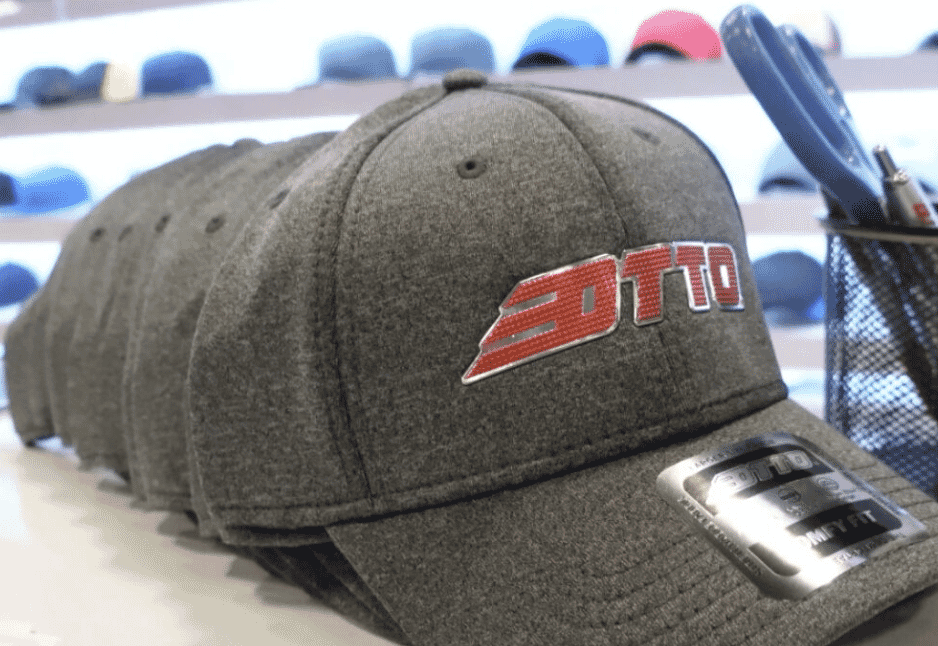
This is the clearest open factory in Denver that we could confirm on a company website, and it makes one product: caps. Its home page says its Made in USA baseball caps are cut and sewn in Denver, and that the company cuts the fabric, sews the cap and runs the decoration itself. Its about page says Marner, Inc., doing business as Competition Headwear, has been cutting, sewing and decorating caps in Denver since July 1992, in the same building on East 44th Avenue.
The company publishes its terms, which is rare. The home page lists 200 embroidery heads on the floor, a 144-unit minimum on stock fabric and a standard run of four weeks or less from start to finish. Its page for brands describes private-label caps for drops, merch and brand launches from 144 units, custom-milled fabric from 500 units, which it says adds 4 to 6 weeks for milling, and inside-cap labels in custom artwork as standard. It also describes itself as Berry Amendment compliant, which matters if you sell to federal buyers.
Watch for: it is a cap factory, not a clothing factory. If your brand needs caps and you want them made in the US, it is one of the few places where cutting, sewing and embroidery happen under one roof at a published minimum. For the garments themselves you will need someone else. Our guide to US hat and cap manufacturers covers the category nationally.
2. Baseline Contract Sewing, Lafayette (contract sewing)
Baseline is the broadest contract sewing shop we could confirm in the metro area. Its home page says it has served clients for over 35 years from its manufacturing facility in Lafayette, and its manufacturing page says it serves the Denver metro, the Front Range and clients nationwide. The service list covers stack cutting, web cutting, die cutting, precision sewing, printing, inspection and packaging, plus in-house product design, pattern work and prototyping.
Decoration and sewing sit under one roof here: the site lists DTF (direct-to-film), screen printing, dye-sublimation and heat-press, along with setting snaps, grommets, rivets and eyelets. The manufacturing page says it can handle a short prototype run or a large-scale production order, and the example it gives is a custom backpack it developed with an outdoor gear startup.
Watch for: look at the industry list before you send a fashion brief. It names outdoor recreation and adventure gear, sports and athletics, medical and healthcare, military and defense, and aviation and aerospace, among others. That is a cross-industry sewn-products shop. It does not publish a minimum, and it does not describe graded fashion collections, so if you need a dress or a knit top made across five sizes, ask early whether that is work it takes.
3. Colorado Threads, Denver (its own activewear)
Colorado Threads is an activewear label, not a contract factory, but it is one of the few businesses whose site says its clothes are made inside the city. Its home page describes hand-crafted activewear made at its boutique manufacturing facility and design studio in Denver, and its story page says it produces its items locally in Denver. The home page also says most of its materials are sourced within a 1,500-mile radius.
The company also runs a custom service. Its custom orders page lists screen printing, embroidery and sublimation for full-colour custom tops and bottoms, promotional products, and low minimums with bulk options. That page says products are designed and produced in the USA; it does not say the custom pieces are sewn in Denver.
Watch for: treat Colorado Threads as a decorator for your merch and as proof that small-batch activewear can be made in the city, not as a factory for your own cut-and-sew designs. Its site does not offer to sew other brands' patterns.
4. The Denver Seamstress, Wheat Ridge (prototypes and samples)
For a first sample, a one-person studio is often the right size. The Denver Seamstress is located in Wheat Ridge near 38th and Wadsworth, according to its site, and its prototypes page says the owner can help you develop and modify a product design with her skills in pattern-making and sample sewing. The page is written for aspiring designers launching a first collection as well as established businesses adding products.
The rest of the site covers alterations, bridal and costume work. That is useful in its own way: someone who does fitting and alteration work can tell you quickly whether a sample hangs right. Watch for: this is a sample maker, not a production floor. Use it to get a pattern and a sample you are happy with, then take both to a factory that can run your quantity.
Checked: Colorado Contract Cut & Sew, location not stated
Colorado Contract Cut & Sew comes up in Denver manufacturer searches, and its own site describes a real production floor. Its home page says it has delivered quality and service since 1989, and its about page calls it a family-owned and operated business. The services page says it is a production facility that typically starts once a product is ready and has been properly tested, and that if you have a hard pattern, even in multiple sizes, it is ready to help. The same page says it does not specialize in prototyping and sampling.
The equipment page lists an Optitex CAD system with a 60-inch marker plotter, an automatic servo cutting table and spreader, die-cutting clickers, three-needle coverstitch, 4- and 5-needle sergers, bartack, buttonhole and embroidery machines, and automatic snap machines. That is a serious cutting room with general garment sewing behind it. Its contact form asks whether you want production in the United States or overseas, in Asia or Mexico.
What the site does not give is a street address or a city. Our rule is to confirm location on the business's own website, so we list it here rather than in the group above. If you have a finished pattern and a tested sample, it is worth a call; ask where your goods will be cut and sewn before you place an order.
A Denver label that designs here: Rockmount
Rockmount Ranch Wear is one of the best-known clothing names in Denver, and its history is a manufacturing story. Its story page says the company was founded in 1946 as Rockmount Ranch Wear Mfg. Co. in Denver's Lower Downtown on Wazee Street, that it has designed western shirts from its historic building there since 1946, and that today it is a four-generation manufacturer of apparel, hats and accessories. Its flagship store is still on Wazee Street.
Some of its product pages say Made in USA. The pages we read do not say where in the US its garments are sewn today, so we list Rockmount as a Denver label that designs here, not as a factory for your collection. It is a useful reminder that a famous Denver name and a Denver sewing floor are two different things.
Checked and left out
Factory Fashion, at Stanley Marketplace, is a name often linked with small-batch clothing production in the metro area. In August 2022, 303 Magazine reported that it had launched a small-batch manufacturing business creating 50 to 100 pieces for local designers, inside a design studio and sewing school. In November 2026 its website said only that it was currently not available, so we could not confirm what it offers today. If you know the studio, ask it directly.
We also left out businesses that appear on directory pages but have no working website of their own, and a full-package factory named in an earlier version of this guide that we could not confirm on any company site this time. Directory listings are often years out of date, so check every name on its own site before you send a tech pack.
How much clothing is sewn in Denver?
Very little, and less than a decade ago. The Bureau of Labor Statistics counts private-sector apparel manufacturing jobs (NAICS 315) by county in its Quarterly Census of Employment and Wages. Denver County averaged 294 such jobs in 2015 and 109 in 2025, a fall of 63%. The number of establishments moved between 9 and 18 over the same years and stood at 16 in 2025.
More workplaces and fewer jobs means each one got smaller. In 2025 the county's 109 apparel manufacturing jobs were spread over 16 establishments, about 7 people each: the size of a workroom or a studio, not a production floor. The peak in the chart, 408 jobs in 2017, did not last, and the count has stayed between 109 and 159 every year since 2019.
Within that total, the cut-and-sew part of the industry (NAICS 3152) had 50 jobs in 10 establishments in Denver County in 2025. Colorado as a whole had 520 apparel manufacturing jobs in 64 establishments, which is 0.66% of the 78,794 apparel manufacturing jobs in the United States.
One caveat cuts in Denver's favour. NAICS 315 counts clothing and apparel accessories; Competition Headwear, for example, lists its code as NAICS 315990. Shops that mostly sew gear such as backpacks may be classed in other industries, so the clothing count does not capture all of the metro area's sewing work. The metro area has more sewing skill than the clothing count suggests; it is simply not organised around clothing.
Why Los Angeles is on another scale
Los Angeles County had 1,288 private apparel manufacturing establishments and 18,842 jobs in 2025, according to the same BLS data. That is nearly a quarter of all US apparel manufacturing employment, in one county. The cut-and-sew part alone had 17,095 jobs in 1,164 establishments.
The bigger difference is what surrounds the factories. A clothing factory needs fabric, trims and other factories close by, and the same data set counts them. In 2025 Los Angeles County had 599 piece goods, notions and dry goods wholesalers, the businesses that sell fabric and trims to factories, against 16 in Denver County. It had 173 textile mills, against 2 in the whole of Colorado.
In practice that density is why a Los Angeles run moves faster once it starts. If a fabric is late or a factory is full, there are other suppliers and other floors in the same county. In Denver, a missing trim usually means a shipment from somewhere else, and a full shop means a wait. Our Los Angeles clothing manufacturers guide covers the factories there.
Is Denver cheaper than Los Angeles?
Not on labour. The BLS Occupational Employment and Wage Statistics program counts sewing machine operators across all industries, not only clothing. In May 2025 the Denver metro area had 530 of them, with a mean wage of $21.75 an hour. The Los Angeles metro area had 9,310, with a mean wage of $19.40. The US mean was $18.08.
So the Denver sewing workforce is real, larger than the clothing count suggests, and paid more per hour than in Los Angeles. The whole Denver metro area had 202 apparel manufacturing jobs in 2023, the latest year with a published metro figure, so most of those operators must sew something other than clothing. For a brand, that means a Denver run will not usually win on price per minute of sewing. It wins when the product suits the shop, when you can be on the floor, and when you avoid shipping samples back and forth across several states.
Average pay for all jobs in apparel manufacturing tells a slightly different story, because it includes design, management and office roles: $66,060 in Los Angeles County in 2025 against $46,537 in Denver County. Treat that as a picture of what kind of jobs each place holds, not as a sewing wage.
When a Denver shop makes sense
- Caps and headwear. A Denver cap factory with a published 144-cap minimum and in-house embroidery is hard to beat for a US-made merch or brand cap.
- Gear-style and technical sewn goods. Webbing, die-cut parts, snaps, rivets, printed panels and hard-wearing fabrics are what the local contract shops describe.
- Prototypes you want to fit in person. A local sample maker lets you try on a sample, mark it up and get the next version without shipping it.
- Small runs where you want to be on the floor. If you can drive to the shop, you can approve the first pieces off the line yourself.
- Decorated merch on stock garments. Printing, embroidery and sublimation are available in the metro area without a cut-and-sew order.
When Los Angeles makes more sense
- A clothing range across sizes. Knit tops, dresses, trousers and outerwear graded across a full size run are what Los Angeles factories do every day.
- Fabric and trims you have not sourced yet. With hundreds of fabric and trim wholesalers in the county, sampling fabric is faster where the suppliers are.
- Several product types at once. If you need jersey, woven and fleece pieces in one launch, a dense base gives you a factory for each.
- Reorders on a deadline. More floors means more chances of a slot when your first factory is full.
- A first collection of your own designs. None of the Denver-area businesses above describes graded fashion collections for outside brands as its core work.
Many Denver brands will end up doing both: develop the pattern and first samples close to home, then send the approved sample and tech pack to a factory that can run the quantity. Our clothing sample rounds playbook walks through how to get from first sample to production approval.
How to brief a Denver shop
Small shops quote per project and work to a tight calendar, so the first message decides whether you get a real answer. Lead with the product and the quantity, and ask four questions.
- Where exactly is the sewing done, and can I visit? A shop that sews locally will name the building. One that sources overseas will say so if you ask.
- What do you already make that is closest to my product? A cap line, a gear shop and a bridal seamstress have very different machines.
- What is your minimum per style and per colour? Only one business above publishes a figure. Everyone else will tell you on the phone.
- Who makes the pattern, and who owns it? Settle pattern ownership in writing before the first sample, because in small runs the pattern is a large part of the cost.
Then send a tech pack with finished measurements, a sample or reference garment, and your real quantity broken down by size and colour. One local shop says outright that it starts from a hard pattern and a tested product, and most production floors work the same way, so arrive with the development done or with a plan to do it first.
Can you label it Made in Denver?
A city name is not a country-of-origin label. The FTC's Made in USA rule, 16 CFR Part 323, says a product may only be labelled Made in the United States when its final assembly or processing happens here, all significant processing happens here, and all or virtually all of its ingredients or components are made and sourced here.
That is why Competition Headwear's site makes the point that fabric, cutting, sewing and decoration all happen at its Denver facility with US-sourced components. If your garment is sewn in Denver from imported fabric, describe it accurately and keep "made in Denver" marketing separate from the country-of-origin label.
Where to produce when Denver is too small
For garments, start with Los Angeles: our Los Angeles guide lists factories there, and our USA apparel manufacturers guide covers the wider domestic market. If you are weighing domestic production against an import, our comparison of Made in USA and offshore production sets out the trade-offs.
This is where OneAim comes in: once your design and samples are ready, we place your production with a documented factory in our group built for the product.
Denver clothing production FAQ
Are there clothing manufacturers in Denver?
Very few. Denver County had 109 private apparel manufacturing jobs in 16 establishments in 2025 (BLS QCEW). On their own websites we confirmed a cap factory in Denver, Competition Headwear, a contract sewing shop in Lafayette, Baseline Contract Sewing, an activewear label that makes its own clothes in Denver, Colorado Threads, and a prototype seamstress in Wheat Ridge.
Is there a factory in Denver that makes custom caps?
Yes. Competition Headwear says it cuts, sews and decorates caps in Denver and has done so since 1992. Its site lists a minimum of 144 caps per style on stock fabric and 500 on custom-milled fabric.
Is Colorado Contract Cut & Sew in Denver?
Its own website gives no street address or city. The site describes a production facility that works from a finished pattern, so ask where your goods will be cut and sewn before ordering.
Should a Denver brand produce in Los Angeles?
For a clothing range across sizes, usually yes. Los Angeles County had 1,288 apparel manufacturing establishments and 599 fabric and trim wholesalers in 2025, against 16 of each in Denver County (BLS QCEW).
Is it cheaper to sew in Denver than in Los Angeles?
Not on labour. Sewing machine operators averaged $21.75 an hour in the Denver metro in May 2025, against $19.40 in the Los Angeles metro (BLS OEWS).
Where can I get a clothing sample made in the Denver area?
The Denver Seamstress in Wheat Ridge offers pattern making and sample sewing for prototypes, and Baseline Contract Sewing in Lafayette lists prototyping and pattern work alongside production.
Can a garment sewn in Denver from imported fabric be labelled Made in USA?
Not without qualification. Under the FTC rule, all or virtually all components must be made and sourced in the US, so a garment made from imported fabric needs accurate origin wording.
OneAim places and manages production with 80 documented clothing manufacturers in the United States. Send the product, the quantity and your target date. Within 24 hours we reply, and we place the order with the US factory in our group that already makes it. Production, invoicing and shipping run directly between you and the factory. Flat fee, no mark-up.
Start my brief US factory directory ($49)References and data
- Competition Headwear, home page, about and brands and creators, checked November 2026. Denver cap factory since 1992, cutting, sewing and decoration in one building, minimums, lead times. Company-stated.
- Baseline Contract Sewing, home page and manufacturing, checked November 2026. Lafayette facility, services, printing, industries served. Company-stated.
- Colorado Threads, home page, our story and custom orders, checked November 2026. Activewear made in Denver, custom decoration service. Company-stated.
- The Denver Seamstress, sewn product prototypes, checked November 2026. Wheat Ridge studio, pattern making and sample sewing. Company-stated.
- Colorado Contract Cut & Sew, home page, services, equipment and contact, checked November 2026. Production facility, equipment, sourcing options; no address on the site. Company-stated.
- Rockmount Ranch Wear, our story and a product page, checked November 2026. Founding in 1946 on Wazee Street, design, Made in USA product label. Company-stated.
- 303 Magazine, Factory Fashion small batch manufacturing, 22 August 2022; Factory Fashion website, checked November 2026.
- US Bureau of Labor Statistics, Quarterly Census of Employment and Wages, NAICS 315, 3152, 313 and 42431, private ownership, annual averages 2015 to 2025 (Denver County, Los Angeles County, Colorado, United States), downloaded November 2026.
- US Bureau of Labor Statistics, Occupational Employment and Wage Statistics, May 2025, sewing machine operators (51-6031), Denver-Aurora-Centennial and Los Angeles-Long Beach-Anaheim metro areas and United States, via the BLS public data API, November 2026.
- 16 CFR Part 323, Made in USA Labeling Rule. eCFR, checked November 2026.
Every business named above appears in this source list. Locations, products, minimums and histories are the businesses' own published statements unless another source is cited; we did not visit them. No business here is a OneAim group member, and none paid to appear. Reviewed and updated 17 November 2026 by Will Godax.
Related guides
- Clothing manufacturers in Los Angeles
- Hat and cap manufacturers in the USA
- Apparel manufacturers in the USA
- Clothing manufacturers in Portland