.jpeg)
Morocco sits 14 kilometers from Spain, and that distance has rewired European fast fashion. The country shipped roughly $4.6 billion of textiles and apparel in 2023, with the EU absorbing more than 90% of volume (AMITH, 2024). Inditex anchors the sector, sourcing from over 100 Moroccan suppliers across the Tangier and Casablanca clusters. For European brands chasing seven-day transit and zero duty, Morocco is the default 2026 nearshore answer.
The pitfalls are real. Briefs that arrive only in English get slower attention on the floor, where French is the working language. Capacity tightens during Inditex peak months. The category range is narrower than Turkey, and structured tailoring or luxury knitwear still belong in Portugal or Italy. This guide walks the country end to end: clusters, categories, MOQs, FOB benchmarks, lead times, sustainability, tariff math under the EU Association Agreement and US MFN, and the operational mistakes we see brands make on first orders.
Heads up: We're OneAim, a group of 100+ documented clothing manufacturers across 15+ countries. We've run programs in 14 countries since 2022. Operational data below comes from our actual production pipeline across Casablanca, Tangier, Fez, and Rabat-Salé. External sources are cited inline.
Key Takeaways
- Duty-free EU access is the headline. The EU-Morocco Association Agreement (in force since 2000) grants 0% import duty on qualifying apparel under Pan-Euro-Med cumulation rules (European Commission, 2024).
- Lead time crushes Asia. Door-to-door from Tangier to Barcelona, Marseille, or Genoa runs 5-8 weeks total, with sea transit of 7 days, versus 25-30 days from Bangladesh (World Bank LPI, 2023).
- Casablanca leads, Tangier accelerates. Casablanca holds roughly 55% of national apparel output, Tangier 30%, with Tangier Free Zone offering 0% corporate tax for five years (Moroccan Ministry of Industry, 2024).
- MOQs are reachable. Mid-tier factories accept 200-500 units per style, with stock-fabric pilots from 150 units across our 2025-2026 quote pipeline.
- Strong categories, narrow range. Fast-fashion knits, denim, and lightweight wovens make up roughly 70% of exports (ITC Trade Map, 2024). Tailoring is thin.
- US duty is the cost trap. When the US-Morocco FTA yarn-forward rule excludes a fabric chain (most fast-fashion chains fail it), US-bound apparel pays the base HTS/MFN rate (16.5% on cotton knits up to roughly 32% on some synthetics) plus an additional across-the-board US tariff layer added in 2025-26. US rates shifted repeatedly through 2025-26, so verify the current total against the live CBP/USITC schedule at time of order rather than assuming a fixed figure.
- AMITH counts 189,000 workers. The sector spans more than 1,600 registered factories, with 70%+ Amfori BSCI audit coverage in export-oriented units (AMITH, 2024).
Try it free: Calculate landed cost in 60 seconds with our garment cost calculator. No email required.
- EU-Morocco Association Agreement
- Free trade agreement in force since March 2000 granting 0% import duty on industrial and most agricultural goods between the EU and Morocco. The textile and apparel chapter relies on Pan-Euro-Med cumulation rules to qualify for preferential origin.
- AMITH
- Association Marocaine des Industries du Textile et de l'Habillement. The national textile and apparel federation that publishes export data, manages industry programs, and acts as the primary interlocutor with government on the Plan Accélération Industrielle.
- Plan Accélération Industrielle (PAI)
- Morocco's 2014-2020 industrial strategy, extended through 2025, which created sectoral ecosystems with shared services, training, and FDI incentives. The textile ecosystem targeted denim, fast fashion, and technical fabrics.
- FOB
- Free On Board. The price quoted by the factory with goods loaded on the vessel at Casablanca or Tanger Med port, before international freight, insurance, or import duty.
- MFN
- Most Favored Nation. The default tariff a country charges any World Trade Organization member when no preferential trade agreement applies. The US MFN base on apparel runs 16.5-32% by HS code, but it is only the base: in 2025-26 an additional across-the-board US tariff layer stacks on top, so the all-in US rate is higher and must be checked against the live CBP/USITC schedule.
- Pan-Euro-Med (PEM) cumulation
- A network of identical rules of origin among the EU, Morocco, Turkey, Tunisia, Egypt, and other Mediterranean partners that lets fabric sourced in any participating country count as originating when transformed in Morocco.
Why is Morocco the EU's nearshore default in 2026?
Morocco is the EU's nearshore default because three forces stack: 14-kilometer geography to Spain, 0% duty under a 26-year-old Association Agreement, and an Inditex anchor that built specialized capacity around fast fashion. Textile and apparel exports reached roughly $4.6 billion in 2023, with the EU taking more than 90% of volume (AMITH, 2024). No other low-cost country combines all three at once.
Inditex alone works with over 100 Moroccan suppliers, a base widely reported in retail trade coverage. That demand built a specialized fast-fashion ecosystem with quick-response cutting, in-house knitting, and dedicated freight slots from Tanger Med port to Algeciras. A container leaves Morocco on Monday and clears Spanish customs by Wednesday afternoon.
The structural advantage most brands miss is Pan-Euro-Med cumulation. Moroccan factories can source fabric from Turkey, Tunisia, Egypt, or any EU member state and still qualify the finished garment as Moroccan-origin under the Association Agreement. Across our 2025-2026 production pipeline, we routed Turkish organic cotton jersey through Casablanca to deliver duty-free GOTS-certified tees into Berlin in seven weeks. Portugal cannot replicate this exact fabric play. Turkey has the customs union but tighter yarn-forward constraints.
Citation capsule: Morocco's apparel sector employs approximately 189,000 workers across more than 1,600 registered factories, with EU buyers absorbing over 90% of the country's $4.6 billion in 2023 textile and apparel exports (AMITH, 2024). Pan-Euro-Med cumulation, 14-kilometer proximity to Spain, and Inditex anchor demand make Morocco the default fast-fashion nearshore destination for European brands.
Where are Morocco's manufacturing clusters?
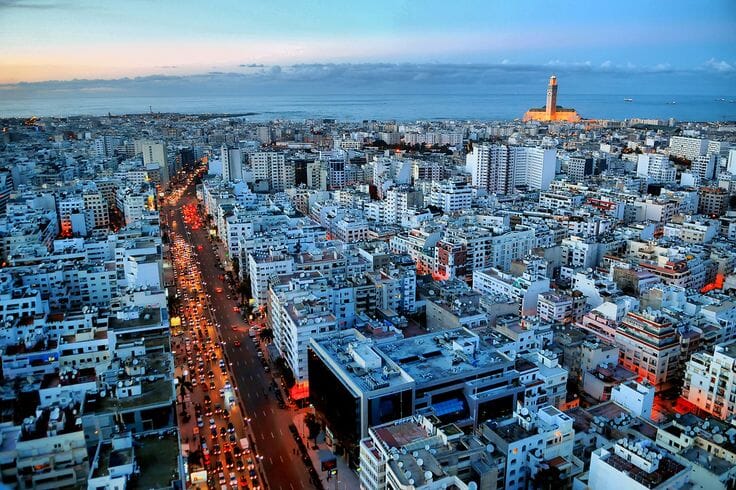
Morocco runs four production clusters: Casablanca holds roughly 55% of national apparel output, Tangier 30%, Rabat-Salé 10%, and Fez 5%, per the Moroccan Ministry of Industry's 2024 sector brief (Ministry of Industry, 2024). Each cluster has a distinct DNA. Route your category to the right city before you brief, or you'll burn weeks shortlisting the wrong factories.
Casablanca: the industrial anchor
Casablanca and its industrial belt of Ain Sebaâ, Sidi Bernoussi, Bouskoura, and Mohammedia hold the largest concentration of vertically integrated factories. Denim, knits, jersey cut-and-sew, and mid-market wovens dominate. Most factories serving Mango, H&M, Decathlon, and the French middle market sit within 30 kilometers of the city. Casablanca's strength is depth: you can find a factory for almost any mainstream category within two days of inquiries.
The drawback is older industrial stock. Many Casablanca factories were built in the 1980s and have not invested in floor digitization. Audit findings around overtime tracking are more common here than in Tangier.
Tangier: fast fashion and the free zone
The Tangier Free Zone (TFZ) and the newer Tanger Automotive City Plus textile extension are purpose-built for export. Factories inside pay 0% corporate income tax for the first five years and 8.75% thereafter (Moroccan Investment Authority, 2024). Tanger Med, among the Mediterranean's largest container ports, clears textile shipments in hours. This is Inditex country.
Expect the highest production speed but the tightest capacity during Zara peak months (February-March, August-September). Small brands trying to onboard during these windows routinely get pushed to the next quarter.
Rabat-Salé and Kenitra: technical and overflow
Rabat-Salé hosts more technical and mid-volume capacity, including activewear, uniforms, sportswear, and some tailored garments. The Kenitra Atlantic Free Zone, opened in 2018, is absorbing overflow capacity and attracting sustainable fiber and recycled-polyester investments backed by EU circular economy programs.
Fez and Marrakech: knits, embroidery, niche
Fez specializes in knit jersey and basics, with several mills supplying yarn locally. Marrakech holds smaller factories focused on embroidered and embellished pieces, often serving European designer labels at 100-300 unit MOQs. Both cities are too small to anchor a high-volume program, but they're useful for capsules.
Find your factory: Browse the free factory directory preview, or unlock the premium directory for $39 to see 100+ documented factories with direct contacts and MOQs.
Citation capsule: Casablanca concentrates roughly 55% of Moroccan apparel output, Tangier 30%, Rabat-Salé 10%, and Fez 5% (Moroccan Ministry of Industry, 2024). The Tangier Free Zone offers 0% corporate income tax for five years and same-day customs clearance at Tanger Med, making it the natural home for fast-fashion exports while Casablanca handles the broader category range.
Which product categories does Morocco do best?
Morocco is strongest in fast-fashion knits, denim, and lightweight woven dresses, which together account for roughly 70% of national apparel exports (ITC Trade Map, 2024). Knit jersey leads at 40-45% of volume, denim adds 15-18%, and lightweight wovens contribute 12-15%. Activewear is growing fast. Structured tailoring remains the weakest category.
Fast-fashion knits and jersey
T-shirts, polos, sweatshirts, dresses, and basic tops are Morocco's commercial center. Factories run circular knitting in-house or partner with mills in Settat and Fez. Reorder turnaround can hit three weeks when fabric is pre-booked. In our 2026 quote pipeline, FOB on a 180 gsm cotton tee at 500 units sits at $6.10-6.40 across Casablanca factories. The same tee in Bangladesh sits 8-10% cheaper but adds 25 days of transit and EU duty risk on non-EBA programs.
Denim
Morocco has a mature denim ecosystem covering washing, laser finishing, ozone treatment, and sustainable indigo. Tangier-based denim houses supply Levi's, Jack & Jones, Zara, and Pepe Jeans. MOQ for finished denim typically starts at 500 pieces per wash. FOB on a 12 oz one-wash 5-pocket jean lands at $14.50-15.00 in our 2026 data.
Activewear and technical
Activewear capacity is expanding rapidly around Casablanca and Rabat-Salé. Decathlon's two-decade presence seeded local know-how in performance fabrics, flatlock seaming, and sublimation printing. Recycled polyester programs are now standard in mid-tier factories. The constraint remains technical fabric availability: most performance knits still arrive from Turkey or Italy under PEM cumulation.
Tailoring (the gap)
Structured suiting, blazers, wool coats, and heavy outerwear are scarce in Morocco. The pattern engineering depth that defines Porto or Bursa is not yet here. If your collection leans tailored, route those styles to Portugal or Turkey and keep the jersey, denim, and woven dresses in Morocco.
Sister-site guides: For Portugal-specialist depth on tailoring and small-MOQ knits, see our sister site Portugal Clothing Factory.
What MOQs and FOB prices can you negotiate in Morocco?
Mid-tier Moroccan factories accept 200-500 units per style for small brands and 1,000-3,000 for fast-fashion programs, with stock-fabric pilots from 150 units across our 2025-2026 production data. That's roughly half the typical Bangladesh threshold and modestly above Portugal's 100-300 range. The real constraint is fabric MOQ, which usually starts at 500-1,000 meters per color.
MOQ by cluster and category
| Cluster | Knits | Denim | Wovens | Activewear |
|---|---|---|---|---|
| Casablanca | 200-500 | 500-1,000 | 300-600 | 500-1,000 |
| Tangier (TFZ) | 500-1,500 | 500-1,500 | 500-1,200 | 1,000-2,000 |
| Rabat-Salé | 300-600 | 500-1,000 | 300-600 | 300-700 |
| Fez | 150-400 | n/a | 200-500 | n/a |
Source: see in-text citations in this section.
Sources: OneAim Apparel internal production data, 2025-2026 quotes across 18 Moroccan factories; AMITH, 2024 cluster specialization brief.
2026 FOB benchmarks at 500 units
| Garment | FOB Casablanca/Tangier | Sea freight + insurance | Landed Barcelona | Landed Paris |
|---|---|---|---|---|
| Cotton T-shirt, 180 gsm jersey | $6.20 | $0.55 | $6.80 | $7.90 |
| Heavyweight hoodie, 380 gsm fleece | $13.40 | $0.80 | $14.30 | $15.60 |
| Denim 5-pocket jean, 12 oz, 1 wash | $14.80 | $0.70 | $15.70 | $16.90 |
| Fast-fashion woven dress, viscose | $11.30 | $0.60 | $12.00 | $13.20 |
| Activewear leggings, recycled poly | $9.80 | $0.55 | $10.45 | $11.50 |
Source: see in-text citations in this section.
Source: OneAim Apparel 2026 quotes across six Moroccan factories, 500-unit benchmark, includes fabric, trims, CMT, finishing, and Incoterms DAP. Duty zero under EU-Morocco Association Agreement.
These numbers assume mid-tier factory selection and pre-booked fabric. Expect 5-8% higher costs when using Tangier Free Zone factories during Zara peak months. Tangier programs trade a small price premium for faster freight and earlier capacity confirmation.
Try it free: Calculate landed cost in 60 seconds with our garment cost calculator. No email required.
Citation capsule: At 500-unit runs, a basic cotton T-shirt lands in Barcelona at roughly $6.80 from Morocco versus approximately $9.20 from Portugal, based on OneAim Apparel's 2026 quote data. Zero EU import duty under the Association Agreement and seven-day sea freight from Tanger Med preserve margin for contemporary and fast-fashion brands sourcing knits and denim.
How fast is Morocco to the EU and US?
Lead times from Morocco to the EU run 5-8 weeks door-to-door, the fastest of any low-cost apparel destination globally. Sampling takes 10-14 days, bulk production 4-6 weeks, and sea transit from Tanger Med to Barcelona, Marseille, or Genoa lands within 7 days, often less (World Bank LPI, 2023). To the US East Coast, transit runs 14-18 days from Casablanca.
That EU number compares to 14-18 weeks from Bangladesh and 10-13 weeks from Vietnam. When a Zara buyer says "two weeks from sketch to shelf," that math only works because of Morocco and Portugal. The country is also one of the few where air freight is rarely needed because sea is fast enough.
Where the time actually goes
- Week 1-2: Tech pack review, fabric booking, lab dips, counter samples
- Week 3-4: PP sample approval, bulk fabric in-house, cutting plan
- Week 5-7: Cut, sew, finish, in-line and final QC
- Week 8: Freight from Tanger Med, customs clearance to EU DC
The single biggest variable is not production speed, it's fabric. In our 2025-2026 placements, programs using stock fabric delivered in 5 weeks. Custom-dyed or printed programs slipped to 9-10 weeks because the dye house, not the factory, became the bottleneck. Plan color development in parallel with sampling, never in sequence.
How does duty work for Morocco-made apparel?
Duty math splits sharply by destination. EU buyers pay 0% under the EU-Morocco Association Agreement with Pan-Euro-Med cumulation (European Commission, 2024). US buyers face the base 16.5-32% MFN rate plus an additional across-the-board US tariff layer added in 2025-26 unless the order qualifies under the US-Morocco FTA's strict yarn-forward rules, which most fast-fashion fabric chains fail. Because US rates shifted repeatedly through 2025-26, verify the current total against the live CBP/USITC schedule at time of order.
EU: the unbeatable lane
The EU-Morocco Association Agreement, in force since March 2000, grants 0% import duty on apparel meeting rules of origin. Pan-Euro-Med cumulation lets Moroccan factories use fabric from the EU, Turkey, Tunisia, Egypt, or other PEM partners and still qualify the finished garment as Moroccan-origin. This is the rule that makes the cost math unbeatable for European brands.
For comparison, apparel from Bangladesh enters the EU duty-free under EBA but faces 25-30 day shipping. Apparel from Turkey enters under the customs union but requires EU or Turkish yarn-forward origin. Morocco under PEM is simply more flexible. To clear EU customs at 0%, your factory needs to provide an EUR.1 movement certificate or REX statement on origin, a commercial invoice with HS codes, and proof of "sufficient transformation" (typically cut and sew in Morocco).
US: the cost trap
The US-Morocco Free Trade Agreement, in force since 2006, technically grants 0% duty on Moroccan apparel. The catch is its yarn-forward rule of origin: yarn must be spun and fabric woven or knitted in Morocco or the US. Most Moroccan factories source knit fabric from Turkey or woven fabric from Spain, neither of which qualifies. The fallback is the base MFN rate, 16.5% for cotton tees and up to 32% for some synthetic outerwear, plus an additional across-the-board US tariff layer added in 2025-26. That layer was the IEEPA "reciprocal" tariff through 2025; the US Supreme Court struck down the IEEPA reciprocal tariffs in February 2026, after which a flat roughly 10% Section 122 tariff applied on top of MFN. Because these rates shifted repeatedly through 2025-26, do not rely on a single fixed total; check the current CBP/USITC schedule at the time you place the order.
Across our 2024-2025 quotes for US brands, this killed the Morocco math more than once. As an illustrative example using the MFN base only: on a US-bound 500-unit cotton tee program, the 16.5% MFN base duty alone wiped out the FOB savings versus Vietnam under the trade preferences in effect at quote time. The actual 2026 landed duty is higher once the current additional US tariff layer is added, and both Morocco and Vietnam now carry that added layer, so recompute the comparison against the live CBP/USITC schedule before relying on it.
Origin documentation, the practical checklist
- EUR.1 movement certificate or REX statement on origin (EU)
- Commercial invoice with full HS codes and country of origin
- Proof of sufficient transformation (cut and sew in Morocco)
- Fabric origin declarations if claiming PEM cumulation
- Factory's EORI or REX registration number on file
Errors here trigger retroactive duty plus penalties that can reach a double-digit percentage of CIF value in the EU. Insist your factory provides a test origin document before the first shipment, and have your customs broker review it.
Citation capsule: The EU-Morocco Association Agreement provides 0% import duty on qualifying apparel, supported by Pan-Euro-Med cumulation rules that allow fabric sourcing from the EU, Turkey, and Mediterranean partners (European Commission, 2024). For US buyers, the US-Morocco FTA's yarn-forward rule excludes most fast-fashion fabric chains, leaving the base 16.5-32% MFN rate plus an additional across-the-board US tariff layer added in 2025-26; because US rates shifted repeatedly, verify the current total against the live CBP/USITC schedule at time of order.
Is Moroccan manufacturing sustainable in 2026?
Moroccan manufacturing is increasingly sustainable, with OEKO-TEX Standard 100 certification widespread and renewables supplying roughly 21-22% of the country's electricity generation, while installed renewable capacity sits closer to 40% (IEA Morocco electricity, 2023). Roughly 150+ Moroccan textile facilities held OEKO-TEX certifications in 2024 (OEKO-TEX, 2024), and recycled-fiber capacity is growing through EU-funded circular economy programs.
Where Morocco is strong
- OEKO-TEX Standard 100 available across most mid-tier and large factories
- Renewable energy supplied roughly 21-22% of electricity generation in 2023, with installed renewable capacity nearer 40%, among Africa's highest (IEA Morocco electricity, 2023)
- Water recycling in denim washing houses around Tangier, with closed-loop systems gaining ground
- Recycled polyester and cotton scaling fast under Spanish and French buyer pressure
- GRS and RCS certification present in 25-30 export-oriented factories we track in our directory
Where Morocco is still catching up
GOTS-certified organic programs exist but remain limited compared to Portugal or Turkey. If certified organic cotton is critical, plan for longer fabric lead times or import organic yarn from Turkey under PEM cumulation. Higg Index FEM coverage is also thinner than in larger Asian programs, though this is shifting fast as Inditex pushes suppliers toward EU Digital Product Passport readiness.
Citation capsule: Morocco's textile sector hosts more than 150 OEKO-TEX Standard 100 certified facilities (OEKO-TEX, 2024) and runs on a grid where renewables supplied roughly 21-22% of electricity generation in 2023, with installed renewable capacity nearer 40% (IEA Morocco electricity, 2023). Lower embedded carbon than most Asian alternatives, plus expanding recycled-fiber capacity, position Morocco well for EU Digital Product Passport requirements landing through ESPR.
What are the most common pitfalls when sourcing from Morocco?
The most common pitfalls are language friction, capacity squeeze during Inditex peak months, origin documentation errors, and informal subcontracting. Roughly 60% of Moroccan factory technical leads work faster from French-translated briefs than from English-only tech packs, based on our 2025-2026 production experience across 18 factories. Each pitfall has a clean mitigation if you plan ahead.
Language: brief in French when possible
Tech packs in English are widely understood in Casablanca, but on the shop floor, French is the operational language. Patternmakers, QC leads, and merchandisers move faster from French-translated briefs. Arabic is the cultural default but rarely used for production documentation. We've seen two brands lose four weeks because the factory's English was "good enough" in email but the production floor misread a seam allowance noted only in English. A 90-minute call with the technical director in French would have caught it.
Seasonal capacity squeeze
Zara, Mango, and Bershka pre-book Tangier capacity months ahead. February, March, August, and September are brutal for small brands trying to onboard. Plan your PO calendar around these windows, or shift to Casablanca where fast-fashion peak pressure is lower.
Origin paperwork
Errors on EUR.1 certificates or REX statements trigger retroactive duty plus penalties. Insist your factory provides a test origin document before the first shipment, and have your customs broker validate the HS codes and origin declaration.
Informal subcontracting
Informal subcontracting to smaller unaudited units is the main hidden risk. Mitigation: require tech pack-level unit visibility in your contract, and run random third-party floor audits on 30% of bulk production. Across our 2025 placements, this caught one subcontracting issue early, before it became a compliance event.
Mid-tier capacity ceiling
Morocco runs out of capacity at the very top end. If you need 50,000+ units of complex outerwear in 8 weeks, the country can't always absorb it. Plan a hybrid Morocco-Portugal or Morocco-Turkey split for high-volume programs, or weigh Eastern European capacity for complex outerwear, and reserve Morocco for the SKUs that benefit most from speed and zero EU duty.
Running into nearshoring decisions? Get in contact and we’ll map the full picture for your brand, or grab a factory-ready tech pack for $79.
Decision Framework: Choose Morocco when...
Morocco is the right answer when speed to EU, zero duty, and fast-fashion category fit converge. It's the wrong answer when the program is tailoring-heavy, US-bound, or under 150 units. Use these conditions to decide, and cross-check them against the broader country comparison for where to manufacture in 2026.
Choose Morocco when:
- Your primary market is the EU and you want to minimize transit time and zero out import duty.
- Your category is fast-fashion knits, denim, lightweight wovens, or expanding activewear lines.
- You need 5-8 week lead times to match a quick-response or capsule-drop calendar.
- Your MOQ tolerance is 200-500 units per style (mid-tier) or 1,000+ units for Tangier Free Zone speed.
- You can brief in French or have an agent who can.
- You value Pan-Euro-Med cumulation flexibility for sourcing fabric across Mediterranean partners.
- Your sustainability target leans on renewable-grid electricity and OEKO-TEX certification.
Don't choose Morocco when:
- The order is structured tailoring, blazers, wool coats, or luxury knitwear (Portugal or Italy fits better).
- The program ships primarily to the US and the fabric chain doesn't qualify under yarn-forward (Vietnam or Mexico fits better).
- Your MOQ ceiling is under 150 units per style and you need ultra-low-volume capacity (Portugal fits better).
- You're trying to onboard between February-March or August-September with no advance booking.
- You need GOTS-certified organic cotton at scale and can't wait on fabric from Turkey.
- Your program leans on heavy embellishment, beading, or hand-finished couture work.
For brands stuck between Morocco and Portugal on a knit-plus-tailoring split, we typically recommend hybrid sourcing: jersey, denim, and wovens in Morocco; tailored pieces, small-MOQ knits, and certified organics in Portugal. The freight cost penalty is minor when you batch consolidations.
Frequently Asked Questions About Clothing Manufacturing in Morocco
What is the minimum order quantity for clothing manufacturing in Morocco?
MOQs in Morocco typically run 200-500 units per style for small brands working with mid-tier factories in Casablanca and Rabat-Salé, and 1,000-3,000 units for fast-fashion programs in the Tangier Free Zone. Pilot runs as low as 150 units are possible when using stock fabric in Casablanca or Fez, based on our 2025-2026 production data across 18 factories. Custom-dyed or printed programs usually require 500+ units per color because of fabric MOQ, not sewing capacity.
How long does it take to manufacture clothing in Morocco?
End-to-end lead time from tech pack to EU delivery runs 5-8 weeks for programs using stock or pre-booked fabric. Sampling takes 10-14 days, bulk production 4-6 weeks, and sea freight 7 days from Tanger Med to Barcelona, Marseille, or Genoa (World Bank LPI, 2023). Morocco is the fastest low-cost apparel sourcing country globally for EU-bound brands, beating Bangladesh by roughly 9 weeks and Vietnam by 5 weeks on door-to-door delivery.
Is clothing made in Morocco duty-free into the EU?
Yes. Under the EU-Morocco Association Agreement (in force since March 2000), qualifying apparel enters the EU at 0% import duty. Pan-Euro-Med cumulation lets factories use fabric from the EU, Turkey, Tunisia, or Egypt and still qualify for preferential origin (European Commission, 2024). You'll need either an EUR.1 movement certificate or a REX statement on origin, plus proof of sufficient transformation (cut and sew) in Morocco.
How do Moroccan costs compare to Portugal and Turkey?
Moroccan landed costs run roughly 25-35% below Portugal and 8-15% below Turkey at 500-unit runs. A basic cotton T-shirt lands in Barcelona near $6.80 from Morocco versus approximately $9.20 from Portugal and $7.60 from Turkey, based on OneAim Apparel's 2026 quote data. Portugal wins on tailoring and very small MOQs. Morocco wins on fast-fashion knits and denim. Turkey wins on technical fabric depth and large-volume programs.
What are Morocco's main manufacturing clusters?
Morocco runs four production clusters: Casablanca (55% of national output, broad category depth), Tangier (30%, fast-fashion exports through TFZ and Tanger Med port), Rabat-Salé (10%, technical and activewear), and Fez (5%, knit jersey and basics) (Moroccan Ministry of Industry, 2024). Marrakech adds smaller embroidery and embellishment factories. Casablanca anchors depth; Tangier drives speed.
What categories should I not source from Morocco?
Avoid Morocco for structured tailoring (blazers, wool suits), heavy technical outerwear, intricate hand-finished knitwear, and luxury silk goods. These remain Portuguese, Italian, or Turkish strengths. Morocco excels at fast-fashion knits, denim, and lightweight woven dresses, which together make up roughly 70% of national apparel output (ITC Trade Map, 2024). Hybrid sourcing (Morocco knits plus Portugal tailoring) often beats single-country programs for mixed collections.
Does Morocco use child labor or have forced labor risks?
Morocco has ratified all eight ILO core conventions, including those on child labor and forced labor (ILO, 2024). In formal export-oriented factories, structural risks are rare. The most frequent audit findings center on overtime tracking and contract documentation, not forced or child labor. The hidden risk is informal subcontracting to unaudited units, which is mitigated by tech pack-level visibility clauses and random third-party floor audits.
What audit certifications do Moroccan factories hold?
Amfori BSCI is the most widely adopted, covering roughly 70%+ of Tangier Free Zone factories (Amfori, 2024). SMETA (Sedex) is common among UK-facing suppliers, WRAP among larger Casablanca manufacturers, and SA8000 in premium supply chains. OEKO-TEX Standard 100 is held by 150+ facilities (OEKO-TEX, 2024). Always request a current report (under 12 months old) plus the factory's social compliance contact before signing.
Can I get organic cotton apparel from Morocco?
Yes, but capacity is limited compared to Portugal or Turkey. In our directory, roughly 25-30 Moroccan factories hold GOTS or GRS certification. The most common workaround is to import certified organic yarn or fabric from Turkey under Pan-Euro-Med cumulation, then knit and finish in Morocco. This preserves the EU 0% duty under the Association Agreement and adds about 2 weeks to fabric lead time.
Why do US brands pay duty on Moroccan apparel when there's a US-Morocco FTA?
The US-Morocco FTA technically grants 0% duty but enforces a strict yarn-forward rule of origin: yarn must be spun and fabric woven or knitted in Morocco or the US (USITC, 2024). Most Moroccan factories source knit fabric from Turkey or woven fabric from Spain, neither of which qualifies. The fallback is the base MFN rate, 16.5% for cotton tees and up to 32% for some synthetic outerwear, plus an additional across-the-board US tariff layer added in 2025-26 (the IEEPA "reciprocal" tariff through 2025, replaced by a flat roughly 10% Section 122 tariff after the US Supreme Court struck down the IEEPA reciprocal tariffs in February 2026). US rates shifted repeatedly through 2025-26, so check the current total against the live CBP/USITC schedule at time of order; the added duty often wipes out the Morocco cost advantage versus Vietnam or Mexico for US-bound programs.
The bottom line on Morocco in 2026
Morocco is the sharpest nearshore tool available to European fashion brands, provided you match the category correctly and plan around Inditex's calendar. Fast-fashion knits, denim, and lightweight wovens land in Barcelona at $6-16 per unit in 5-8 weeks, duty-free under the EU Association Agreement, with renewable-powered factories and 70%+ Amfori BSCI audit coverage in export-oriented units. Tailoring and luxury categories still belong in Portugal or Italy.
The playbook is operationally simple and unforgiving in execution. Brief in French when the design is technical, pre-book fabric aggressively, avoid Tangier during Zara peak months if you're a small brand, and verify origin documentation before your first shipment. Done right, Morocco gives you Asian cost with European delivery speed and zero import duty.
For US-bound programs, run the yarn-forward math before you commit. The base 16.5-32% MFN rate plus the additional across-the-board US tariff layer added in 2025-26 has killed more than one Morocco quote in our pipeline, and Vietnam or Mexico often wins those orders on landed cost despite a longer transit. Because US rates shifted repeatedly through 2025-26, price every US quote against the live CBP/USITC schedule rather than a fixed total.
Talk to a real person: get in contact with our team. No pitch, no upsell.
We're a group of 100+ documented clothing manufacturers across 15+ countries. Tell us your product, volume, and timeline. We'll route your brief to the factory in our group built for it, usually within 24 hours. You produce directly with the factory. Flat fees, no markups, no pitch.
Get in contact Download the directory ($39)Need a tech pack? Get a factory-ready single-style tech pack for $79. See what's included.
References
- AMITH, Association Marocaine des Industries du Textile et de l'Habillement, sector statistics and 2024 cluster brief, textile.ma
- Moroccan Ministry of Industry and Trade, sector brief on textile and apparel ecosystem, 2024, mcinet.gov.ma
- Plan Accélération Industrielle Morocco, textile ecosystem program 2014-2025, Moroccan Ministry of Industry, mcinet.gov.ma
- Office des Changes Maroc, foreign trade statistics on textile and apparel exports, 2024, oc.gov.ma
- European Commission, EU-Morocco Association Agreement and trade policy, 2024, policy.trade.ec.europa.eu
- World Bank Logistics Performance Index, country score for Morocco, 2023, lpi.worldbank.org
- International Labour Organization, Morocco country profile and ILO core conventions, 2024, ilo.org
- Amfori BSCI, country risk classification and audit coverage data, 2024, amfori.org
- OEKO-TEX Association, certified company database for Morocco, 2024, oeko-tex.com
- International Energy Agency, Morocco electricity generation and renewable share, 2023, iea.org/countries/morocco/electricity
- International Trade Centre Trade Map, HS Chapters 61-62 Morocco apparel exports, 2024, trademap.org
- United States International Trade Commission, Harmonized Tariff Schedule and US-Morocco FTA rules of origin, 2024, hts.usitc.gov
- Reuters, Inditex Moroccan supplier base reporting, 2023, reuters.com
- Moroccan Investment Authority (AMDIE), Tangier Free Zone tax incentives, 2024, amdie.gov.ma
- Italian Trade Agency (ICE), Mediterranean apparel sourcing brief, 2024, ice.it
Related Reading
- Clothing Manufacturing in Tunisia
- Best Clothing Manufacturers in Morocco
- Where to manufacture apparel in 2026: country comparison hub
- Morocco vs Portugal vs Turkey: nearshore EU comparison
- Clothing manufacturing in Portugal: 2026 guide