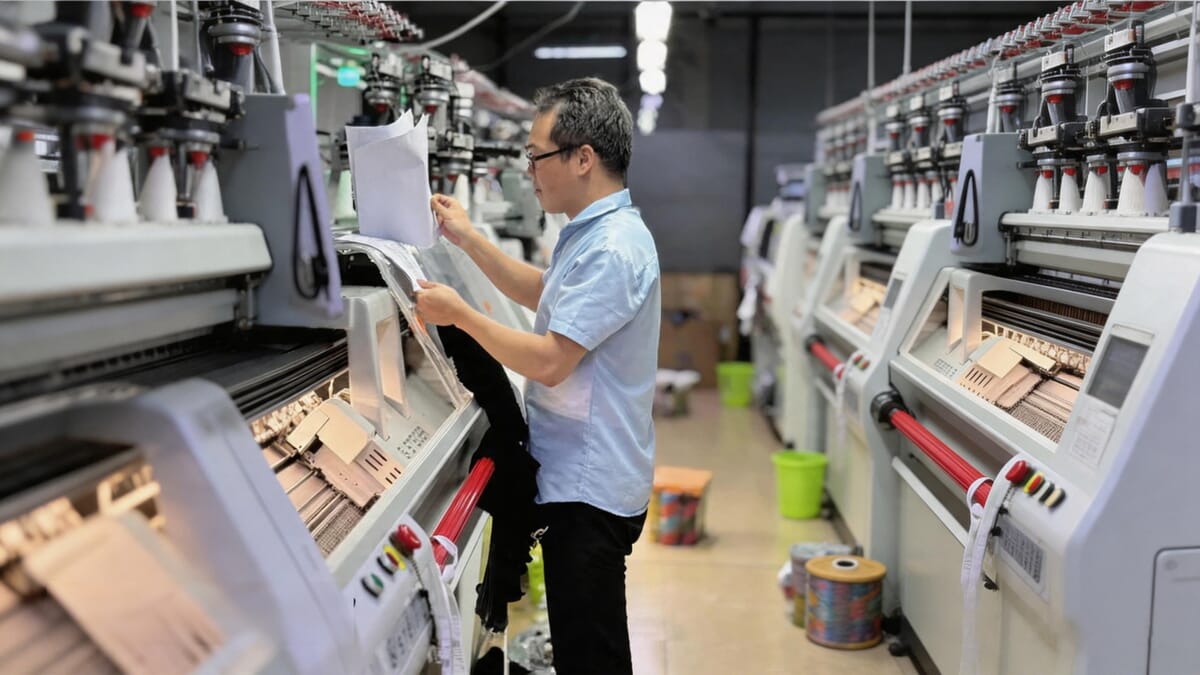
A cardigan is knitted, not cut and sewn, so US cardigan manufacturers are flat-bed knitting mills, and only a handful of them still take work for other brands. A t-shirt factory buys fabric, cuts panels and sews them. A cardigan factory starts with cones of yarn and a flat-bed knitting machine. Different machines, different skills, and mostly different companies.
This guide lists six US knitting mills that make sweaters and cardigans for other brands, three in New York City and three in the Los Angeles area, each checked again on its own website in November 2026. For each one we note where it knits, what machines and gauges it names and what minimum it publishes. After the list we explain the three knit methods and gauge, then add US data on knitting jobs, wages and the import duty a US-made cardigan avoids, a labelling checklist and what to send a mill. Every company and number is listed in the Sources section.
About us: OneAim places and manages production with documented clothing factories in the United States. The companies below are independent US knitting mills listed from their own public websites. They are not members of our group. What OneAim does instead: we place your production with a documented factory in our group built for your product.
The short list
- Six mills, all self-reported. Simply Knitting Mills, Tailored Industry and Knit Illustrated in New York City; Andari, Ball of Cotton and Avatar Knit in the Los Angeles area. The evidence is each company's own website.
- Knitting is not cut and sew. Cardigans are built from yarn on flat-bed machines, so the supplier list barely overlaps with tees and hoodies.
- Gauge is the first filter. Simply Knitting Mills states 3.5 to 10 gauge and Avatar Knit 16 down to 3 gauge. A fine 12gg or 14gg cardigan needs fine-gauge machines.
- Minimums run from none to quote-only. Tailored Industry sells on-demand with zero minimums inside a paid membership; Knit Illustrated states 1 to 2,000 units per style with a surcharge on small runs; the other four do not publish a figure.
- US capacity is shrinking. BLS counts 71.9 thousand apparel manufacturing jobs in October 2026 (preliminary), against 129.8 thousand in October 2016.
- Fibre sets the duty you avoid. An imported cardigan wholly of cashmere pays 4% general duty; one in acrylic or other man-made fibre pays 32%.
Free estimate: calculate your landed cost with our garment cost calculator in about a minute. No email needed.
Why is a cardigan a knitting job, not a sewing job?
Because it starts as yarn, not cloth. A woven shirt begins with fabric that already exists, and the factory's skill is cutting and sewing it. A cardigan begins on a knitting machine that builds the fabric and, on the better methods, the shape of each panel at the same time. The machine, the yarn and the stitch are the product, and the sewing room only joins and finishes.
That is why the commonest briefing mistake is sending a cardigan tech pack to the factory that already makes your t-shirts. A cut-and-sew house can make a cardigan only by buying knitted yardage and cutting it, which gives you overlocked seams and cut edges at the shoulders and front band. If you want a fully-fashioned or seamless cardigan, ask a factory what knitting machines it owns, and at what gauges, before you send anything.
The same logic applies to the other knit accessories in a range. Our guides to beanie manufacturers and scarf manufacturers cover the knitters that make hats and scarves, which are often different companies again.
What are the three knit construction methods?
Cut-and-sew knit knits a length of fabric, cuts panels from it and overlocks them together. It is the cheapest to set up and the fastest to scale, but it wastes yarn at the cutting table and leaves a bulkier seam. Most sweatshirts and jersey dresses are made this way.
Fully-fashioned knits each panel to its finished shape, then joins the panels by linking them stitch by stitch, usually on a linking machine. No yarn is cut away, the seams lie flat, and the front band and neck rib can be knitted and linked on. It is slower and more skilled, which is part of why a fully-fashioned cashmere cardigan costs what it does.
Whole-garment, also called seamless or 3D knitting, knits the whole cardigan in one piece on a flat-bed machine: no cutting and little or no linking. The catch is the machine, which is expensive, so its time is priced into every piece. Tailored Industry, Andari and Knit Illustrated all name 3D or whole-garment knitting on their sites.
| Method | How the cardigan is built | Yarn waste | Typical fit |
|---|---|---|---|
| Cut-and-sew knit | Panels cut from knitted fabric and overlocked | Highest (cut-away fabric) | Price-led basics, jersey cardigans |
| Fully-fashioned | Panels knitted to shape and linked stitch by stitch | Low | Premium wool and cashmere cardigans |
| Whole-garment (3D) | Whole garment knitted in one piece | Lowest | Seamless styles, on-demand runs |
Ask which method a quote assumes. Two quotes for "a merino cardigan" can differ by method alone, and a fully-fashioned sample will not look like a cut-and-sew bulk order made later.
What is knitting gauge, and why does it set your price?
Gauge counts the needles per inch on the machine's needle bed, so a higher gauge means a finer stitch and a finer yarn. 3gg is chunky, the fisherman look. 5 to 7gg is the mid-weight workhorse. 12gg is a fine cardigan. 14gg and up is superfine, the knit that folds into almost nothing.
Finer usually costs more, and not because the machine is fancier. More stitches per inch means more machine minutes per panel, filled with a finer and often more expensive yarn. A chunky cardigan uses more yarn by weight but knits fast; a fine one uses less yarn but takes longer on the machine.
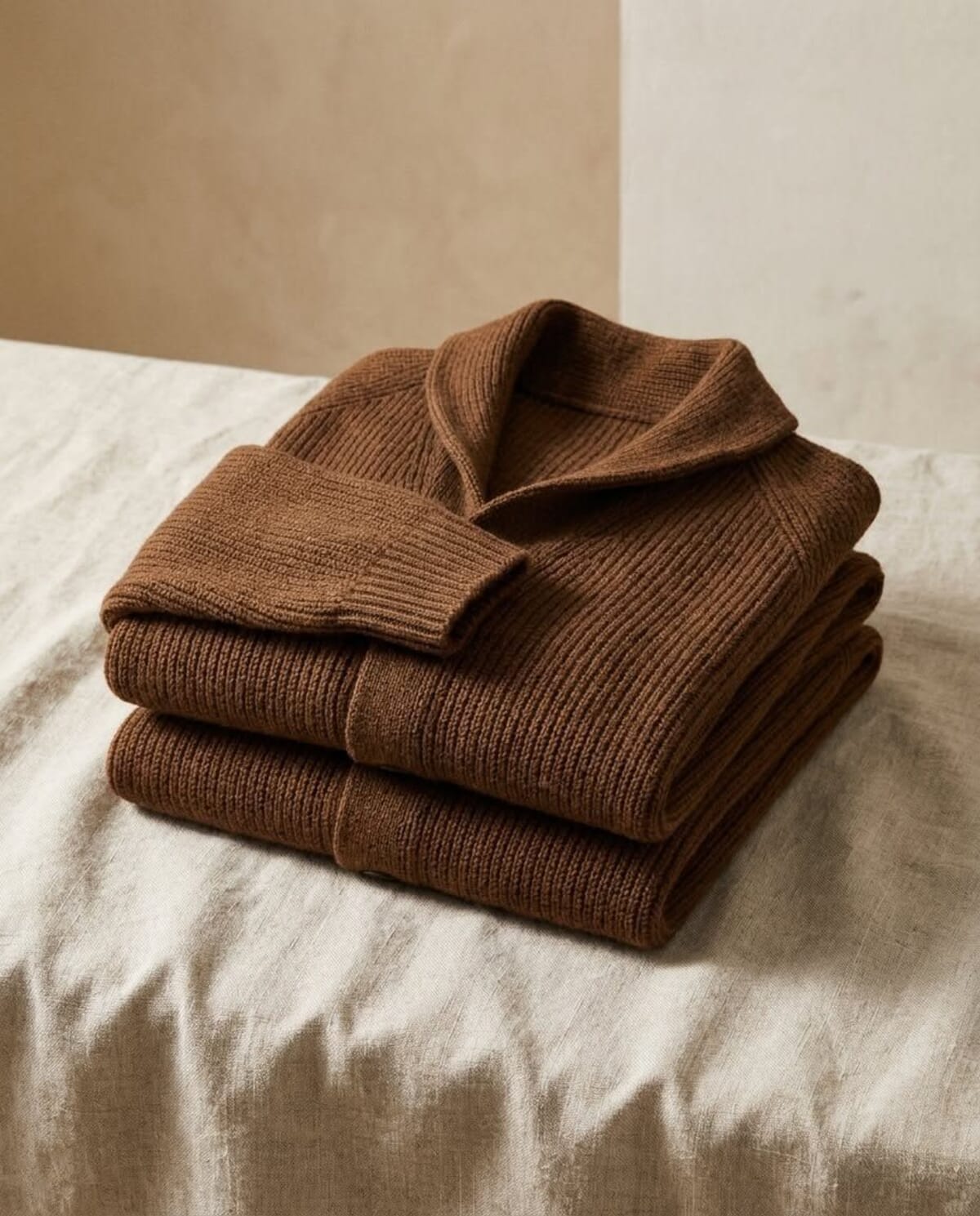
The practical test: hold a swatch to the light. A 3gg knit lets light through in visible gaps; a 14gg knit reads almost as a solid surface. Ask any mill for a knitted swatch at your target gauge before you approve a sample, because gauge is the one spec that photographs badly and feels obvious in the hand. Then check the mill's published gauge range against it: a mill that tops out at 10 gauge is the wrong place for a 14gg cardigan.
How did we choose these cardigan manufacturers?
We used three tests. First, the company's own website must say that it knits garments in the United States, or name a US factory and machines. Second, it must take work for other brands: development, sampling, private label or contract production. Third, its site must show knitwear such as sweaters and full-fashion or whole-garment knits. Then we read those pages again on 13 November 2026 and wrote down what they say, including any published gauge range and minimum.
Here is what that does and does not prove. Every entry is self-reported: we read websites, we did not visit knitting floors, and nobody paid to appear. Some well-known US sweater makers knit only their own label and show no contract work, so they are not here. Others appear in older directories but their websites are parked or no longer describe current production, so we left them out. Several of the mills below also offer production outside the US; where a site says so, we say so, and you should ask which floor will knit your order.
We did not rank the six. The right one depends on your yarn, your gauge, your method and your volume.
Which US knitting factories make cardigans for brands?
Six mills: three in New York City and three in the Los Angeles area.
Simply Knitting Mills (Ridgewood, New York City)
Simply Knitting Mills describes itself as "Fully fashioned knitwear, made in New York", established in 1993, and its about page places it in Ridgewood, NY, as one of the handful of knitting mills left from the area's busier decades (Simply Knitting Mills, about). Its home page says it works with small to medium-sized brands and designers on both sample development and production, handles specialty yarns from 3.5 gauge to 10 gauge, uses Stoll flat bed machines exclusively, and invites brands to add a "Made in New York" label to their collections (Simply Knitting Mills).
Its services page lists stitch and swatch development, prototyping and production, and says grading is done according to customer specifications once production yarns arrive (Simply Knitting Mills, services). That gauge range suits chunky to mid-weight cardigans; for a 12gg or finer cardigan, ask first. Minimums are not published. Best for: a fully-fashioned wool cardigan in a chunky or mid gauge, developed from swatch to bulk in one New York mill.
Tailored Industry (Brooklyn, New York)
Tailored Industry is an on-demand knitwear factory. Its factory page is headed "Advanced Manufacturing, Made in Brooklyn" and says its 3D knitting process builds garments in a single piece, with no cutting, no sewing and no waste (Tailored Industry, the factory). It lists Italian merino wool, Scottish cashmere, Italian cotton and Lenzing EcoViscose among its always-on yarns.
The model is different from a classic mill. Its home page sells "On-Demand, Zero Minimums", a library of 300+ market-ready styles and order to launch in 9 business days, with products synced from your online store to its Brooklyn factory (Tailored Industry). Access comes through three membership tiers priced at $2,990, $10,000 and $20,000 per year: Boutique for ready styles under your label, Studio for customised silhouettes, and Flagship for full custom development. So "zero minimums" means no per-style minimum, not no cost of entry. Best for: a brand that wants to sell cardigans made to order without holding stock.
Knit Illustrated (New York City)
Knit Illustrated describes itself as a knitwear development and production service based in New York City, with a mission to give established and emerging designers a "feasible and trusted domestic option" (Knit Illustrated). Its New York machine list runs from hand-flat machines at 16 down to 1 1/2 gauge, to Shima computer machines at 16 and 12 gauge and a Shima whole-garment machine at 15 gauge, which covers fine-gauge cardigans.
It is one of the few mills here that publishes timings: swatches in 2 days to 1 week, sampling in 2 to 4 weeks, and production in 8 to 12 weeks from when its factory receives yarns. Its production range is 1 to 2,000 units per style, with a larger surcharge the fewer you make. The same page also lists machines in China and "scalable production domestic and overseas", so specify domestic production when you brief it. Best for: fine-gauge or whole-garment cardigan development with a published lead time.
Andari (Los Angeles, California)
Andari calls itself "one of the United States' leading private label knitwear manufacturers" and says it uses seamless 3D knitting that creates knitwear in one entire piece, in a factory powered by solar panels (Andari, local and sustainable production). Its about page places it in Los Angeles, says it harnesses both 3D knitting and fully-fashioned capabilities, and states that it was established in 1991 and provides both local and overseas knitwear manufacturing; it also states SEDEX certification and membership of the BCI Cotton platform (Andari, about us).
Its home page lists design consultation including tech packs, material sourcing, sample development and production, for on-demand or mass runs (Andari). Because Andari offers overseas production too, confirm in writing that your order is knitted in Los Angeles. Minimums are not published. Best for: a brand that wants design and tech pack help plus a choice of fully-fashioned or 3D knitting.
Ball of Cotton (Commerce, California)
Ball of Cotton is a contract knitwear manufacturer in Commerce, in the Los Angeles area. Its about page says it has been family owned since 1991, works from yarn sourcing to commercial production, and produces garments in cotton, wool, cashmere and various yarn blends "right here in Southern California, made in the USA" (Ball of Cotton, about). Its services page says all production is made in house in Los Angeles, offers development for runway or trade-show samples, and notes that yarn must be provided by the client (Ball of Cotton, services).
Its cardigan record is public. A 2014 report in The Philadelphia Inquirer says the Team USA cardigan worn at the opening ceremony of the 2014 Sochi Winter Olympics was knitted at Ball of Cotton. Ralph Lauren was Team USA's official outfitter, and the report says the owners and about 50 employees averaged 12 hours over each cardigan (The Philadelphia Inquirer, 2014). Minimums are not published. Best for: a brand that can supply its own yarn and wants a Los Angeles contract knitter with a cardigan track record.
Avatar Knit (Walnut, California)
Avatar Knit's site describes it as a quality knitwear manufacturer in Southern California, with over 60 fully computerized flat knitting machines from 16 gauge to 3 gauge in a modern building of over 40,000 square feet, and lists an address in Walnut, CA (Avatar Knit). That gauge spread covers everything from a chunky shawl-collar cardigan to a fine layering piece, for both development and production.
The website is brief and carries a 2023 copyright line, so confirm current capacity, services and minimums directly before you rely on it. Best for: a wide gauge range under one roof in Southern California.
Here is how the six compare at a glance.
| Mill | Where | Knit method | Published gauge | Published minimum |
|---|---|---|---|---|
| Simply Knitting Mills | Ridgewood, NY | Fully-fashioned (Stoll) | 3.5 to 10gg | Not published |
| Tailored Industry | Brooklyn, NY | 3D whole-garment, on demand | Not published | Zero minimums; membership $2,990 to $20,000 per year |
| Knit Illustrated | New York, NY | Full-fashion and whole-garment | 1 1/2 to 16gg (hand flat); 12, 15, 16gg (Shima) | 1 to 2,000 units/style, surcharge on small runs |
| Andari | Los Angeles, CA | Fully-fashioned and 3D | Not published | Not published |
| Ball of Cotton | Commerce, CA | Contract knitwear | Not published | Not published; client supplies yarn |
| Avatar Knit | Walnut, CA | Computerized flat knitting | 3 to 16gg | Not published |
Source: each company's own website, checked 13 November 2026. Self-reported; confirm before you brief.
How much US knitting capacity is left?
Less every year. The Bureau of Labor Statistics counts all employees in US apparel manufacturing, a group that includes apparel knitting mills. In October 2016 it stood at 129.8 thousand. In October 2026 the preliminary figure is 71.9 thousand, about 45% lower.
Knitting is a small part of that. The BLS occupational survey counts 13,030 textile knitting and weaving machine setters, operators and tenders in the US in May 2025, against 104,880 sewing machine operators. That category also includes weaving, so the number of people running flat-bed sweater machines is smaller still.
What this means for a brand: US cardigan capacity is concentrated in a few mills, each with a few sampling slots. Book development early, keep your style count tight for the first season, and expect a mill to ask about volume before it quotes. The numbers also explain why most of the six publish no minimum: they price each project rather than run a standard line.
What does US knitting labour cost?
Less than many brands assume, per hour. In the May 2025 BLS estimates, the median hourly wage for textile knitting and weaving machine setters, operators and tenders was $18.36, close to the $17.63 median for sewing machine operators and below the $24.51 median for all US occupations.
Hourly pay is only one input. In a cardigan, the cost drivers are machine minutes per panel (set by gauge and stitch), the linking and hand finishing on a fully-fashioned piece, yarn price and yield, and the number of sample rounds before bulk. A 14gg cardigan with a knitted-on front band and hand-linked shoulders takes far more machine and finishing time than a 5gg cut-and-sew version. Ask each mill to quote the same tech pack at the same gauge and method so the numbers can be compared.
What import duty does an imported cardigan pay?
Cardigans are entered under heading 6110 of the Harmonized Tariff Schedule, the heading for sweaters, pullovers, sweatshirts, waistcoats and similar knitted articles. The general rate depends on the fibre: 4% for a cardigan wholly of cashmere, 16% for wool, 16.5% for cotton and 32% for most man-made fibres such as acrylic.
Two things follow. First, a cardigan knitted in the US pays no import duty on the finished piece, which matters most for acrylic and other synthetic blends at 32%. Second, the gap is small for pure cashmere at 4%, so for a cashmere cardigan the case for a US mill rests on lead time, minimums and control rather than duty. Yarn bought abroad can carry its own duty, and additional duties can apply by country of origin, so check the current rate for your exact fibre blend and source before you cost a style.
For a wider view of the trade-off, see our comparison of made in USA versus offshore production.
What labels does a cardigan need in the US?
A wool or cashmere cardigan falls under the Wool Products Labeling Act rules in 16 CFR Part 300, which include sections on required label information, on the use of the terms mohair and cashmere, and on the country where wool products are processed or manufactured (16 CFR Part 300). Cotton and synthetic cardigans fall under the textile rules in 16 CFR Part 303.
- Fibre content. Generic fibre names by percentage, including any cashmere or wool blend share.
- Origin. The FTC's Made in USA rule says a product may only be labelled Made in the United States when final assembly or processing happens here, all significant processing happens here, and all or virtually all ingredients or components are made and sourced here (16 CFR Part 323).
- Imported yarn. The textile labeling rules give "Made in USA of imported fabric" as the example wording for a garment made here from imported materials (16 CFR Part 303); ask your mill and your compliance adviser how this applies to imported yarn.
- Care. A permanent care label is required too (16 CFR Part 423). Hand wash, dry flat and dry clean instructions are common for wool and cashmere.
- Identity. Your brand name or a registered identification number on the label.
Our trims and labels guide covers label formats and suppliers.
What should you send a cardigan manufacturer?
A knitwear tech pack needs more than a cut-and-sew one, because the mill programs the machine from it. Send these before you ask for a price:
- Yarn. Fibre, count or weight, mill and colour reference, or say that you want the mill to source it. Ball of Cotton, for example, asks clients to provide yarn.
- Gauge and method. The target gauge, and whether the cardigan is cut-and-sew, fully-fashioned or whole-garment.
- Stitch structure per area. Body, sleeves, cuffs, hem rib, front band and collar: jersey, 1x1 or 2x2 rib, cable, links or jacquard.
- Front band and closures. Knitted-on or sewn-on band, button count, size and placement, buttonhole direction, and who supplies the buttons.
- Measurements. Relaxed measurements per size with tolerances, plus a stretched measurement for ribs, and the size range you will grade to.
- Finishing. Washing, steaming or milling, and the hand you want after finishing.
- Labels and packing. Fibre content, care, origin, brand label position, folding and bagging.
- Quantity per style and colour. Knitting minimums are often per colour because each colour is a separate yarn order.
If you do not have a tech pack yet, build one before you contact a mill; we build a factory-ready tech pack if you need one, and our sample rounds playbook explains what happens after you send it.
How long does US cardigan production take?
Only two of the six publish timings. Knit Illustrated states swatches in 2 days to 1 week, sampling in 2 to 4 weeks and production in 8 to 12 weeks from when its factory receives yarns. Tailored Industry states order to launch in 9 business days for styles from its ready library. The others quote per project.
Plan around yarn. A mill cannot start bulk until the yarn has arrived, and a specialty colour or a cashmere lot can take longer to source than the knitting itself. Approve the swatch and colour before the sample, approve the sample before you order bulk yarn, and leave room for a second sample round on a new style.
Cardigan manufacturing FAQ
Who manufactures cardigans in the USA?
Flat-bed knitting mills, not cut-and-sew houses. The six we checked are Simply Knitting Mills, Tailored Industry and Knit Illustrated in New York City, and Andari, Ball of Cotton and Avatar Knit in the Los Angeles area. Each one's own website shows knitwear made for other brands; check your gauge and volume with the mill before you send a tech pack.
What is the minimum order for a custom cardigan in the USA?
It varies more than in cut and sew. Tailored Industry states zero minimums on its on-demand model, inside a membership that costs $2,990 to $20,000 per year. Knit Illustrated states 1 to 2,000 units per style, with a surcharge on smaller runs. Simply Knitting Mills, Andari, Ball of Cotton and Avatar Knit do not publish minimums, so ask each one per style and per colour.
What is the difference between fully-fashioned and cut-and-sew knitwear?
Fully-fashioned knits each panel to its finished shape and joins panels by linking them stitch by stitch, so no yarn is cut away. Cut-and-sew knit cuts panels out of knitted fabric and overlocks them, which is cheaper to set up and faster, but wastes yarn and leaves a bulkier seam.
What is whole-garment or seamless knitting?
A complete garment knitted in one piece on a flat-bed machine, with no cut panels and little or no linking. In this list, Tailored Industry, Andari and Knit Illustrated name 3D or whole-garment knitting on their sites.
What knitting gauge should I choose for a cardigan?
Gauge counts needles per inch, so higher means finer. Use 3gg for chunky fisherman knits, 5 to 7gg for mid-weight cardigans, 12gg for a fine cardigan and 14gg or finer for superfine knits. Finer gauges take more machine minutes per panel and use finer yarn, so cost usually rises with gauge.
What is the import duty on a cardigan in the US?
Cardigans fall under HTS heading 6110. General rates run from 4% for a cardigan wholly of cashmere to 16% for wool, 16.5% for cotton and 32% for most man-made fibres, before any additional duties. A cardigan knitted in the US pays no duty on the finished piece.
Which yarn is right for a cardigan?
Cashmere for luxury, at the highest yarn cost. Lambswool and merino for durable premium knitwear. Cotton for transitional weights, and acrylic or blends where price matters more than hand feel. Yarn is usually the largest single line in a cardigan's cost, so fix it before you compare quotes.
OneAim places and manages production with 80 documented clothing manufacturers in the United States. Send the product, the quantity and your target date. Within 24 hours we reply, and we place the order with the US factory in our group that already makes it. Production, invoicing and shipping run directly between you and the factory. Flat fee, no mark-up.
Start my brief US factory directory ($49)References and data
- Simply Knitting Mills, about and services, checked November 2026. Made in New York, 1993, Ridgewood, Stoll machines, 3.5 to 10 gauge, services and grading. Company-stated.
- Tailored Industry and the factory, checked November 2026. Brooklyn factory, 3D knitting, yarns, zero minimums, 300+ styles, 9 business days, membership prices. Company-stated.
- Knit Illustrated, checked November 2026. New York base, machine list, lead times, 1 to 2,000 units per style, domestic and overseas production. Company-stated.
- Andari, local and sustainable production, about us and home page, checked November 2026. Private label knitwear, 3D and fully-fashioned, 1991, local and overseas, solar, SEDEX, BCI, services. Company-stated.
- Ball of Cotton, about and services, checked November 2026. Commerce, family owned since 1991, fibres, in-house production in Los Angeles, client-supplied yarn. Company-stated.
- The Philadelphia Inquirer, Team USA's official, vilified cardigan, 19 February 2014. Ball of Cotton knitting the 2014 Team USA cardigan for Ralph Lauren, about 50 employees, 12 hours per cardigan.
- Avatar Knit, checked November 2026. Southern California, Walnut address, 60+ computerized flat knitting machines, 16 to 3 gauge, 40,000+ sq ft, 2023 copyright. Company-stated.
- US Bureau of Labor Statistics, Current Employment Statistics, series CEU3231500001, apparel manufacturing, all employees, not seasonally adjusted, queried November 2026. October 2026 is preliminary.
- US Bureau of Labor Statistics, Occupational Employment and Wage Statistics, May 2025 national estimates for SOC 51-6063 and 51-6031 and all occupations, queried November 2026.
- US International Trade Commission, Harmonized Tariff Schedule, heading 6110, checked November 2026. Source of the general duty rates.
- 16 CFR Part 300, Wool Products Labeling Act rules; 16 CFR Part 303, Textile Fiber Products Identification Act rules; 16 CFR Part 323, Made in USA Labeling Rule; 16 CFR Part 423, Care Labeling. eCFR, checked November 2026.
Every company named above appears in this source list. Locations, machine counts, gauges, founding dates, minimums and capacity claims are the companies' own published statements unless another source is cited; we did not inspect the mills. The knit-method, gauge and tech pack notes are general guidance, not measured data. No company here is a OneAim group member, and none paid to appear. Reviewed and updated 13 November 2026 by Will Godax.