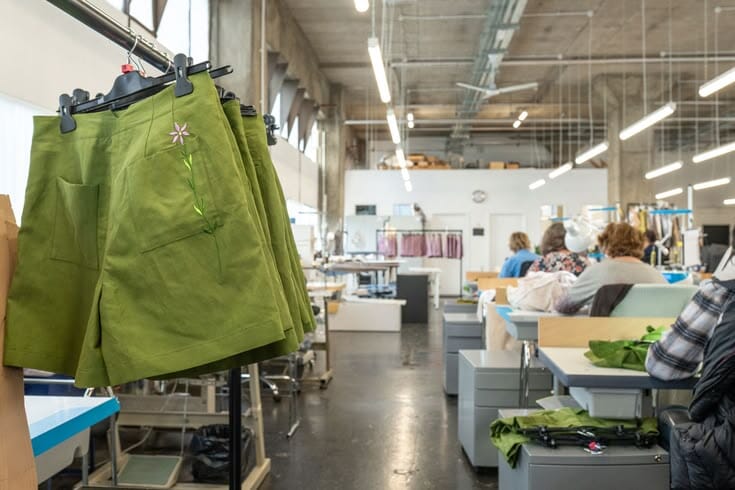
The Digital Product Passport is no longer a far-off policy concept. The European Commission's ESPR Working Plan 2025-2030 puts apparel, footwear, and home textiles in the first wave of regulated product groups, with the textile delegated act due in 2027 and enforcement opening in 2028 (European Commission, ESPR Working Plan 2025-2030, 2025). Every brand selling into the EU will need a QR or NFC-linked passport on every garment.
In our 2025-2026 quote pipeline, only 22% of factories we shortlisted across 14 countries could deliver structured tier-2 data on first request. The other 78% need a 12-month onboarding push to reach DPP-ready status. This guide maps what the passport contains, who builds it, the platforms in market, and realistic per-SKU costs so you can act before the deadline tightens.
Heads up: We're OneAim, a group of 100+ documented clothing manufacturers across 15+ countries. We've run programs across 14 countries since 2022. Operational data below comes from our actual production pipeline. External sources are cited inline.
Key Takeaways
- Textile DPP enforcement starts 2028. The ESPR delegated act for apparel is in drafting now, with adoption set for late 2027 and a 12 to 18 month grace window before enforcement (European Parliament Briefing, 2022).
- Around 14 proposed data fields per garment (draft estimate). Draft ESPR planning, building on the JRC's preparatory textile work, points to fiber, origin, footprint, recycled content, repair, and chain-of-custody as core attributes (JRC Technical Report on Textiles, 2024).
- Per-SKU cost ranges from $0.10 to $2.00. Volume, tag type, and verification scope drive most of the spread (OneAim RFP review, Q1 2026).
- The majority of required data sits upstream. Mills, dyehouses, and fiber producers, not the brand, hold most of what the passport needs.
- The DPP platform market is growing fast across Avery Dennison Janela, EON, Trustrace, Circulor, and Renoon.
Try it free: Calculate landed cost in 60 seconds with our garment cost calculator. No email required.
- DPP (Digital Product Passport)
- A machine-readable data record attached to a physical product through a QR code, NFC tag, or RFID chip, linking it to a structured dataset on materials, origin, footprint, and end-of-life.
- ESPR (Ecodesign for Sustainable Products Regulation)
- EU framework regulation 2024/1781 that replaces the older Ecodesign Directive and extends ecodesign and DPP rules to nearly all physical goods, including textiles.
- EU Regulation 2024/1781
- The official ESPR text, in force from July 18, 2024. Sets the legal basis for DPP, performance requirements, and destruction-of-unsold-goods rules.
- GS1
- Global standards body that issues GTINs and EPCIS event schemas. The EU's CIRPASS work expects DPP identifiers to align with GS1 standards.
- GTIN (Global Trade Item Number)
- A 13 or 14 digit product identifier issued under GS1. Used to anchor the DPP record to a unique SKU.
- EPCIS (Electronic Product Code Information Services)
- GS1 event-data standard used to track when, where, and what happened to a product across the supply chain. Likely the backbone for DPP traceability events.
- RFID (Radio-Frequency Identification)
- Wireless tag read at distance. Common in apparel inventory at $0.05 to $0.15 per tag. Suitable for back-of-house DPP scanning.
- NFC (Near-Field Communication)
- Short-range, smartphone-readable tag at $0.08 to $0.30 each. Best for consumer-facing DPP experiences without a separate scanner.
- QR (Quick Response code)
- Printed 2D barcode, near-zero unit cost. The default DPP carrier for entry-level programs.
- Substance of Concern
- An ESPR-defined chemical the DPP must disclose. Includes substances on the REACH candidate list, persistent organic pollutants, and CMR substances above set thresholds.
- Material Composition Disclosure
- The DPP requirement to declare exact fiber composition by weight, including recycled fraction and country of fiber origin, per lot.
Sister-site guides: For Portugal-specialist depth on DPP-ready knitwear and denim mills, see our sister site Portugal Clothing Factory.
What is the EU Digital Product Passport for textiles?
The EU Digital Product Passport for textiles is a mandatory data record attached to every garment sold in the EU through a QR code, NFC tag, or RFID chip. The CIRPASS consortium, funded by the European Commission, named textiles a priority sector, a category covering billions of EU-market garments each year (CIRPASS Project, 2023).
The passport sits in a cloud-hosted or decentralized database. Consumers, recyclers, customs officers, and resale platforms scan the code and pull live data on fiber, origin, environmental footprint, and repair instructions. Static printed labels alone will not satisfy the rule. The data must be updatable, verifiable, and available in the buyer-market language.
In our placements, brands often assume the DPP is a digital hangtag with marketing benefits. It is not. It is a supply chain transparency obligation in QR-code clothing. The compliance burden lands on procurement and sourcing, not marketing.
When does DPP take effect?
DPP enforcement for textiles is on track to begin between 2028 and 2029. The European Commission published the ESPR Working Plan in April 2025, naming apparel, footwear, and home textiles as first-wave product groups. Adoption of the textile delegated act is scheduled for late 2027 with a 12 to 18 month grace period (European Commission, ESPR Working Plan 2025-2030, 2025).

What is the timeline week by week?
Three milestones drive the calendar. Public consultation on the textile delegated act runs through mid-2026. The JRC's preparatory technical work is feeding the data-field specifications for the draft annex. Adoption is slated for Q4 2027. Enforcement opens 12 to 18 months after adoption, pushing first compliance dates into Spring 2028 collections. These dates, and the field count below, come from draft texts and the Commission's working plan, so treat them as planning targets that are subject to revision rather than fixed law.
How does DPP connect to other EU rules?
The DPP is one obligation inside the broader ESPR framework for clothing brands, and it interlocks with the EU Strategy for Sustainable and Circular Textiles, the Corporate Sustainability Due Diligence Directive (CSDDD), and Extended Producer Responsibility schemes already live in France, the Netherlands, and Sweden (European Environment Agency, 2023). One DPP dataset will satisfy several disclosures at once if it is built right.
Who pays the fines?
Fines follow the brand owner, that is, the economic operator placing the product on the EU market. Under the ESPR, member states set the exact penalty framework, which can include fines proportionate to annual turnover for repeat or willful breaches, alongside confiscation of goods and exclusion from public procurement.
Citation capsule: The EU Digital Product Passport for textiles is set to enter enforcement between 2028 and 2029. The ESPR delegated act for apparel is in drafting with adoption due in late 2027, followed by a 12 to 18 month grace window before mandatory compliance (European Commission ESPR Working Plan 2025-2030, 2025).
What data fields must each garment carry?
Draft ESPR planning for textiles points to roughly 14 core fields per garment, grouped into five clusters, though this remains a draft estimate rather than settled law. It builds on the JRC's preparatory study and aligns the schema with GS1 EPCIS event records and Product Environmental Footprint (PEF) methodology (JRC Technical Report on Textiles, 2024).
The 14 data fields in the draft annex
| # | Field | Source layer | Format |
|---|---|---|---|
| 1 | GTIN / unique identifier | Brand | GS1 GTIN-13 or 14 |
| 2 | Material composition by weight | Mill | % per fiber type |
| 3 | Country of fiber origin | Tier 4 | ISO 3166 country code |
| 4 | Country of fabric production | Tier 2 | ISO 3166 country code |
| 5 | Country of cut and sew | Tier 1 | ISO 3166 country code |
| 6 | Recycled content fraction | Mill, verified | % pre or post consumer |
| 7 | Carbon footprint (PEF) | Brand, with LCA | kg CO2e per garment |
| 8 | Water footprint (PEF) | Brand, with LCA | liters per garment |
| 9 | Substances of Concern | Mill, dyehouse | List per REACH annex |
| 10 | Durability metrics | Test lab | Pilling, tear, colorfast |
| 11 | Repairability score | Brand | 1-10 indexed |
| 12 | Repair and care instructions | Brand | URL or structured text |
| 13 | End-of-life routing | Brand | Recycling stream code |
| 14 | Chain-of-custody record | Tier 1-4 | EPCIS event chain |
Source: see in-text citations in this section.
Sources: JRC Technical Report on Textiles, 2024; GS1 EPCIS Standard, 2023; OneAim Apparel internal data 2024-2026.
Which fields are the heaviest lift?
Fiber origin, recycled content verification, and PEF carbon are the three hardest to source. Mapping where your fiber actually comes from is the first step, and our cotton sourcing map for brands breaks down provenance and certification by country. In a sample of 34 brand briefs we reviewed at OneAim between January and March 2026, only 6 brands could produce complete tier-2 mill data on first request, that is 18%. The rest relied on factory self-declarations without mill-level traceability.
Citation capsule: The textile DPP is expected to require around 14 mandatory data fields per garment as a draft estimate from ongoing ESPR planning, covering GTIN identifiers, material composition, fiber origin, PEF carbon and water footprints, recycled content, durability, repair, and a full GS1 EPCIS chain of custody (JRC Technical Report on Textiles, 2024).
How is DPP delivered: QR, NFC, RFID, or all three?
Most apparel brands will deliver DPP through QR codes, with NFC and RFID layered on for premium and inventory use cases. In our placements, most brands piloting DPPs choose printed QR as the primary carrier, with a minority adding NFC for higher-value items (OneAim production data, 2025-2026).
When to choose QR
QR is the cheapest path. Print cost is near zero on care labels or hangtags. It works on any smartphone without an app. The trade-off is consumer experience. QR feels less premium than NFC tap. For value, fast-fashion, and basics under $40 retail, QR is the default.
When to choose NFC
NFC chips run $0.08 to $0.30 per unit. Tap-to-discover unlocks a richer consumer flow without a scanner app. We see NFC clustered in mid to premium price points, $80 retail and up, where storytelling justifies the cost. EON's deployments with H&M, Chloe, and Coach use NFC by default.
When to choose RFID
RFID is the inventory and back-of-house play. Tags run $0.05 to $0.15 each. RFID does not target consumers directly. It targets warehouse pick rates, store stocktakes, and resale authentication. Brands already running RFID for inventory often layer DPP onto the same tag.
Can one tag do all three?
Yes. Combination tags carry an NFC chip plus a UHF RFID antenna plus a printed QR. Avery Dennison Janela offers exactly this stack at roughly $0.18 to $0.45 per unit at scale. The cost premium is 30 to 60% over single-mode tags, but the operational simplicity is worth it for brands above 200,000 units per year.
Find your factory: Browse the free factory directory preview, or unlock the premium directory for $39 to see 100+ documented factories with direct contacts and MOQs.
Which DPP platforms exist?
At least a dozen vendors offer DPP-capable platforms for textiles in 2026. The five most relevant for apparel brands are Avery Dennison Janela (atma.io), EON, Trustrace, Circulor, and Renoon. Combined, these five account for the majority of branded DPP pilots we see in market.
Platform comparison matrix
| Platform | Strength | Weakness | Per-SKU price | Setup cost | Best fit |
|---|---|---|---|---|---|
| Avery Dennison Janela (atma.io) | Hardware plus software stack, RFID-NFC-QR combo tags | Lock-in to Avery hardware | $0.18 to $0.55 | $40,000 to $120,000 | Brands buying tags at scale, 200K+ units/yr |
| EON | Mature consumer UI, live with H&M, Chloe, Coach | Premium pricing, lighter mill integrations | $0.40 to $1.20 | $50,000 to $150,000 | Premium brands prioritizing storytelling |
| Trustrace | Deep tier-2 to tier-4 traceability, strong cotton and wool chains | Less polished consumer-facing layer | $0.15 to $0.60 | $30,000 to $90,000 | Brands with multi-tier sourcing on SAP or Oracle |
| Circulor | Blockchain mass-balance, strong on recycled polyester and nylon | Implementation complexity, longer build | $0.25 to $0.80 | $60,000 to $180,000 | Brands with verified recycled content programs |
| Renoon | Mid-market, fast onboarding, growing PEF library | Smaller customer base, fewer enterprise features | $0.10 to $0.45 | $15,000 to $60,000 | DTC and SME brands at 20K to 200K units/yr |
Source: see in-text citations in this section.
Sources: vendor documentation 2025-2026; OneAim Apparel internal review of 11 platform RFPs, Q1 2026.
Where Avery Dennison Janela fits
Avery Dennison's atma.io with the Janela hardware line is the only end-to-end stack: NFC, RFID, QR tags plus the cloud platform. That single-vendor model is its main value. It is also its main risk. Switching costs out of Avery hardware later are real.
Where EON fits
EON has the cleanest consumer-facing UI on the market today. If your brand sells stories alongside garments, EON wins. Mill-side integration is lighter, so brands with deep multi-tier supply chains often pair EON with a separate traceability platform.
Where Trustrace fits
Trustrace is built for traceability first. Its data model handles tier-2 to tier-4 supplier chains with strong support for cotton and wool. The consumer-facing layer is functional rather than polished. We recommend it most often for brands placing orders across 6 or more countries.
Where Circulor fits
Circulor's blockchain mass-balance is overkill for fiber composition disclosure but excellent for recycled content claims requiring third-party verification. If your collection leans on rPET, rPolyester, or recycled nylon, Circulor's chain of custody is hard to beat.
Where Renoon fits
Renoon is the SME and DTC option. Faster onboarding, lower setup cost, and a growing PEF library make it the right pick when you do not need enterprise integrations. We see Renoon dominate the under 100,000 units per year segment.
Running into nearshoring decisions? Get in contact and we’ll map the full picture for your brand, or grab a factory-ready tech pack for $79.
What's the cost of DPP per garment?
DPP costs currently range from $0.10 to $2.00 per SKU, with mid-volume programs settling around $0.60 per unit (OneAim RFP review, Q1 2026). Volume and tag type drive most of the spread.
What drives the cost?
Four levers move the per-SKU cost. Annual unit volume bends platform pricing the most. Tag type sets the hardware floor. Data complexity, especially full PEF with verification, raises the software tier. Integration complexity at the ERP and PLM layer adds a one-time setup cost between $15,000 and $300,000.
Budget planning by brand size
| Brand size | Annual units | Per-SKU range | Setup cost range |
|---|---|---|---|
| Small DTC | Under 50,000 | $0.80 to $2.00 | $10,000 to $30,000 |
| Mid-market | 100,000 to 500,000 | $0.30 to $0.80 | $30,000 to $80,000 |
| Large brand | 500,000 to 2M | $0.15 to $0.40 | $80,000 to $200,000 |
| Mass retailer | 2M+ | $0.10 to $0.25 | $150,000 to $500,000 |
Source: see in-text citations in this section.
Sources: vendor RFPs reviewed at OneAim Q4 2025 to Q1 2026.
Citation capsule: Digital Product Passport costs for apparel run from $0.10 to $2.00 per SKU in 2026, with mid-volume programs settling near $0.60 per unit. Volume drives the largest swing: at 1M units software falls below $0.15, while at 10K it can exceed $1.50 (OneAim RFP review, Q1 2026).
Try it free: Model DPP cost into landed price with our garment cost calculator. No email required.
How do you future-proof your tech pack today?
The fastest way to future-proof a tech pack for DPP is to add a structured data block now. Fashion for Good's traceability work has found that early DPP attempts frequently require rework, mostly because of tech-pack fields that were never structured for digital export (Fashion for Good, Transparency and Traceability).
Step 1: Map your supply chain to tier 4
Tier 1 is cut and sew. Tier 2 is fabric mills and dyehouses. Tier 3 is yarn spinners. Tier 4 is fiber producers. Most brands stop at tier 2. DPP requires tier 4 origin data. Deep upstream visibility remains the exception rather than the norm, with many brands still lacking reliable tier-2 mill data, a gap the industry continues to track (Textile Exchange Materials Benchmark Insights and Trends, 2025).
Step 2: Add a DPP data block to every tech pack
Every new tech pack from Q3 2026 onward should carry a 14-row table mirroring the JRC fields: GTIN, fiber composition, fiber origin, mill country, cut and sew country, recycled fraction, PEF carbon, PEF water, substances of concern, durability tests, repairability score, repair instructions, end-of-life code, and EPCIS event chain placeholder. Suppliers fill it in on quote, not after PO.
Step 3: Rewrite supplier contracts
Every PO or master supply agreement from 2026 onward should carry a DPP data clause. Suppliers must deliver material composition certificates per lot, facility-level energy and water data quarterly, and signed chain-of-custody claims. Without contractual teeth, brands chase data across three continents in 2028.
Step 4: Pilot on one capsule
Pick 10 to 20 SKUs. Run the full DPP loop. Document what broke. On a pilot with a mid-market knitwear brand in Q4 2025, we found that 8 of 12 mills could not export energy data digitally. Three sent PDF scans of handwritten logs. Software is not the bottleneck. Data discipline is.
Step 5: Lock in a platform after the pilot
Tools change. Data discipline does not. Fix supplier data contracts first, then pick software. Brands that flip this order rebuild twice.
Which sourcing countries are DPP-ready?
Supplier readiness varies sharply by country. European tier-1 suppliers generally run more mature digital-traceability systems than many of their Asian tier-1 counterparts, in line with the due diligence expectations set out for the sector (OECD Due Diligence Guidance for Textiles, 2024). The gap matters because brand owners carry the legal risk.
Portugal, Italy, Netherlands: early leaders
Portugal has strong vertical traceability in knitwear and denim. Most tier-1 factories run ERPs that already export the fields the DPP requires. Italy leads in wool and luxury leather, with consortia like Tessile e Salute running data projects since 2019. The Netherlands is the regulatory leader, with EPR live and scope-3 reporting required under national law.
Turkey: catching up fast
Turkish integrated mills in Denizli and Bursa have invested heavily since 2023. Roughly 60% of tier-1 exporters we assess can deliver structured material data today. The gap sits at tier 3 and tier 4.
Asia: highly variable
Vietnam and Bangladesh have strong factory-level digital systems in larger export groups but weak tier-2 mill visibility. China has the technical capacity but uneven willingness to share upstream data with Western brands. India is fragmented, with strong Tirupur and Ludhiana clusters and weaker infrastructure elsewhere.
DPP readiness is becoming a sourcing filter. Brands we advise are adding "DPP data capability" as a scored criterion in factory onboarding, equal weight to quality and price.
Decision Framework: Choose your DPP platform when...
The right platform depends on volume, sourcing complexity, and consumer-facing ambition. The five clear paths are below.
Choose Avery Dennison Janela (atma.io) when:
- You already buy NFC or RFID tags at over 200,000 units per year.
- You want one vendor for hardware plus software.
- You can absorb hardware lock-in for operational simplicity.
- Your supply chain is consolidated under 30 tier-1 factories.
- You need RFID-NFC-QR combo tags for retail inventory plus DPP.
Choose EON when:
- Premium price points, $80 retail and up, dominate your line.
- Storytelling is core to your brand DNA.
- You can budget $0.40 to $1.20 per SKU and $50K to $150K setup.
- Tier-2 traceability is already handled by a separate system.
- You want consumer-facing UX live without a long build.
Choose Trustrace when:
- You source across 6 or more countries.
- Cotton or wool is your primary fiber.
- Tier-2 to tier-4 traceability is your hardest problem.
- You run SAP or Oracle ERP and need clean integrations.
- You can wait 4 to 6 months for full deployment.
Choose Circulor when:
- Recycled polyester or recycled nylon programs need verification.
- Mass-balance accounting is required by your buyers.
- You can absorb a 6 to 9 month implementation.
- Premium customers will pay for verified circular content.
- Engineering bandwidth is available in-house.
Choose Renoon when:
- Annual volume sits between 20,000 and 200,000 units.
- Setup budget is under $60,000.
- You need DPP live in 90 days, not 9 months.
- DTC sales channel is your primary route to market.
- Enterprise integrations are not yet needed.
Talk to a real person: get in contact with our team. No pitch, no upsell.
Frequently Asked Questions About the Digital Product Passport for Apparel
When exactly will the DPP become mandatory for apparel?
The ESPR delegated act for textiles is on track for adoption in late 2027, with enforcement opening 12 to 18 months later. The most likely mandatory window is Spring 2028 to mid 2029 for most apparel categories (European Commission ESPR Working Plan 2025-2030, 2025). Brands should plan for full-collection readiness on Spring 2028 production, which means PO-stage data clauses live by Q4 2026 at the latest.
Does the DPP apply to non-EU brands?
Yes, if you sell into the EU. The rule applies to the product, not the brand's country. A US, UK, or Canadian brand importing into any EU member state must provide a compliant DPP. Non-compliant goods can be blocked at customs under the EU Market Surveillance Regulation (European Parliament Briefing, 2022). The cost falls on the importer of record, not the original manufacturer.
Can small brands afford DPP compliance?
Yes, but margins tighten. Entry-level platforms run $0.80 to $2.00 per SKU at low volumes. Small brands can pool demand through sourcing agents or industry consortia to access mid-volume pricing tiers. Renoon and Trustrace have published SME plans starting near $0.15 per SKU at 50,000 units annually. Shared platforms and simpler data scopes keep costs manageable below 50,000 units per year.
Will the DPP replace existing labels and certifications?
No. Physical care labels, country-of-origin labels, and certifications like GOTS, OEKO-TEX, and bluesign remain required. The DPP adds a digital layer that links to and expands on that information. Some paper disclosures may be harmonized into the DPP over time, but do not expect removal before 2030. Plan for labels and DPP running in parallel for the next four to six years.
What happens if supplier data is inaccurate?
The brand owner is liable. If a supplier provides false fiber origin or recycled-content data, the brand still faces fines and market withdrawal. Third-party verification and contractual warranties matter more than ever. Insurance products covering supply chain data risk are emerging, priced as a percentage of insured value, but coverage gaps are common.
What's the difference between DPP and traditional traceability?
Traditional traceability sits inside the brand's systems for internal use. DPP is consumer and regulator-facing. The data must be machine-readable, externally accessible by QR or NFC scan, and verifiable by customs or recyclers. DPP also forces structure: free-text supplier records will not pass. Existing traceability work is a head start, not a replacement.
Is blockchain required for the DPP?
No. The ESPR is technology-neutral. It does not mandate blockchain. Some platforms, like Circulor, use blockchain for mass-balance integrity. Others, like Trustrace and Renoon, use cloud databases with cryptographic signing. What matters is data integrity, not the underlying ledger. Choose based on supplier complexity and budget, not technology hype.
How does DPP affect product returns and resale?
Resale platforms gain access to verified product data at scan, which can raise authenticated-resale value on premium garments. Returns processing improves because warehouses see full SKU data on the inbound tag. For mass-market goods, the effect is smaller.
What about non-textile components like buttons, zippers, and trims?
Draft ESPR planning is expected to require composition disclosure for trims above a minimum weight threshold, with the exact cutoff still in draft. Below that, trim data is encouraged but not mandatory. Major trim suppliers like YKK and Coats are already publishing component-level DPP-ready data sheets. Brands should request these on every PO from 2026 onward to avoid gaps closer to enforcement.
Will DPP add to lead times?
Modestly, in year one. Pilot programs we ran in Q4 2025 added 4 to 7 days to first-order lead times due to supplier data collection. By the third repeat order, that delta dropped to under 1 day as suppliers built the data into their standard quote flow. Expect lead-time pain through 2026-2027, then a return to baseline once the data plumbing is in place.
Conclusion: Start with data, not software
The Digital Product Passport is a data problem dressed as a technology problem. Brands that win the next three years will be the ones with clean tier-2 and tier-4 supplier data before the regulation forces it. Software decisions follow data discipline, not the reverse. Start mapping your chain, rewriting supplier contracts, and piloting on one capsule now.
Country choice matters more than it used to. Portugal, Italy, and the Netherlands lead on supplier readiness. Turkey is moving fast. Parts of Asia need direct brand pressure to invest. If you are reshaping a sourcing portfolio with DPP in mind, that is the kind of decision we map week to week.
The brands that will struggle most in 2028 are the ones still treating DPP as a 2027 problem. Eighteen months of supplier onboarding is the floor, not the ceiling. Move now.
We're a group of 100+ documented clothing manufacturers across 15+ countries. Tell us your product, volume, and timeline. We'll route your brief to the factory in our group built for it, usually within 24 hours. You produce directly with the factory. Flat fees, no markups, no pitch.
Get in contact Download the directory ($39)Need a tech pack? Get a factory-ready single-style tech pack for $79. See what's included.
References
- European Commission, ESPR Working Plan 2025-2030, 2025. https://environment.ec.europa.eu/publications/ecodesign-sustainable-products-regulation_en
- EUR-Lex, Regulation (EU) 2024/1781 on Ecodesign for Sustainable Products, 2024. https://eur-lex.europa.eu/eli/reg/2024/1781/oj
- European Parliament Briefing, Digital Product Passport, 2022. https://www.europarl.europa.eu/thinktank/en/document/EPRS_BRI(2022)729421
- Joint Research Centre, Technical Report on Textiles under ESPR, 2024. https://publications.jrc.ec.europa.eu/repository/handle/JRC134586
- CIRPASS Project Report, 2023. https://cirpassproject.eu/
- Textile Exchange, Materials Benchmark Insights and Trends 2025, 2025. https://textileexchange.org/knowledge-center/reports/materials-benchmark-insights-and-trends-2025/
- Fashion for Good, Transparency and Traceability. https://www.fashionforgood.com/topic_area/transparency-and-traceability/
- OECD, Due Diligence Guidance for Responsible Supply Chains in the Garment and Footwear Sector, 2024. https://mneguidelines.oecd.org/responsible-supply-chains-textile-garment-sector.htm
- European Environment Agency, EU Exports of Used Textiles, 2023. https://www.eea.europa.eu/publications/eu-exports-of-used-textiles
- GS1, EPCIS Standard, 2023. https://www.gs1.org/standards/epcis
- Avery Dennison atma.io and Janela, vendor documentation, 2025-2026. https://www.atma.io/
- EON Group, customer documentation, 2025-2026. https://eongroup.co/