Boutique clothing manufacturers are not smaller versions of big factories. They are a different business, built so a 30-piece order still pays for itself. Over 76% of US apparel manufacturing establishments (NAICS 315) had fewer than 10 employees, while only 0.7% had more than 500 (USFIA, analysis by Dr. Sheng Lu of U.S. Census data, 2021 data published 2025). Small shops are the norm, not the exception.
This directory profiles 8 boutique manufacturers in the USA that publish, or openly market, low minimums per style: seven in the Los Angeles area and one in New York. Every figure comes from the factory's own site, checked 26 October 2026, and is hedged where the factory hedges.
Heads up: We're OneAim, a group of documented United States clothing factories. The companies below are independent factories listed on public sources, not members of our group. OneAim's role is separate: we place your production with a documented cut-and-sew manufacturer in our group built for your product.
Key Takeaways
- "Boutique" means small runs, not luxury. It describes a line set up for 10 to 150 pieces per style, not a price tier.
- Published minimums start around 10 to 25 pieces. The Evans Group quotes 10 to 50 per style, Grace Apparel from 20, ARGYLE Haus from 25, all self-reported.
- Small shops dominate US apparel. Over 76% of establishments have fewer than 10 employees (USFIA, 2021 data).
- The fabric minimum, not the sewing minimum, is what usually stops you. Mill and dye-lot floors sit far above a 50-piece run.
- CMT and full-package minimums differ. Bomme Studio's CMT minimum is 150 units per style; its full-package minimum is 600, which is no longer boutique.
Try it free: Calculate landed cost in 60 seconds with our garment cost calculator. No email required.
What does "boutique" actually mean in manufacturing?
It means the line is configured for small runs, and nothing else. It's not a statement about quality, price tier, or luxury. A boutique factory is one whose setup costs (marker-making, cutting, machine changeover) are structured so a 30-piece order still makes commercial sense. A volume factory can make the same garment, often better, but its economics collapse below a few hundred units.
The word also gets used as a marketing skin: plenty of factories call themselves boutique while quoting 600-unit full-package minimums. The only test that counts is the published per-style number and which service it applies to.
How did we choose these manufacturers?
We only included companies whose low-minimum positioning is publicly documented: a number on their own site or a directory listing we could check. Every profile is sourced to the page the claim came from, checked 26 October 2026. Where a factory publishes two different figures, or markets "low MOQ" without a number, we say so instead of inventing one.
We didn't rank them, because the right boutique factory depends on your garment and whether you supply fabric. A directory padded with unverifiable numbers isn't a directory; it's a guess.
Which US boutique factories publish the lowest minimums?
Six of the eight publish a specific number, from 10 to 150 pieces per style. The other two market "low minimums" without committing to a figure, which is common and not disqualifying. But it means you learn the real floor only after you send a tech pack.
The Evans Group (Los Angeles, CA)
TEG runs small-batch and couture-level cut and sew, pattern making, sampling, fabric sourcing, and designer mentorship, plus blank-label production. It quotes 10 to 50 pieces per style, the lowest published floor here, and positions low minimums as a service to emerging designers. That range is self-reported and the real floor moves with garment complexity. Best for a first collection where pattern work matters more than unit price.
Grace Apparel Production (New York City, NY)
Based at 270 W 39th St in the Garment District, Grace runs full-package production across knits, denim, woven, silk, leather, swimwear, lingerie, and bridal: design, patterns, grading, marking, cutting, sewing. It states orders from 20 to 1,500 units per style. The 20-unit floor is self-reported, and the company is also listed in the CFDA Production Directory. It says it works with many factories and produces in New York City and overseas, so ask where your run will be sewn.
ARGYLE Haus of Apparel (San Fernando, CA)
ARGYLE Haus covers design, development, and small-batch manufacturing across menswear, womenswear, athletic wear, lingerie, outerwear, uniforms, and swimwear. Its production facility is in San Fernando, with a showroom in The New Mart building in downtown Los Angeles. It says a standardized costing model makes runs "as low as 25 pieces" affordable, and that it does not outsource any part of its work. Treat 25 as a floor, not a promise for every garment type.
Sam Studios Los Angeles (Los Angeles, CA)
A downtown LA company covering cut and sew, screenprinting, embroidery, private labeling, finishing, product development, and product photography. Its home page states a minimum of 48 pieces per style, and its production page lists per-service minimums: 48 pieces for label sewing and 36 for poly-bagging and screenprinted neck labels. It says all production is done in Southern California and that most orders are fulfilled in 10 to 15 business days.
Essentials Made (Los Angeles, CA)
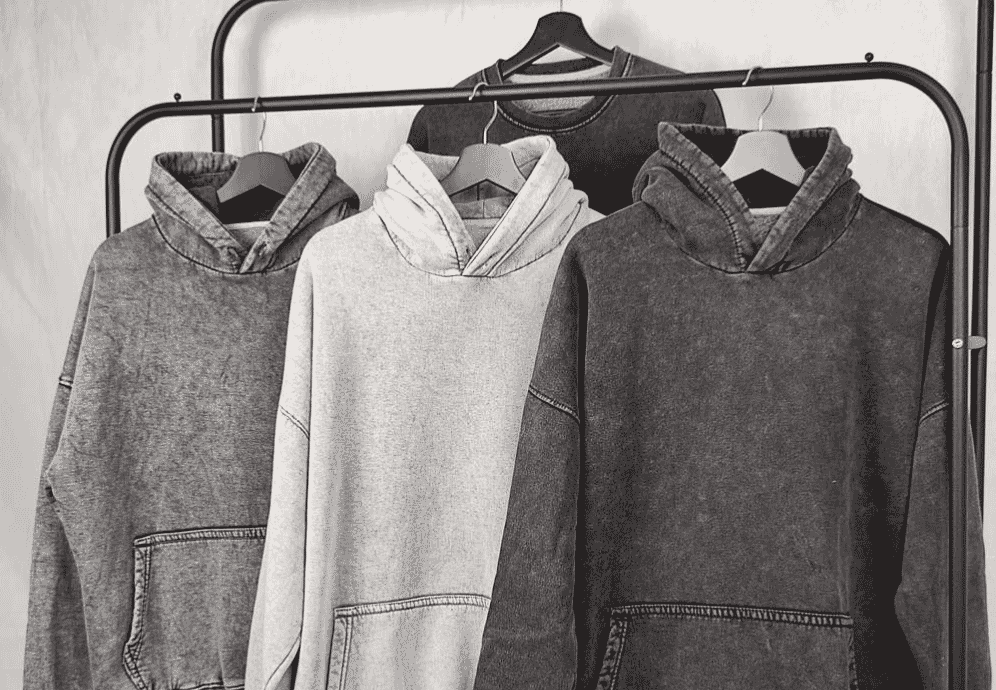
Custom 100% cotton, garment-dyed essentials: hoodies, sweatpants, crewnecks, tees, sets, and activewear. Its Los Angeles page gives a worked example of two styles at 72 pieces each sharing one fabric and one dye lot, and says programmes run from small capsule batches up to standard 300-piece runs depending on fabric and dye lot. It publishes no single minimum, so confirm yours in writing. Paid development typically costs $600 to $900 per style, samples take about two weeks, and production needs a 50% deposit.
Bomme Studio (Los Angeles, CA)
Bomme runs cut, make, and trim (CMT) in its Los Angeles facility for brands with production-ready samples. Its CMT minimum is 150 units per style, with a maximum of two colours per style, and you supply all fabrics, trims, and labels. Its full-package programme is a separate service with a 600-unit minimum per style, made overseas, so only the CMT line counts as boutique here.
Make It LA (Los Angeles, CA)
Cut and sew, full-package production, private labeling of print-ready dyed blank tees, and fabric sourcing, plus US-made French terry sold by the roll or the yard. Its Maple Ave facility in Los Angeles is by appointment only, and it quotes from a tech pack or a detailed visual. It states "low minimums per style/design" but publishes no number, so we don't attach one to it.
Full Speed 100 (Los Angeles, CA)
A downtown LA cut-and-sew and private-label operation with fabric and trim sourcing, embroidery, screen print, DTG, and sublimation, on a made-in-USA position. It advertises "low minimums" and "no-to-low MOQ" on branding applications, but no number appears on its homepage. Assume nothing until you hold a written quote against your tech pack.
What minimums look like at boutique factories
Why does a lower MOQ cost more per unit?
Because the fixed costs of a run don't shrink with the run. Pattern making, grading, marker making, machine setup, and threading a line for your garment cost roughly the same at 30 pieces as at 3,000. Spread across 30, that setup lands on every unit. Spread across 3,000, it disappears. That's arithmetic, not a factory punishing you.
Fabric compounds it. Small runs rarely qualify for mill pricing, so you buy at stock-fabric or jobber rates and often pay for more yardage than you consume. Expect your unit cost at 50 pieces to sit well above the price a competitor quotes at 1,000. Price from your actual cost sheet, not a benchmark you saw online.
What is the fabric-minimum trap?
The trap is assuming the sewing minimum is the only minimum. A factory may happily cut 30 pieces. But the mill that weaves the fabric and the dye house that colours it set their own floors. Those are routinely written in hundreds or thousands of metres per colour, far more than a 50-piece run consumes. Your sewing MOQ is 30; your fabric MOQ can be an order of magnitude higher.
How the fabric minimum shapes low-MOQ factories
That one constraint explains how low-MOQ factories operate. It's why they steer you toward stock fabric, deadstock, house blanks, or shared dye lots. Look again at Essentials Made: its worked example is two styles of 72 pieces each sharing one fabric and one dye lot. Sharing the lot spreads the dye house's minimum across your styles. So the sharper question isn't "what's your MOQ?" but "which fabrics can I get at my quantity?"
How do you get a boutique factory to say yes?
Arrive specified. A small factory's scarcest resource is development time, and a small order can't pay for much of it. Brands that get accepted send a complete tech pack with a bill of materials, graded measurements, stitch and seam callouts, trims, and labelling, plus a reference garment. Make It LA quotes from a tech pack. Most of the others will too.
Be easy to work with
Then be easy to work with. Pay for sample rounds, keep your colour and size grid tight (Bomme, for example, allows a maximum of two colours per style on CMT), accept stock or deadstock fabric where it fits, and consolidate styles onto shared dye lots.
Citation capsule: Low minimum order quantities cost more per unit because setup costs (pattern making, grading, marker making, and machine changeover) are fixed per run rather than per unit. Fabric compounds the effect: mill and dye-lot minimums sit far above what a small run consumes, so boutique factories steer brands toward stock fabric, deadstock, or shared dye lots across multiple styles.
The most common failure in boutique sourcing
Is a US boutique factory the right choice at all?
Often, yes, and the reason is structural rather than patriotic. US textile and apparel manufacturing employment fell to 270,700 in 2024, down 18.4% from 2019 (USFIA, citing BLS). What survived skews small: sample-room and short-run capacity, which is exactly what a small brand needs.
The trade-off is unit cost. Domestic boutique production buys short lead times (Sam Studios quotes most orders at 10 to 15 business days), in-person sample reviews, and no duty or freight exposure, at a higher price per garment. Overseas production can cost less per unit, but it adds freight, duty, and distance from your samples. Pick your risk, then read where to manufacture clothing.
Frequently Asked Questions About Boutique Clothing Manufacturers
What is a boutique clothing manufacturer?
A factory configured for small per-style runs rather than volume. It's a production model, not a quality tier. Published minimums at verified boutique factories in 2026 run from 10 pieces per style at The Evans Group in Los Angeles up to 150 for CMT at Bomme Studio, with most between 20 and 72.
What is the lowest MOQ for clothing manufacturing?
Among factories that publish a number, The Evans Group in Los Angeles quotes 10 to 50 pieces per style, and Grace Apparel Production in New York states a range starting at 20 units.
Why is low-MOQ production more expensive per unit?
Because setup costs are fixed per run, not per unit. Pattern making, grading, marker making, and machine changeover cost roughly the same at 30 pieces as at 3,000, so on a 30-piece run they land heavily on each garment. Small runs also miss mill fabric pricing.
Can I really get 50 pieces made?
Yes, if the fabric cooperates. Sam Studios states 48 pieces per style and ARGYLE Haus states minimums as low as 25. The binding constraint is usually the mill or dye-house floor, which sits far above what a 50-piece run consumes. That's why low-MOQ factories work from stock fabric or shared dye lots.
What's the difference between CMT and full-package minimums?
They're different numbers at the same factory. In CMT you supply fabric and trims and the factory cuts, makes, and trims. Bomme Studio's CMT minimum is 150 units per style, but its full-package minimum, where the factory sources materials too, is 600. Always ask which service the quoted minimum applies to.
How do I get a small factory to accept my order?
Send a complete tech pack with a bill of materials, graded measurements, and trim callouts, plus a reference garment. Development time, not sewing capacity, is what a boutique factory can least afford to give away on a small run. Pay for sample rounds and stay flexible on fabric.
We're a group of 80 documented clothing manufacturers in the United States. Tell us your product, volume, and timeline. Our team replies within 24 hours and places your production with the factory in our group built for it. You produce directly with the factory. Flat fees, no markups, no pitch.
Get in contact Download the directory ($49)Need a tech pack? Get a factory-ready single-style tech pack for $79. See what's included.
Sources
- USFIA, "The State of U.S. Textile and Apparel Manufacturing, Employment, and Trade", analysis by Dr. Sheng Lu citing U.S. Census and BLS data (2021 establishment data published 2025; 2024 employment data).
- The Evans Group (TEG), small-batch clothing manufacturing, checked 26 October 2026.
- Grace Apparel Production, about, and its CFDA Production Directory listing, checked 26 October 2026.
- ARGYLE Haus of Apparel, small-batch clothing manufacturing, checked 26 October 2026.
- Sam Studios Los Angeles, home page and production, checked 26 October 2026.
- Essentials Made, clothing manufacturers in Los Angeles, checked 26 October 2026.
- Bomme Studio, CMT manufacturing USA and full package production, checked 26 October 2026.
- Make It LA, home page, checked 26 October 2026.
- Full Speed 100, home page, checked 26 October 2026.