Only a handful of companies still cut and sew robes in the United States, and they split into two very different groups. One group makes bathrobes and lounge robes for hotels, spas, gift programmes and retail labels. The other makes robes that never go near a bathroom: academic gowns, judicial robes, choir robes and hospital delivery robes. If you are planning a robe line, the first job is to know which group your product belongs to.
This guide profiles four US robe makers that say on their own websites that they make in the United States and sell to other businesses. We checked each site again in November 2026. Then we cover the decisions that set your cost and your compliance: fabric, fabric weight, collar, flammability rules for adult and children's robes, labels, and the import duty a US-made robe avoids. Every company and number below is listed in the Sources section.
About us: OneAim places and manages production with documented clothing factories in the United States. The companies below are independent robe makers listed on public sources. They are not members of our group. What OneAim does instead: we place your production with a documented factory in our group built for your product.
The short list
- The US robe bench is small. We profile four makers: Robeworks in Los Angeles, The Vermont Flannel Company in East Barre, Vermont, Oak Hall Industries in Roanoke and Salem, Virginia, and Stitch Texas in Austin.
- Hotel robes and retail robes are two businesses. Contract buyers specify weight, shrinkage and industrial laundering. Retail buyers specify drape, hand-feel and the photograph.
- Kids' robes are children's sleepwear in US law. The federal flammability standards for sizes 0 to 6X and 7 to 14 name robes in their definitions, so a kids' robe needs a test plan before it needs a colourway.
- None of the four publishes a minimum order. Robeworks says minimums apply to wholesale orders. Ask early, and give quantities per colour.
- Fibre changes the duty. An imported cotton robe pays a general rate of 7.5% to 8.7%; a polyester (man-made fibre) robe pays 14.9% to 16%, before any extra duties. A robe made in the US pays none.
Free estimate: calculate your landed cost with our garment cost calculator in about a minute. No email needed.
How did we choose these robe manufacturers?
Three tests decided inclusion. First, the company's own website must say that it makes its robes in the United States. Second, it must sell to other businesses: wholesale, private label, custom label, institutional or bulk orders. Third, it must be identifiable at a named US location. We left out listicles, marketplace storefronts and sourcing agents. A directory entry is not proof that a sewing floor exists behind a name.
Those tests removed several well-known hotel robe suppliers. Many sell to the trade from US offices, but their own sites do not say that the robes are made here, so they are not on this list. Where a capability is a company's own claim, we say so. We did not visit the factories, and nobody paid to appear.
We did not rank the four. The right one depends on a single question: are you filling a hotel or spa contract, launching a retail or gift robe, or ordering a specialist robe such as academic, judicial, choir or medical?
| Maker | Where | Robe type | How it sells to businesses | Published minimum |
|---|---|---|---|---|
| Robeworks | Los Angeles, CA | Microfiber outer, terry lining; spa, hooded, kids and wedding styles | Wholesale to hotels, spas, cruise lines and clubs; private label and bulk programmes; in-house embroidery | Not published ("minimum order quantities apply") |
| The Vermont Flannel Company | East Barre, VT | Cotton flannel robes and nightshirts | Wholesale programme with a woven label carrying your brand name | Not published |
| Oak Hall Industries | Roanoke and Salem, VA | Academic, judicial, choir and religious robes | Custom regalia for schools, courts and churches | Not published |
| Stitch Texas | Austin, TX | Maternity delivery robes, medical sewn goods | Design, development and bulk orders for healthcare buyers | Not published |
Which US manufacturers make bathrobes for hotels and brands?
Robeworks (Los Angeles, California)
Robeworks is a domestic robe maker rather than an importer with a US office. Its home page says "Every Robeworks bathrobe is 100% handmade in the USA" and that each one is "designed, cut, and sewn in Los Angeles, California by skilled tailors and seamstresses" (Robeworks). It describes itself as a bathrobe manufacturer and wholesale supplier to luxury hotels, resorts, spas, cruise lines and private clubs since 1995, and it offers "private label and bulk wholesale programs for properties that want a fully customized robe".
The construction is its own design: a microfiber exterior with an absorbent terry lining. The company claims this outlasts traditional cotton or terry robes "by up to three times"; treat that as a supplier claim to test against your own wash protocol, not as a measured fact. Its retail store lists an Original, a Classic, a Hooded, a Short Spa, a Wedding and a Kids robe, which gives you a quick read of the patterns it already cuts.
For wholesale, Robeworks says embroidery is done in-house on its own equipment and that it never outsources embroidery. The wholesale form asks for quantity, style and colour combination, and the page states that "Minimum order quantities apply" without giving a number (Robeworks, wholesale). Best for: a hotel, spa, cruise or private-label programme that wants a terry-lined robe with a logo, made in California.
The Vermont Flannel Company (East Barre, Vermont)
The Vermont Flannel Company was founded by Mark and Linda Baker in East Barre, Vermont in 1991 and became part of USA Brands in 2022. Its story page says "Our teams in the USA hand-cut, sew and inspect all of our products", and describes its cotton flannels as yarn-dyed, tightly woven and brushed on both sides (Vermont Flannel, our story). Robes sit in its sleepwear range next to nightshirts and pajamas.
Its wholesale programme offers a woven logo label "featuring your brand name", with pricing on request (Vermont Flannel, wholesale programme). Be precise about what this is: a US flannel brand that will put your label on its products, not an open cut-and-sew contractor that will make your own pattern. Best for: a retailer, lodge, gift shop or corporate gift programme that wants a US-made flannel robe under its own name without developing one.
Which US manufacturers make specialist robes?
"Robe" also covers garments built for ceremonies, courtrooms and hospitals. They use different cloth, different patterns and different buyers, and they are made by different specialists.
Oak Hall Industries (Roanoke and Salem, Virginia)
Oak Hall says it was founded in Roanoke, Virginia in 1889 and calls itself "one of the world's premier manufacturers of academic, judicial and religious apparel". Its history page lists choir robes from 1960, the 1980 acquisition of the Bentley and Simon Company, which it describes as the robe supplier for the Justices of the US Supreme Court, and a move to a larger facility in neighbouring Salem, Virginia in 1984 (Oak Hall, history).
The same page describes how it kept sewing in Virginia while others left: in 1996 it bought a facility in Wytheville and rehired its 70 employees, and in 2003 it opened a third plant in Chilhowie, adding 100 jobs. Today it lists four sewing facilities and warehouses totalling more than 455,000 square feet, and says it is "dedicated to keeping the textile industry alive in the United States". Best for: schools, universities, courts, churches and choirs that need custom robes made in the US.
Stitch Texas (Austin, Texas)
Stitch Texas describes itself as a female-owned apparel development facility in Austin since 2014. Its service list includes maternity delivery robes, bulk medical scrubs and surgical caps, alongside design consultation, sourcing and development (Stitch Texas, about). Its delivery robe page calls the company a B2B manufacturer with bulk ordering options and says the robes are built to withstand repeated industrial laundering (Stitch Texas, maternity delivery robes).
It publishes no minimum order. Best for: a medical brand, birthing centre or hospital buyer that needs a delivery robe developed, sampled and produced in Texas.
Skip the cold emails: Browse our factory directory for $49, or get in contact and we'll place your production with the domestic factory built for it, usually within 24 hours. Flat fee, no markups.
How big is the robe market, and why do the numbers disagree?
IMARC Group, a market-research publisher, estimates the global bathrobe market at USD 4.2 billion in 2025 and USD 4.5 billion in 2026, and expects it to reach USD 6.5 billion by 2034, a growth rate of 4.89% a year over 2026 to 2034 (IMARC Group). The same report says hotels account for the majority of the market by end user, and cotton for the majority by material.
Read that figure as a paid estimate, not a measurement. Customs data has no single line for "robe". In the US tariff schedule, bathrobes and dressing gowns sit inside four different headings: men's knit, women's knit, men's woven and women's woven garments, and each heading splits again by fibre. Some of those lines share a heading with nightwear and underwear. So every research firm models the gap differently, and published market sizes can differ by billions.
For a brand, the useful takeaway is simpler. Robes are a steady, replacement-driven category, hotels are the biggest buyer, and cotton is the default fibre. Use market estimates to size an opportunity. Do not use them to forecast your own sales.
Terry, waffle, velour, flannel or satin: which robe fabric do you need?
Pick the fabric from the use case, because each one is good at one job and weak at another.
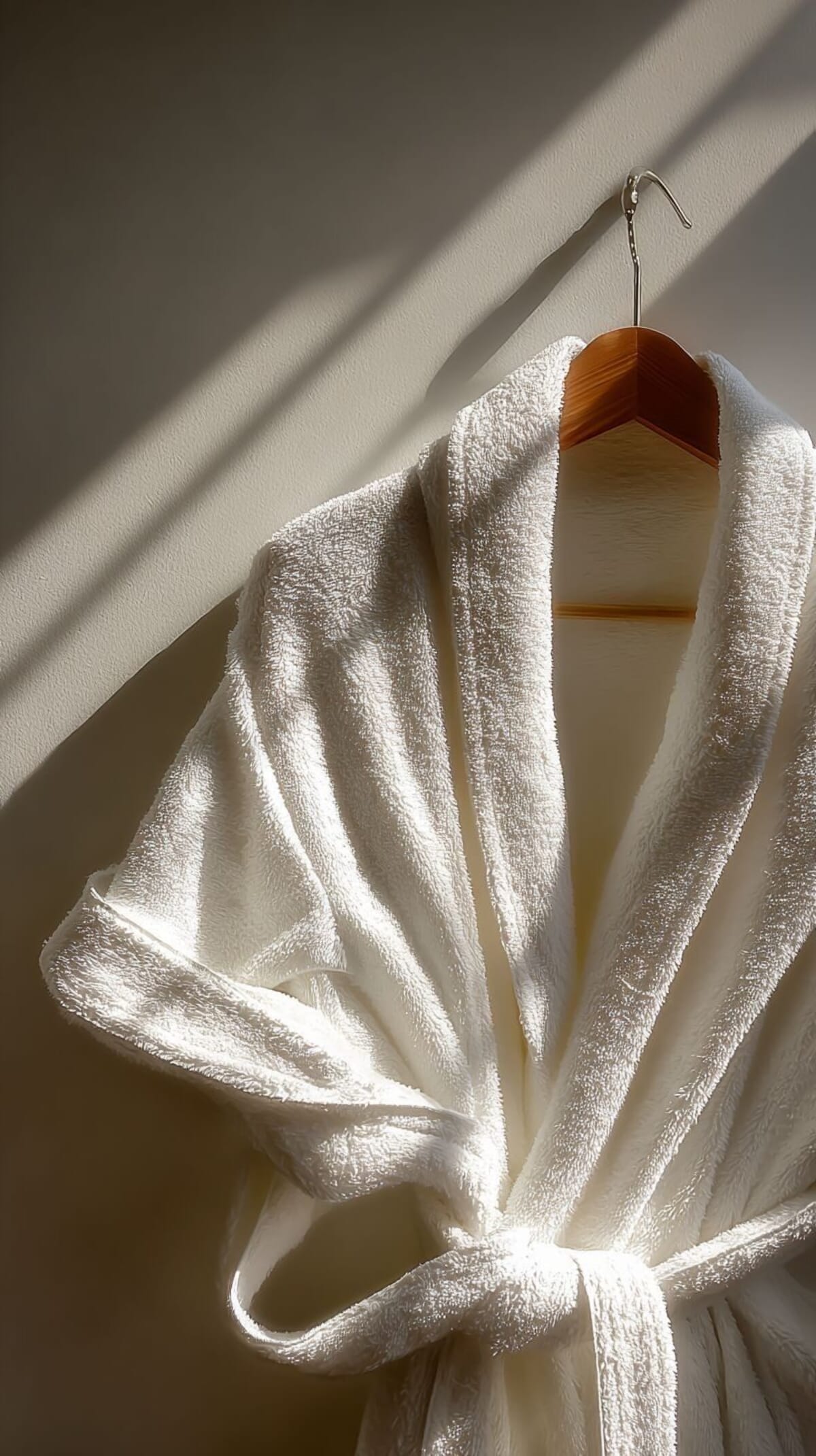
- Terry loop. Uncut cotton loops on both faces. Maximum absorbency. The fabric of the hotel bathroom and the after-shower robe. Heavy, and slow to dry.
- Terry velour. Terry with the loops sheared on one face. Smooth and plush on the outside, so it reads as luxury, but the sheared face absorbs less. Good robes put the velour outside and keep loops inside.
- Waffle. A light honeycomb weave. Quick-drying, packable and cool. Common in spas and warm-climate resorts. It can feel thin to a customer expecting a hotel terry robe.
- Microfiber with terry lining. A polyester outer for a soft hand and colour, with a cotton terry inside for absorbency. This is the Robeworks construction.
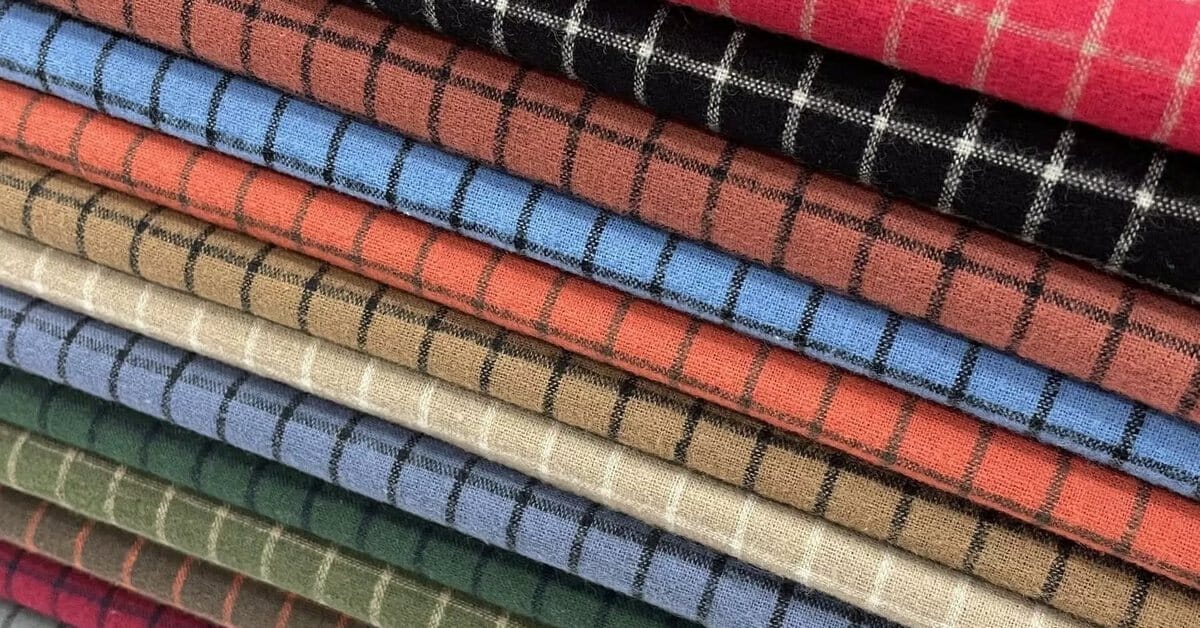
- Flannel. Brushed woven cotton. Warm and soft, made for wearing on a cold morning rather than for drying off. This is the Vermont Flannel category.
- Fleece, plush and chenille. Raised, fuzzy surfaces that feel warm and cosy. They are the fabrics most affected by the flammability rules below.
- Satin and lightweight woven polyester. Retail sleepwear robes sold on drape and sheen. They do not absorb water and belong in the same brief as your pajama line.
Fibre choice also moves your landed cost if you ever compare a US make with an import. The tariff schedule charges cotton robes far less than man-made fibre robes, as the duty chart further down shows.
Fabric weight: where fabric becomes a number
Weight is the spec that decides how a robe feels and much of what it costs, because you buy cloth by weight. Fabric weight is stated as grams per square metre (GSM) or ounces per square yard, and the standard way to measure it is ASTM D3776, the test methods for mass per unit area of fabric (ASTM D3776). Waffle sits at the light end, retail terry in the middle and hotel terry at the heavy end. Satin is far lighter than any of them.
We have not found a published industry table of robe weights that we trust, so we will not print one. Ask each factory for the GSM of its standard robe cloth, handle a swatch, and write your target into the tech pack with a tolerance. For terry, also ask how absorbency is tested. ASTM D4772 is the standard test method for surface water absorption of terry fabrics (ASTM D4772), and naming it in your spec turns "absorbent" into something a lab can check.
Shawl, kimono or hooded: does the collar change the price?
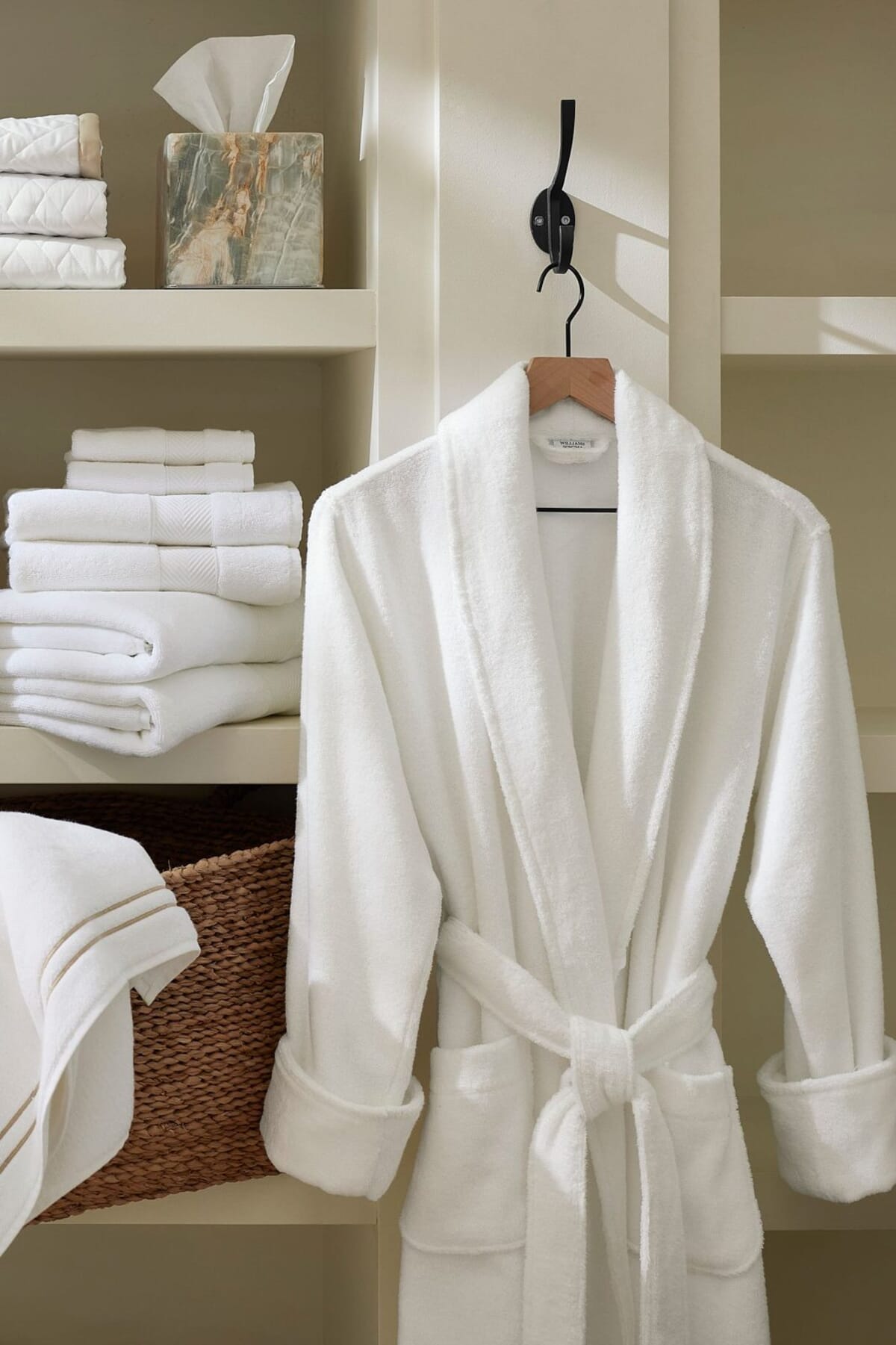
Yes, and it is the spec most brands leave vague. A shawl collar is a rolled band that runs from the hem up and around the neck. It takes extra fabric, a separate pattern piece and more sewing. It is the classic hotel and luxury look. A kimono collar is a flat band with no roll. It is simpler to cut and sew, cooler to wear, and the usual choice for spa and summer robes. A hood adds pattern pieces and seams, and it is standard on kids' robes and beach robes.
Whichever you choose, put it in the tech pack as finished measurements: collar width, band length, hood height and opening, not just a word. Add the details that change the sewing time: belt loops, a sewn-in or loose belt, patch or in-seam pockets, cuffs, piping, and the embroidery position and size. Two robes that look alike in a photo can differ by many minutes of sewing.
What flammability and labeling rules apply to robes sold in the US?
Robes are clothing, so the general federal flammability standard for clothing textiles, 16 CFR Part 1610, applies. It sorts fabrics into classes. A plain-surface fabric is Class 1, normal flammability, when its burn time in the test is 3.5 seconds or more. A raised-surface fabric, such as fleece, plush or a napped terry, is Class 1 when the burn time is more than 7.0 seconds, or when it shows only a quick surface flash that does not ignite or fuse the base fabric (16 CFR Part 1610). Raised surfaces are the ones to test early.
Children's robes are a separate and stricter case. The federal standards for children's sleepwear define it as wearing apparel "such as nightgowns, pajamas, or similar or related items, such as robes, intended to be worn primarily for sleeping or activities related to sleeping". One standard covers sizes 0 through 6X (16 CFR Part 1615) and the other sizes 7 through 14 (16 CFR Part 1616). Under Part 1616, for example, the average char length of five specimens must not exceed 17.8 cm (7.0 in.), and no single specimen may burn the full 25.4 cm (10 in.) length. A cosy fleece kids' robe is exactly the kind of product these standards were written for, so decide on fabric, any flame-resistant treatment or a tight-fitting cut with your factory and a lab before sampling.
Two labeling rules apply to every robe. The care labeling rule requires a permanent label with regular care instructions that stays attached and legible for the useful life of the product (16 CFR Part 423). And the Federal Trade Commission's textile guidance sets the origin wording: a US-made robe sewn from imported cloth should say "Made in U.S.A. of imported fabric", and Customs requires identification of the country where the fabric was made (FTC, textile labeling). This matters for robes because most terry is woven abroad, even when the robe is cut and sewn in the US.
What is the import duty on robes, and what does a US make avoid?
If you are comparing a US make with an imported robe, duty is part of the gap. The US tariff schedule lists bathrobes and dressing gowns by gender, construction and fibre. The general rates run from 7.5% for women's woven cotton robes to 16% for women's robes in man-made fibres (USITC Harmonized Tariff Schedule). Those are the base rates. Extra duties can apply depending on the country of origin and current trade measures, so check the live schedule before you quote.
Two practical points follow. A polyester or microfiber robe pays roughly twice the base duty of a cotton robe when imported. And a robe cut and sewn in the US pays no import duty on the finished garment, although imported fabric can carry its own duty when it comes in.
Should you sell robes to hotels or to shoppers?
They look like one product and behave like two businesses. Hotel and contract buyers specify fabric weight, shrinkage after a stated number of industrial wash cycles, colour fastness to bleach, and a reorder they can repeat. They buy on durability and on cost across the laundry life of the robe, and the replacement rate matters as much as the unit price. That is the market Robeworks says it serves: hotels, resorts, spas, cruise lines and private clubs. Stitch Texas makes the same point for hospitals, saying its delivery robes are built for repeated industrial laundering.
Retail buyers specify none of that. They specify drape, hand-feel, fit and how the robe photographs. A retail robe programme has more in common with your loungewear and pajama manufacturing than with a hotel linen contract, and it usually needs lower minimums per colour. If you sell robes to hotels, you will probably sell towels too; our guide to towel manufacturers covers that side.
Bottom line: In the United States, hotel robe supply and retail robe supply are separate businesses. Contract buyers specify weight, shrinkage across industrial laundering and colour fastness, and buy on replacement rate. Retail buyers specify drape, hand-feel and fit. Children's robes are covered by the federal children's sleepwear flammability standards, which name robes in their definitions.
What should you send a robe manufacturer?
Send these and a robe quote comes back faster and closer to the final price:
- Use. Hotel or spa contract, retail, gift, academic or judicial, medical.
- Fabric. Terry loop, terry velour, waffle, microfiber with terry lining, flannel, fleece or satin, and the fibre content.
- Weight. Target GSM with a tolerance, measured by ASTM D3776.
- Collar and hood. Shawl, kimono or hooded, with finished measurements.
- Size chart. Finished measurements by size, not just S, M and L. For kids' sizes, state the size range so the flammability standard is clear.
- Trims. Belt, belt loops, pockets, piping, cuffs, embroidery position and stitch count.
- Labels. Fibre content, care, origin wording and your brand label.
- Quantity per colour. Dyeing is a batch process, so colour splits change the cost.
- Wash protocol for contract robes. Number of industrial washes, temperature and maximum shrinkage.
Ask about minimums early, because none of the four makers here publishes one. If you do not have a tech pack yet, build one before you contact a factory; our sample rounds playbook explains what happens after you send it.
Robe manufacturers: FAQ
Who manufactures bathrobes in the USA?
Only a few companies still cut and sew robes in the US. Robeworks in Los Angeles makes terry-lined microfiber bathrobes for hotels, spas and private label programmes. The Vermont Flannel Company in East Barre, Vermont makes flannel robes and offers a woven label with your brand name to wholesale customers. Oak Hall Industries in Virginia makes academic, judicial and choir robes, and Stitch Texas in Austin makes maternity delivery robes.
How big is the bathrobe market?
IMARC Group estimates the global bathrobe market at USD 4.2 billion in 2025 and USD 4.5 billion in 2026, reaching USD 6.5 billion by 2034 at 4.89% a year. It is a research estimate: bathrobes are spread across several tariff headings, so no customs line measures them directly.
Are children's robes covered by flammability rules?
Yes. The US children's sleepwear standards, 16 CFR Part 1615 for sizes 0 through 6X and Part 1616 for sizes 7 through 14, name robes in their definition of children's sleepwear. Plan fabric and testing with your factory and a lab before sampling.
What is the difference between terry and velour robes?
Terry loop leaves the cotton loops uncut, which gives the most absorbency. Terry velour shears the loops on one face, which gives a smooth, plush surface that absorbs less. Many robes use velour outside for the look and loops inside for drying.
What is the import duty on bathrobes in the US?
General rates range from 7.5% for women's woven cotton robes (HTS 6208.91.10) to 16% for women's robes in man-made fibres (HTS 6108.92.00 and 6208.92.00). Extra duties can apply by country of origin. A robe cut and sewn in the US pays no duty on the finished garment.
What is the minimum order for custom robes?
None of the four makers here publishes a number. Robeworks says minimum order quantities apply to wholesale orders, and the others quote per project. Give quantities per colour when you ask, because colour splits change the price.
Can a robe made from imported terry be labeled Made in USA?
Not with an unqualified "Made in U.S.A." label. The FTC's textile guidance gives "Made in U.S.A. of imported fabric" as the wording for a product made here from imported cloth.
OneAim places and manages production with 80 documented clothing manufacturers in the United States. Send the product, the quantity and your target date. Within 24 hours we reply, and we place the order with the US factory in our group that already makes it. Production, invoicing and shipping run directly between you and the factory. Flat fee, no mark-up.
Start my brief US factory directory ($49)References and data
- Robeworks, home page and Wholesale, checked November 2026. Source of the Los Angeles make, 1995, customer types, private label and bulk programmes, the microfiber and terry construction, the durability claim, the store styles, in-house embroidery and the minimums statement. Company-stated.
- The Vermont Flannel Company, our story and Wholesale programme, checked November 2026. Source of the 1991 founding, USA Brands in 2022, US cutting and sewing, the flannel description and the woven brand label. Company-stated.
- Oak Hall Industries, history, checked November 2026. Source of the 1889 founding, choir robes, the Bentley and Simon acquisition, the Salem, Wytheville and Chilhowie facilities, the 455,000 square feet and the US textile statement. Company-stated.
- Stitch Texas, about and Maternity delivery robes, checked November 2026. Source of the 2014 founding, services, the B2B and bulk statement and the industrial laundering claim. Company-stated.
- IMARC Group, Bathrobe Market Report, updated October 2026. Source of the 2025, 2026 and 2034 market sizes, the 4.89% growth rate and the hotel and cotton segments. Commercial estimate.
- US International Trade Commission, Harmonized Tariff Schedule, headings 6107, 6108, 6207 and 6208, checked November 2026. Source of the general duty rates.
- 16 CFR Part 1610, Standard for the Flammability of Clothing Textiles, eCFR. Source of the Class 1 burn-time rules.
- 16 CFR Part 1615 and 16 CFR Part 1616, Standards for the Flammability of Children's Sleepwear, eCFR. Source of the definitions that name robes and the Part 1616 char length criteria.
- 16 CFR Part 423, Care Labeling of Textile Wearing Apparel, eCFR. Source of the care label definition.
- Federal Trade Commission, Threading Your Way Through the Labeling Requirements Under the Textile and Wool Acts. Source of the "Made in U.S.A. of imported fabric" wording.
- ASTM D3776/D3776M and ASTM D4772, standard titles checked November 2026.
Every company named above appears in this source list. Founding dates, capabilities, customer types and minimum statements are the companies' own published statements, labelled as such in the text; we did not inspect the factories. No company here is a OneAim group member, and none paid to appear. Reviewed and updated 11 November 2026 by Will Godax.