Very few US factories say "maternity" on their own websites, and most maternity lines made in the United States are sewn by stretch and knit womenswear factories working from the brand's own maternity pattern. That is the honest picture behind any list of maternity clothing manufacturers. A maternity garment has to fit a body that changes shape for months and then changes again after birth, so the hard part is the pattern and the grade, not the sewing.
This guide lists eight United States makers we checked again on their own websites in November 2026: where they are, what they say about making in the US, what they make and what minimums they publish. Two of them name a maternity product. The other six show the base skill a maternity line depends on: stretch and knit womenswear cut and sewn in the US. After the list we cover what the makers will not do for you: grading for the bump, building nursing access, choosing fabric by recovery rather than stretch, labels and the duty a US make avoids. Every company and number below is listed in the Sources section.
About us: OneAim places and manages production with documented clothing factories in the United States. The companies below are independent US manufacturers listed from their own public websites. They are not members of our group. What OneAim does instead: we place your production with a documented factory in our group built for your product.
The short list
- Eight makers, all self-reported. Argus Apparel, Lefty Production Co., Essentials Made and Plucky Reach in Los Angeles; Apparel Production Inc. and Grace Apparel Production in New York; Stitch Texas in Austin; WSI Sports in Eagan, Minnesota. The evidence is each company's own website.
- Only two name maternity. Argus Apparel lists maternity and nursing intimates; Stitch Texas makes maternity delivery robes for hospitals and birthing centers. The other six show stretch and knit womenswear, which is the base skill, not proof of maternity grading.
- The grade is your job. Bump circumference, front length and nursing openings are extra points of measure on top of a normal womenswear size chart. Put them in the tech pack and check them in the first sample.
- Specify recovery, not just stretch. Name a test such as ASTM D2594 for fabric growth and stretch of low-power knits, and ask the mill for the result.
- Your customer is in her thirties. In provisional CDC data for 2026 Q2, women aged 30 to 34 had the highest birth rate of any age group, at 96.3 births per 1,000 women.
Free estimate: calculate your landed cost with our garment cost calculator in about a minute. No email needed.
How did we choose these maternity clothing makers?
We used three tests. First, the company's own website must say that it makes garments in the United States. Second, it must take work for other brands: private label, cut and sew, full package or bulk orders. Third, its site must show either a named maternity or nursing product, or stretch and knit womenswear such as leggings, bras, knit tops, swimwear or lingerie. Then we read those pages and wrote down what they say, including any published minimum.
Here is what that does and does not prove. Every entry is self-reported: we read websites, we did not visit sewing floors, and nobody paid to appear. Names that only turned up in old directory listings or ranking articles, with websites that were parked, missing or unclear about where sewing happens, were left out. So were brands that make maternity wear in the US only for themselves. Several of the makers below also offer production outside the US; where a site says so, we say so, and you should ask which floor will sew your order.
We did not rank the eight. The right one depends on what you are making: maternity and nursing intimates, hospital delivery robes, maternity leggings and activewear, or a mixed womenswear line with dresses and tops.
| Maker | Where | What its site shows | Published minimum |
|---|---|---|---|
| Argus Apparel | Los Angeles, CA | Maternity and nursing intimates; private label lingerie | "Low MOQs", no figure |
| Stitch Texas | Austin, TX | Maternity delivery robes for hospitals and birthing centers | Not published |
| Lefty Production Co. | Los Angeles, CA | Women's wear from yoga pants to formal gowns | Not published |
| Essentials Made | Los Angeles, CA | Cotton and spandex leggings, sports bras, yoga sets | Set by the fabric: about 600 yards per fabric at the mill |
| Plucky Reach | Los Angeles, CA | Nylon and polyester spandex leggings, sports bras, sets | 100 pieces per style per colorway |
| Apparel Production Inc. | New York, NY | Leggings, knit tops, bra tops, dresses, sleepwear | 200 per style (domestic) |
| Grace Apparel Production | New York, NY | Knits, swimwear, lingerie, womenswear | 20 to 1,500 units per style |
| WSI Sports | Eagan, MN | Performance knits; women's leggings and sports bras in its own range | 144 pieces per style per color |
Source: each company's own website, checked 12 November 2026. Self-reported; confirm before you brief.
Which US makers name maternity products on their own sites?
Argus Apparel (Los Angeles, California)
Argus Apparel is a private label lingerie and apparel manufacturer. Its lingerie page is titled "Custom Intimate Apparel Made in the USA", lists "Maternity and nursing intimates" among its specialty pieces, and says it produces maternity and nursing lingerie with "easy-open clasps, supportive bands, and soft, breathable fabrics" (Argus Apparel, lingerie manufacturer). The page lists a Los Angeles address in its footer. On minimums it says only that it offers low MOQs, "depending on style and materials".
That makes Argus the only maker in this list that names both maternity and nursing products. Treat it as a starting point for nursing bras and maternity intimates, and ask two things in writing before you brief: which of your styles will be cut and sewn in Los Angeles, and what the minimum is per style and colour. Best for: a brand launching nursing bras, maternity briefs or maternity sleep sets.
Stitch Texas (Austin, Texas)
Stitch Texas describes itself as "a female owned apparel development facility since 2014" in Austin (Stitch Texas, about). It has a dedicated page for maternity delivery robes, where it calls itself a B2B partner for hospitals, birthing centers and clinics throughout Texas, offers bulk ordering, and describes "discreet snaps or ties" for medical examinations, epidural administration and skin-to-skin contact with the newborn. It also says the robes withstand repeated industrial laundering (Stitch Texas, maternity delivery robes).
That is hospital maternity wear, not fashion maternity, but the access engineering is the same problem a nursing top solves: openings that work one-handed and stay closed when they should. The site menu also links to Lefty Production Co. in Los Angeles. Best for: a medical brand, birthing centre or hospital buyer that needs delivery robes or labour gowns developed and made in Texas.
Which US stretch and knit factories can make a maternity line?
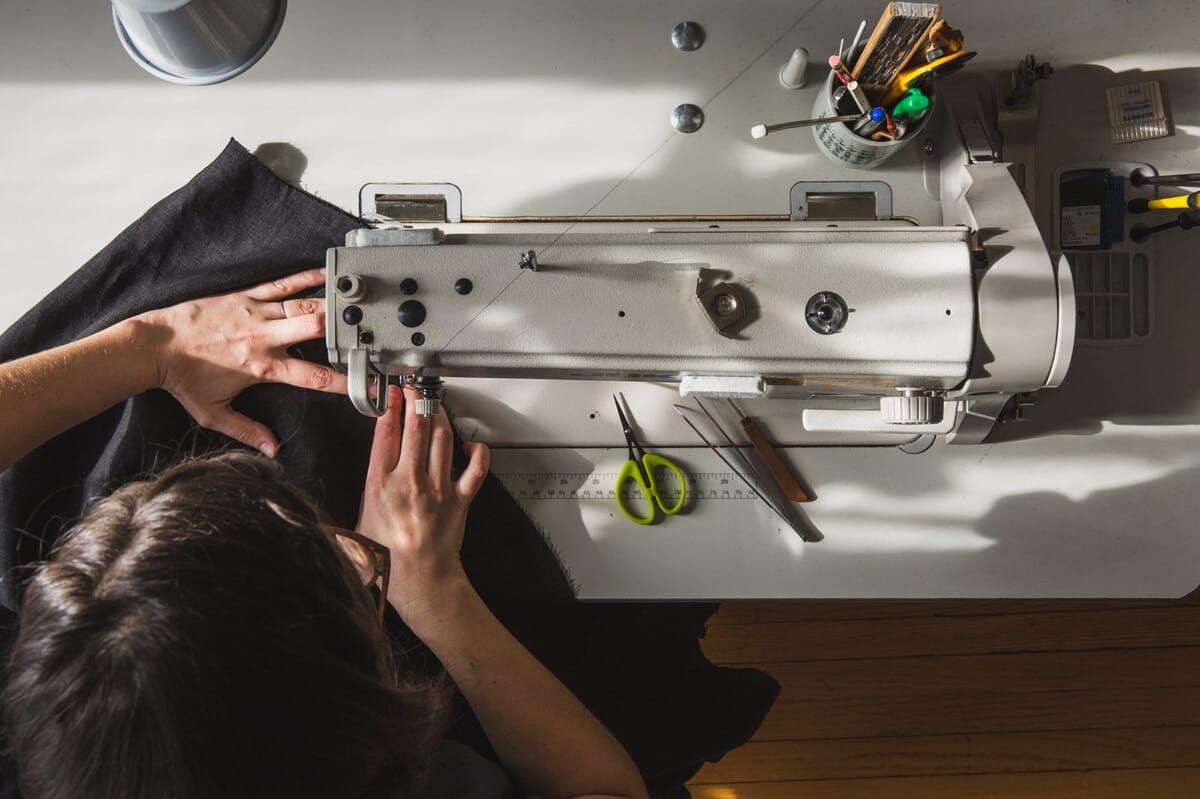
The next six do not name maternity. Each one shows the machinery and the fabrics a maternity line is built on, and each entry says exactly what its site shows, so you can judge the fit for your line.
Lefty Production Co. (Los Angeles, California)
Lefty Production Co. is a development and production house in downtown Los Angeles. Its women's wear page is headed "Women's Wear Made in the USA" and says its capabilities "span from casual garments like yoga pants all the way to formal dresses and gowns"; its service menu also lists athletic wear, swimwear and lingerie (Lefty Production Co., women's wear). There is no maternity page and no published minimum. Best for: a maternity line that mixes dresses, tops and leggings and needs development and production in one place.
Essentials Made (Los Angeles, California)
Essentials Made is a private label cut-and-sew manufacturer. Its activewear page describes a 90% cotton / 10% spandex programme for four-way stretch leggings, yoga sets and everyday sports bras, garment-dyed after sewing, with pattern development, cut and sew, garment dyeing and finishing "all in our Arts District facility in Downtown Los Angeles" (Essentials Made, activewear). It notes that spandex content affects "dye uptake rates, shrinkage behavior, and stretch recovery", which is exactly the issue a maternity jersey raises.
On minimums it is specific about why it cannot give one number: cotton-spandex is knit to order, the mill sets a yardage minimum of around 600 yards per fabric, and the piece count depends on your silhouettes and how many styles share one fabric. It quotes 6 to 7 week production timelines after deposit. Best for: a cotton-rich maternity legging and nursing bra capsule with a natural-fibre story.
Plucky Reach (Los Angeles, California)
Plucky Reach says leggings, sports bras, gym shorts, crop tops and coordinated sets are cut and sewn in Los Angeles, starting at 100 pieces per style per colorway, with sampling usually taking 2 to 4 weeks and bulk production 5 to 7 weeks after sample approval. It says most pieces land between $12 and $35 per unit depending on fabric and construction (Plucky Reach, activewear manufacturing).
Its fabric notes are useful for a maternity brief: nylon/spandex blends are "typically 80/20 or 75/25", nylon has "higher stretch recovery", and spandex content of typically 15 to 25% sets the stretch and recovery, with higher spandex giving "better shape retention". Best for: maternity leggings and support layers in performance fabrics.
Apparel Production Inc. (New York, New York)
Apparel Production Inc. is in New York's Garment District. Its domestic production page says pattern making and samples are in-house, cites "75 skilled sewing operators", and lists leggings, activewear, knit tops, bra tops, dresses, sleepwear and swimwear among its garment capabilities (Apparel Production Inc., domestic production). It states minimums of 200 per style for domestic orders and 300 per style for overseas orders.
Its pattern makers are available for fittings on-site or off-site, which matters for maternity, where a fitting on a pregnant body is the only real test of the grade. The same company sells overseas production, so state that you want the New York factory if you need a Made in USA label. Best for: a maternity dress and knit top line at a few hundred pieces per style.
Grace Apparel Production (New York, New York)
Grace Apparel Production calls itself a full package services production company in the Garment District, "Made in New York", offering design, fitting, patterns, grading, marking, cutting and sewing. It says orders range "from small amounts of 20 units to 1500 units per style", and lists knits, swimming wear, lingerie and womenswear among its categories (Grace Apparel Production).
It also says it works with many factories and offers production in New York City and overseas, so confirm the New York sewing location in your quote. Best for: a small first maternity drop that needs grading done in-house and runs below 100 pieces per style.
WSI Sports (Eagan, Minnesota)
WSI Sports says it was founded in 1990 and that its products are "100% Knit, cut and sewn in the USA"; its about page says "We proudly design, cut, and sew our apparel in Eagan, Minnesota" (WSI Sports, about). Its custom apparel page sets private label minimums of 144 pieces per style per color, with sizes mixed in 24-piece blocks and a 3 to 4 week standard production time (WSI Sports, custom apparel).
Its own women's range includes leggings and sports bras. This is technical stretch knit made in one building, a good fit for maternity leggings and base layers, but there is no maternity grading on the site. Best for: performance maternity leggings and support layers at a few hundred pieces.
Skip the cold emails: Browse our factory directory for $49, or get in contact and we'll place your production with the domestic factory built for it, usually within 24 hours. Flat fee, no markups.
How do you grade maternity clothing for the bump?
A womenswear size chart grades bust, waist and hip from one size to the next. Maternity needs the same chart plus measurements a normal chart does not carry. Start from a standard body-measurement table, such as ASTM D5585, the standard tables of body measurements for the adult female misses figure type in sizes 00 to 20 (ASTM D5585), or your own fit data, and then add maternity points of measure on top. The notes below are spec guidance for your tech pack, not industry figures: the numbers have to come from your own fit sessions.
The extra points of measure
- Full bump circumference. Measured around the fullest point of the belly. This is the measurement a womenswear grade does not have, and it changes through pregnancy while the hip changes far less.
- High bump and under-bump. Above and below the belly. They decide where a waistband sits: an over-belly panel covers the bump, an under-belly band sits below it.
- Under-bust. For nursing tops, dresses and bras. It decides band size and where an empire seam falls.
- Front length versus back length. The bump lifts the front hem. A maternity top or dress needs extra front length, often taken up with side ruching, so the hem stays level.
- Front rise versus back rise. In maternity trousers and leggings the front rise is lowered or replaced by a panel, while the back rise stays close to the normal block.
Writing the grade rule
Decide first what your sizes mean. Many brands size maternity by the customer's usual size, so a size M is meant to fit a woman who wore M before pregnancy. If you do that, say it on the size chart, and grade the bump measurements as allowances on top of each size rather than as a separate size run. Then write the grade rule as a table: every point of measure, its increment between sizes, and its tolerance. A factory cannot grade what is not written down.
Test the grade on bodies, not on a dress form. A first sample that fits at one stage of pregnancy can pull at another, so fit the sample on people at different stages, or at least check panel and ruching allowances at the largest bump you design for. This is where the factories above differ most: Apparel Production Inc. and Grace Apparel Production say grading or fittings happen in-house, the others will grade from the rules you send.
Bottom line: Maternity grading adds points of measure that a womenswear size chart does not carry: full bump circumference, high bump and under-bump, under-bust, and the difference between front and back length and rise. Most US factories that make maternity work grade from the brand's own rules, so those measurements belong in the tech pack before sampling.
How do you build nursing access into maternity clothing?
Nursing access is a construction choice, and it changes the pattern, the trims and the sewing time. Pick one per style and spec it, rather than writing "nursing friendly" in the brief.
- Clip-down cups. The standard for nursing bras: a clasp at the strap lets the cup fold down. Argus Apparel names easy-open clasps on its maternity and nursing lingerie. Spec the clasp, its position and a one-hand opening test.
- Double layer. An outer layer lifts and an inner layer pulls down, so the stomach stays covered. It adds a pattern piece and fabric, and both layers must recover after repeated stretching.
- Wrap and crossover fronts. The neckline itself opens to one side. Simple to sew, but the overlap must be graded so it still covers at the largest bust size.
- Hidden zips and side openings. Vertical zips under a yoke or at the side seams. They look like a normal top, but zips add cost and a stiff line on stretch fabric.
- Button or snap plackets. Familiar on shirts and nightdresses. Stitch Texas uses snaps or ties on delivery robes for examination and skin-to-skin access.
Two grading points matter. Place each opening relative to the bust point of each size, not at one fixed distance from the shoulder, or it will sit too high on small sizes and too low on large ones. And test every opening in the fit session with one hand, with the garment on a body: the clasp or zip that works on a table can be awkward when someone is holding a baby.
Should the same factory make maternity and nursing? Usually yes. One supplier that handles both bump panels and nursing access saves you a second fit block and a second sampling cycle, and the customer moves from one to the other. In this list only Argus Apparel names both maternity and nursing products; with the others, test nursing openings in the first sample.
Why does recovery matter more than stretch in maternity fabric?
A belly panel has to stretch a long way and come back to shape every time it is worn and washed, over months. Fabric that stretches and stays stretched has failed, even if it felt wonderful in the sample. Stretch tells you how far a fabric goes. Recovery tells you whether it comes back. A maternity spec needs both.
Put a test method in the spec instead of an adjective. ASTM D2594 is the standard test method for stretch properties of knitted fabrics having low power, and it measures fabric growth and fabric stretch for form-fitting apparel (ASTM D2594). ASTM D4964 covers tension and elongation of elastic fabrics, which suits waistband elastic and power mesh (ASTM D4964). Ask the mill for its results on your actual fabric, and set a pass mark with your factory.
- Nylon/spandex. Plucky Reach describes the common activewear blends as typically 80/20 or 75/25 and says nylon has higher stretch recovery. A strong choice for belly panels and leggings.
- Polyester/spandex. Plucky Reach says polyester is more durable, dries faster and is required for sublimation printing. Good for printed leggings.
- Cotton/spandex jersey. Essentials Made runs a 90% cotton / 10% spandex programme and warns that spandex changes dye uptake, shrinkage and recovery. A natural-fibre option for tops and leggings.
- Viscose and modal jersey. Soft and drapey, popular for maternity dresses. They can grow with wear, so ask for growth results before you use them in a panel that carries load.
Spandex content also changes how the garment is classified when it is imported: the US tariff schedule has separate statistical lines for women's knit trousers "Containing 5 percent or more by weight of elastomeric yarn" (USITC HTS). It does not change the duty rate in the chart below, but it is one more reason to state fibre content exactly in your spec.
Who buys maternity clothing in the US, and how big is the market?
Start with the customer. CDC's provisional quarterly estimates for 2026 Q2 put the US birth rate for women aged 30 to 34 at 96.3 per 1,000, the highest of any age group, ahead of 83.7 for ages 25 to 29. The rate for ages 35 to 39, 55.4, is above the 51.5 for ages 20 to 24 (CDC NCHS, VSRR quarterly provisional estimates). For a maternity brand that means designing for a customer in her thirties, often in work clothes as well as leggings.
The same dataset shows a gently falling base: the general fertility rate was 52.7 births per 1,000 women aged 15 to 44 in 2026 Q2, against 53.7 in 2025 Q2. It also puts the cesarean delivery rate at 32.5 per 100 births in 2026 Q2. That second number belongs in your postpartum brief, because waistband height and seam placement matter on a body recovering from surgery.
Grand View Research, a market-research publisher, values the global maternity wear market at USD 24.5 billion in 2025 and USD 25.6 billion in 2026, and forecasts USD 35.8 billion by 2033, growth of 4.9% a year from 2026 to 2033. It gives North America the largest regional share, 27.2% of revenue in 2025 (Grand View Research).
Read that as a paid estimate, not a measurement: there is no customs line for "maternity". Use it to size an opportunity, not to forecast your own sales. With a flat or falling number of births, a maternity brand grows by fitting better and by keeping the customer into nursing, not by riding volume.
What import duty and labels apply to maternity clothing?
The US tariff schedule has no separate maternity heading. A maternity legging is entered as women's knit trousers, a nursing bra as a brassiere, a maternity dress as a women's knit dress. General duty rates on those lines run from 8.5% for cotton knit nightdresses to 32% for women's knit tops in man-made fibres (USITC Harmonized Tariff Schedule). Additional duties can apply by country of origin, so check the live schedule before you quote.
Two points follow. Synthetic knits, the fabrics that recover best, pay the highest base duty when imported: 28.2% for synthetic knit leggings against 14.9% for cotton. And a garment cut and sewn in the US pays no import duty on the finished piece, although imported fabric can carry its own duty when it comes in.
Labels need the same care. The FTC's Made in USA rule says a product may only be labelled "Made in the United States" when final assembly or processing happens here, all significant processing happens here, and "all or virtually all ingredients or components" are made and sourced here (16 CFR Part 323). For textiles, the labeling rules give "Made in USA of imported fabric" as the wording for a garment made here from imported materials (16 CFR Part 303). Much stretch fabric is knit abroad, so check before you print an unqualified Made in USA label. A permanent care label is required too (16 CFR Part 423).
What should you send a maternity clothing manufacturer?
Send these and the quote comes back faster and closer to the final price:
- Product and stage. Pregnancy, postpartum, nursing, or all three, and which styles cover which stage.
- Size chart with maternity points of measure. Bump circumference, high bump, under-bump, under-bust, front and back length, front and back rise, with tolerances.
- Grade rule. Increments between sizes for every point of measure, and whether sizes follow the customer's usual size.
- Panel construction. Over-belly or under-belly, panel fabric, waistband elastic and its width.
- Nursing access. Clip-down cup, double layer, wrap, zip or placket, with the trim named.
- Fabric and tests. Fibre content, weight, and the stretch and recovery test you want reported, such as ASTM D2594.
- Labels. Fibre content, care, origin wording and your brand label.
- Quantity per style and colour. The minimums above are per style, and some are per colour.
If you do not have a tech pack yet, build one before you contact a factory; our sample rounds playbook explains what happens after you send it. Maternity shares much with plus-size grading and with leggings manufacturing, so those guides are worth a read too.
Maternity clothing manufacturers: FAQ
Who manufactures maternity clothing in the USA?
Few US factories name maternity on their own sites. Of the eight we checked, Argus Apparel in Los Angeles lists maternity and nursing intimates, and Stitch Texas in Austin makes maternity delivery robes for hospitals. Six more (Lefty Production Co., Essentials Made, Plucky Reach, Apparel Production Inc., Grace Apparel Production and WSI Sports) cut and sew stretch and knit womenswear in the US, which is the base a maternity line needs. All of it is self-reported.
What is the minimum order for custom maternity clothing?
Four of the eight publish a number: Grace Apparel Production from 20 units per style, Plucky Reach 100 pieces per style per colorway, WSI Sports 144 pieces per style per color, and Apparel Production Inc. 200 per style for domestic orders. Essentials Made says its minimum is set by the mill, at around 600 yards per fabric. Argus Apparel says MOQs are low without a figure.
How do you grade maternity clothing?
Start from a normal womenswear size chart and add maternity points of measure: full bump circumference, high bump and under-bump, under-bust, and front versus back length and rise. Write increments and tolerances for each, decide whether sizes follow the customer's usual size, and test the first sample on pregnant bodies.
What fabric should a maternity belly panel use?
Choose for recovery, not only stretch. Nylon/spandex blends, typically 80/20 or 75/25, recover well. Ask the mill for stretch and growth results under ASTM D2594 rather than judging a swatch by feel.
Should maternity and nursing wear come from the same factory?
Usually yes. One supplier that handles bump panels and nursing access saves you a second fit block and sampling cycle. In this list only Argus Apparel names both maternity and nursing products.
What is the import duty on maternity clothing in the US?
There is no separate maternity line. Maternity garments are entered as ordinary women's garments, with general rates from 8.5% for cotton knit nightdresses to 32% for knit tops in man-made fibres, before any additional duties. A garment cut and sewn in the US pays no duty on the finished piece.
Can maternity clothing made from imported fabric be labelled Made in USA?
Not with an unqualified label. The textile labeling rules give "Made in USA of imported fabric" as the wording for a garment made in the US from imported materials.
OneAim places and manages production with 80 documented clothing manufacturers in the United States. Send the product, the quantity and your target date. Within 24 hours we reply, and we place the order with the US factory in our group that already makes it. Production, invoicing and shipping run directly between you and the factory. Flat fee, no mark-up.
Start my brief US factory directory ($49)References and data
- Argus Apparel, lingerie manufacturer, checked November 2026. Made in USA heading, maternity and nursing intimates, easy-open clasps, Los Angeles address and MOQ wording. Company-stated.
- Stitch Texas, about and Maternity delivery robes, checked November 2026. 2014 founding, Austin, B2B and bulk statement, snaps or ties, industrial laundering. Company-stated.
- Lefty Production Co., women's wear, checked November 2026. Made in USA heading, yoga pants to gowns, service menu. Company-stated.
- Essentials Made, activewear manufacturer Los Angeles, checked November 2026. 90/10 cotton-spandex programme, Arts District facility, 600-yard mill minimum, 6 to 7 week timelines. Company-stated.
- Plucky Reach, activewear manufacturing, checked November 2026. LA cut and sew, 100-piece minimum, sampling and production times, unit price range, fabric blends and spandex content. Company-stated.
- Apparel Production Inc., domestic production, checked November 2026. Garment District location, in-house patterns and samples, 75 sewing operators, garment list, 200 and 300 per style minimums. Company-stated.
- Grace Apparel Production, checked November 2026. Made in New York, services, 20 to 1,500 units per style, categories, many factories, New York and overseas production. Company-stated.
- WSI Sports, about and Custom apparel, checked November 2026. 1990 founding, knit, cut and sewn in the USA, Eagan, Minnesota, 144-piece minimum, 24-piece size blocks, 3 to 4 week production. Company-stated.
- CDC, National Center for Health Statistics, VSRR quarterly provisional estimates for selected birth indicators (data.cdc.gov, dataset 76vv-a7x8), queried November 2026. Source of the age-specific birth rates, the general fertility rates and the cesarean delivery rate. Provisional.
- Grand View Research, Maternity Wear Market Report, checked November 2026. Source of the 2025, 2026 and 2033 market sizes, the 4.9% growth rate and the 27.2% North America share. Commercial estimate.
- US International Trade Commission, Harmonized Tariff Schedule, headings 6104, 6106, 6108 and 6212, checked November 2026. Source of the general duty rates and the elastomeric yarn statistical lines.
- ASTM D2594, ASTM D4964 and ASTM D5585, standard titles and scope checked November 2026.
- 16 CFR Part 323, Made in USA Labeling Rule; 16 CFR Part 303, Textile Fiber Products Identification Act rules; 16 CFR Part 423, Care Labeling. eCFR, checked November 2026.
Every company named above appears in this source list. Locations, made-in-USA statements, capabilities and minimums are the companies' own published statements; we did not inspect the factories. The grading and nursing notes are spec guidance, not measured data. No company here is a OneAim group member, and none paid to appear. Reviewed and updated 12 November 2026 by Will Godax.
Related guides
- Plus-size clothing manufacturers
- Leggings manufacturers
- Lingerie manufacturers
- Women's clothing manufacturers