An apron is the cheapest serious custom garment you can put your logo on, and that's why so many hospitality and retail brands start there. One panel, a few seams, no size grade, no fit block. The demand base is enormous: the global workwear market, which counts food and beverage among its application segments, sits at $19.2 billion in 2025 and is forecast to reach $28.1 billion by 2033 (Grand View Research, 2025; read from the publisher's summary page, not a full report).
This directory profiles 3 US apron manufacturers we verified by reading each company's own website, not a listicle and not a marketplace listing. The list is short on purpose: several well-known apron brands don't say on their own sites where their aprons are sewn, so they are not on it. Then it covers what actually sets your cost: canvas versus denim versus poly-cotton, waxed finishes, cross-back versus neck strap, rivets, pockets, branding methods, the US labelling rules, and industrial-wash survival.
About us: OneAim places and manages production with documented clothing factories in the United States. The companies below are independent apron and workwear makers listed on public sources, not members of our group. What OneAim does instead: we place your production with a documented factory in our group built for your product.
The short list
- Aprons are the lowest-friction custom garment there is. One panel, few seams, no size grade. A common first product for a cafe, a restaurant group, or a brand testing retail merch.
- There's no credible "apron market" figure, so use workwear. $19.2 billion in 2025, growing to $28.1 billion by 2033, work apparel taking 74.7% of revenue (Grand View Research, 2025).
- Fabric is the whole decision. Poly-cotton for industrial-wash programs, denim and canvas for retail-facing brands, waxed canvas for bars and butchers.
- Minimums are low, and two of the three publish them. CHEFtog states "No Minimums". Artifact asks for 30 or more aprons for a custom colour and 50 or more for a custom print.
- Cross-back straps aren't a style choice. They spread load across the shoulders instead of hanging it off the neck.
Free estimate: calculate your landed cost with our garment cost calculator in about a minute. No email needed.
Why do brands start with aprons?
Because an apron is the shortest path from an idea to a real, branded, sellable garment. No armhole, no sleeve pitch, none of the things that make a first hoodie run take months. The demand side is real too: US restaurant and foodservice sales are forecast to hit $1.55 trillion in 2026, with 15.8 million people working in the industry (National Restaurant Association, 2026).
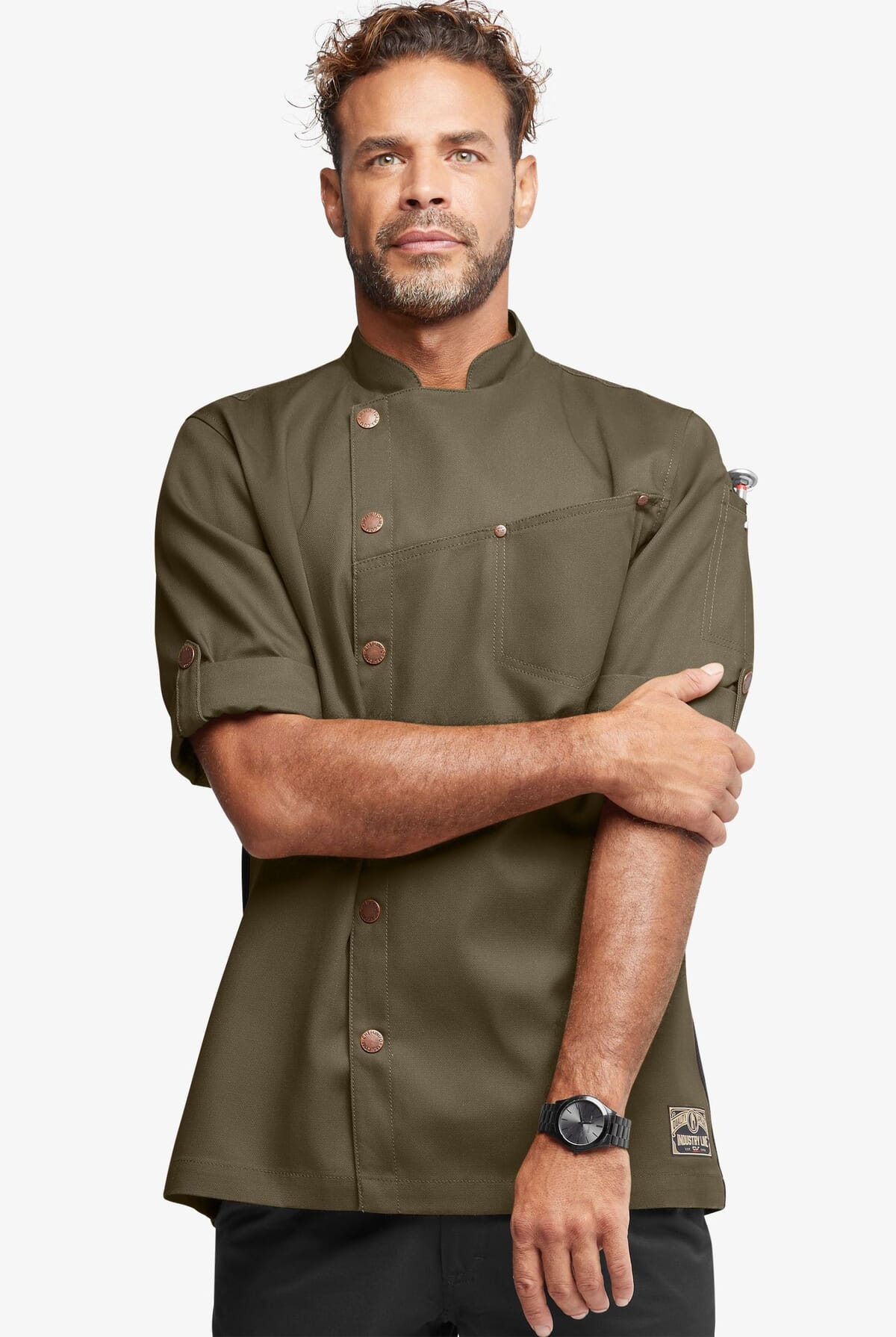
Why it sticks: An apron is one of the few garments where a small brand's unit economics can work on the first run, because there is no size grade to multiply the sample and pattern cost. It also gets worn in public, all day, by someone who talks to customers. That makes it a uniform and a piece of marketing at the same time.
How did we choose these manufacturers?
We fetched each company's own website and read what it says about itself. No directory listings, no "top 10" listicles, no marketplaces. If a page wouldn't load, the company didn't make the list, and several didn't. We also left out well-known apron brands whose own websites don't say where their aprons are sewn, because "made in the USA" has to be on the maker's own page to count here.
We also rejected the site that would have been most convenient: a page ranking high in search with very precise-sounding claims (millions of aprons a year, a specific MOQ) that read like lead generation rather than a factory. Rental services, print-on-demand shops, and marketplace storefronts were excluded too, because none of them manufacture anything. We didn't rank them, either. "Best" for a 40-site restaurant group and "best" for a cafe merch line are different companies.
Which US apron manufacturers are worth a first call?
Three, each confirmed on its own website as sewing aprons in the United States and taking custom work for other businesses. They suit different jobs: a restaurant apron programme, a leather or canvas apron with your brand on it, and a small logo run on an existing design.
CHEFtog (West Chicago, Illinois, USA)
A restaurant and chef apron manufacturer that states "CHEFtog is a West Chicago, Illinois-based manufacturer of premium handmade restaurant aprons and chef aprons made in the USA" and that "Every apron is cut, sewn, and assembled in the USA" (CHEFtog). It offers fully custom aprons, where you choose fabric, colour, length, pocket setup and hardware, plus branding and uniform programmes for hospitality businesses. Its home page states "No Minimums". Built for foodservice programmes rather than fashion aprons. Best for: a restaurant group or cafe that wants its own apron spec made in the USA.
olpr. (Mooresville, North Carolina, USA)
A family-run leather goods workshop with its manufacturing address in Mooresville, North Carolina. It states that "All our aprons are personalized and handmade by top artisans in Mooresville, North Carolina" and that it "makes aprons for brands by embossing or engraving the name, logo and other details", including "fully customized aprons that are made just for your brand or workshop" (olpr.). It also runs a private-label page and offers a sample before a bulk order. No minimum is published. Best for: leather and heavy-duty work aprons for barbers, bars, woodshops and retail brands.
Artifact (Omaha, Nebraska, USA): custom logo aprons, not white label
Read this one as a maker with a custom programme, not a private-label supplier. Artifact states "Since 2010, we have been creating small batch products in our Omaha, NE studio", handmaking aprons and bags on its own floor (Artifact). Its custom aprons page publishes the add-ons: embroidered logos at a $25 digitising fee plus $12 or more per piece, debossed leather logo tags at a $40 die plus $2 per piece, custom colours from 30 aprons and custom prints from 50. It also says plainly that it is "not a manufacturer and do[es] not offer unbranded / white label / OEM products", so your logo goes on an Artifact apron. Lead time is up to three weeks for a single customised apron. Best for: a small logo run on a proven American-made design.
Who wears aprons at work in the US?
Far more people than the market reports suggest. The Bureau of Labor Statistics counts about 10.5 million jobs across nine occupations where an apron is common working kit: fast food and counter workers (a category that includes baristas), waiters, restaurant cooks, food preparation workers, bartenders, dishwashers, cafeteria cooks, hairdressers and butchers (BLS OEWS, May 2025). Not every one of those workers wears an apron, and some wear a disposable one, but the scale explains why apron makers can stay in business on small, repeat orders.
Two things follow for a brand. First, the buyer is usually an operator, not an end consumer: a restaurant group, a coffee chain, a salon or a butcher shop that needs the same apron in volume and again every few months. Second, the apron has to survive the job. A barista apron is wiped down and washed often; a butcher's apron takes blood, fat and hot water; a stylist's apron needs to shed hair and resist bleach. The fabric and finish follow from that, which is why the next sections spend more time on spec than on style.
What does branding add to the cost of an apron?
More than most first-time buyers expect, and the method matters more than the quantity. Only one of the three makers here, Artifact, publishes its branding rates, so it is the only one we can do real arithmetic on. An embroidered logo carries a one-off $25 digitising fee plus $12 or more per piece. A debossed leather logo tag carries a one-off $40 die plus $2 per piece (Artifact).
Spread across 100 aprons, the embroidery works out at about $12.25 a piece and the leather tag at about $2.40. The setup fee stops mattering quickly; the per-piece rate is what you pay on every reorder. For a 100-apron programme that is roughly $1,225 of embroidery against roughly $240 of leather tags, before the apron itself. If your brand mark works as a small tag, that gap pays for a better fabric.
The same page lists what changes to the base design cost: an additional pocket from $20, a towel loop $20, a hammer loop $25, a pocket flap $25, a custom tool or phone pocket from $30, lengthening from $30 and shortening $20, a wider bib $25, petite sizing $40 and XXL-plus sizing from $50 (Artifact). Those are one maker's retail-facing rates, not an industry price list, but they show the pattern: every extra panel, loop or size step is labour, and labour is what you pay for in a US-made apron. CHEFtog points restaurant groups to a separate bulk pricing page rather than a public rate card, so ask for a quote against your exact spec.
Which apron fabric, strap and hardware should you specify?
Start from how the apron will be cleaned, then work back to the look. A spec that ignores laundering is the most common reason a first apron run disappoints: the colour fades, the hardware rusts or the wax finish disappears after a month.
- Industrial laundry programme: poly-cotton twill, around 7 oz. It holds colour and shape through repeated commercial washing and dries fast. The right choice for a restaurant group whose aprons go out to a linen service.
- Kitchen and workshop use, washed in-house: cotton duck canvas, roughly 10 to 16 oz. Structured and abrasion-resistant, it softens over time. Heavier weights hang flat but are hot on a long shift.
- Retail-facing and barista use: denim at 8 to 10 oz. It reads as a fashion piece, takes embroidery well and ages visibly, which many brands want.
- Bars, butchers and woodshops: waxed canvas or leather. Both shed liquid and wear well, but neither goes in a washing machine. Plan for wiping down and periodic re-waxing or conditioning.
Straps come next. A neck strap is cheaper to sew and fine for short front-of-house shifts. A cross-back harness spreads the load over both shoulders and is the better choice for anyone standing for eight hours or more, especially with loaded pockets. Ask for adjustable straps if one apron has to fit a whole team, because aprons are rarely size-graded.
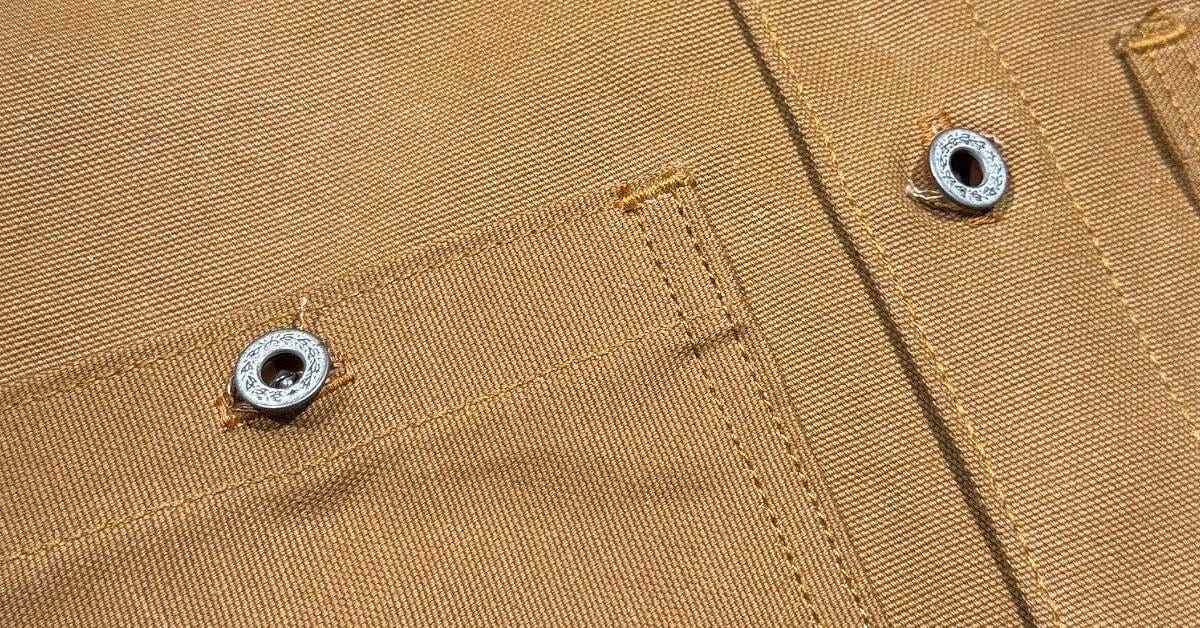
Hardware is where cheap aprons fail. Specify the material of every rivet, grommet, D-ring and swivel clip, and ask whether it is rated for the wash method you chose. Brass and stainless steel survive commercial laundering; plated steel can rust and stain the fabric. Bar-tack the stress points where straps meet the bib and where pockets meet the body, and state the stitch type in the tech pack rather than leaving it to the sewing line.
What rules apply to aprons made or sold in the US?
Three sets of rules are worth knowing before you put your name on an apron, and none of them is optional because the garment is simple.
Made in USA claims. The Federal Trade Commission's standard is that a product labelled Made in USA must be "all or virtually all" made in the United States: final assembly or processing here, all significant processing here, and components made and sourced here. The FTC finalised a Made in USA Labeling Rule in August 2021 that codifies that standard for labels and online marketing, with civil penalties for unqualified claims that don't meet it (FTC). That is why this list only includes makers whose own sites say where they sew. If a US workshop uses imported canvas, ask how it labels the apron before you print "Made in USA" on your product page.
Textile labelling. Under the Textile and Wool Acts, most clothing must carry a label with fibre content, country of origin, and the company name or Registered Identification Number (RN) of the business responsible. Care instructions go on a permanent label under a separate FTC rule (FTC). The FTC guide doesn't name aprons either way, so agree with your maker who supplies the label and whose RN goes on it, especially for a private-label run you plan to sell at retail.
Food safety. The FDA Food Code, which most states adopt in some form, says food employees "shall wear clean outer clothing to prevent contamination" of food and equipment (section 2-304.11, FDA Food Code). In practice that means a kitchen needs enough aprons per person to change one when it gets dirty, not one apron per cook. Size the order for a rotation, and check your state or county's adopted version, because local rules can add detail.
How do you brief an apron maker and compare quotes?
Send every maker the same written spec and ask the same questions, or the quotes won't be comparable. A short brief works better than a mood board.
- Use and wash method. Who wears it, for how long, and whether it goes to an industrial laundry, a home machine or a wipe-down.
- Fabric. Fibre, weave and weight in oz, plus colour with a reference swatch or Pantone number.
- Construction. Bib or waist apron, finished length and width, strap type, tie length, pocket layout and every loop.
- Hardware. Material and finish for each rivet, grommet, buckle and clip.
- Branding. Method (embroidery, leather tag, print), size and position measured from the top edge, and thread or tag colours.
- Labels and packing. Who supplies the fibre, origin and care label, whose RN it carries, and how the aprons are folded and bagged.
- Quantity and timing. First order, expected reorder size and frequency, and the date you need them in hand.
Then ask each maker four questions in writing: what the minimum is for this exact spec, what a sample costs and how long it takes, whether the sample fee is credited against the order, and what the lead time is for the bulk run after sample approval. Artifact, for example, quotes up to three weeks for a single customised apron and says a volume order can take longer (Artifact). Get that kind of statement for your quantity before you set a launch date.
Apron manufacturing FAQ
Which US apron manufacturers take custom orders?
The three in this directory all do, in different ways. CHEFtog in West Chicago builds fully custom restaurant aprons with no stated minimum. olpr. in Mooresville, North Carolina makes leather and heavy-duty aprons with your name or logo and runs a private-label page. Artifact in Omaha adds your logo or a custom colour to its own American-made aprons, but does not do white label.
What is the minimum order for custom aprons?
Lower than for almost any other garment. CHEFtog states "No Minimums". Artifact asks for 30 or more aprons for a custom colour and 50 or more for a custom print. olpr. doesn't publish a minimum. Structurally, aprons are among the lowest-minimum custom garments: one panel, few seams, no size grade, no fit block. Confirm the real minimum for your spec with each maker before you plan a launch around it.
What fabric is best for a chef apron?
Cotton duck canvas, roughly 10 to 16 oz, is the chef standard: structured, abrasion-resistant, heavy enough to hang flat. Poly-cotton twill (about 7 oz) is used where aprons go through industrial laundry, because it survives repeated commercial washing. Denim at 8 to 10 oz suits retail and barista use, softening with wear.
Why do chefs prefer cross-back aprons?
Because a neck strap hangs the weight of a wet, loaded apron off the cervical spine, and a ten-hour shift makes that hurt. Cross-back straps run over both shoulders and cross behind, spreading the load across the back.
Can waxed canvas aprons be machine washed?
No. Waxed finishes repel liquids but can't be industrially laundered; heat and detergent strip the wax. Waxed aprons are wiped down and periodically re-waxed instead. If you're supplying a restaurant group on a commercial laundry contract, specify poly-cotton twill or cotton duck, not waxed canvas.
What does a custom apron cost?
None of the three makers here publishes a base unit price for a custom apron, so any price attached to a named apron factory online is unverified. Artifact does publish its logo add-ons: $12 or more per piece for embroidery and $2 per piece for a debossed leather tag, plus one-off setup fees. Cost is driven, in order, by fabric weight and finish, seam count and strap style, hardware quality, branding method, and order size. Quote against a fixed spec sheet, not a photo.
How big is the apron market?
There's no credible standalone apron figure; searches surface only content-mill reports whose numbers contradict each other by orders of magnitude. The useful proxy is workwear: $19.2 billion in 2025, forecast to $28.1 billion by 2033, work apparel taking 74.7% of revenue (Grand View Research, 2025).
What should be in an apron tech pack?
Fabric and weight in oz, strap type with adjustment hardware, waist tie length, pocket configuration (split pouch, pen slot, towel loop), rivet material and placement, buckle or D-ring spec, branding method with artwork placed from the top edge, and the wash standard the apron must survive. Our tech pack service covers the format.
OneAim places and manages production with 80 documented clothing manufacturers in the United States. Send the product, the quantity and your target date. Within 24 hours we reply, and we place the order with the US factory in our group that already makes it. Production, invoicing and shipping run directly between you and the factory. Flat fee, no mark-up.
Start my brief US factory directory ($49)References and data
- Grand View Research, Workwear Market industry analysis, 2025. Source of the $19.2B (2025) and $28.1B (2033) market size, the 4.9% CAGR and the 74.7% work apparel share, the 2026 estimate of $20.0B. Read from the publisher's summary page, not a full report.
- National Restaurant Association, 2026 State of the Restaurant Industry, 2026. Source of the $1.55 trillion sales forecast and 15.8 million jobs figure.
- CHEFtog, About and home page, checked October 2026. Source of the West Chicago location, the "cut, sewn, and assembled in the USA" statement, the custom apron options and "No Minimums". Company-stated.
- olpr., aprons and About us, checked October 2026. Source of the Mooresville, North Carolina manufacturing address, the handmade-in-Mooresville statement and the brand and private-label apron offer. Company-stated.
- US Bureau of Labor Statistics, Occupational Employment and Wage Statistics, national estimates, May 2025. Source of the employment figures for the nine food service, personal care and meat processing occupations in the chart.
- Federal Trade Commission, Complying with the Made in USA Standard. Source of the "all or virtually all" standard and the August 2021 Made in USA Labeling Rule.
- Federal Trade Commission, Threading Your Way Through the Labeling Requirements Under the Textile and Wool Acts. Source of the fibre content, country of origin, RN and care label requirements.
- US Food and Drug Administration, Food Code. Source of section 2-304.11 on clean outer clothing for food employees.
- Artifact and Artifact, custom aprons, checked October and November 2026. Source of the Omaha studio statement, logo, colour and enhancement pricing, the 30 and 50 apron minimums, the lead time and the "not a manufacturer ... white label" statement. Company-stated.
Every company named above appears in this source list. Made-in claims, minimums, prices and lead times are the companies' own published statements, labelled as such in the text, and we did not independently audit them. Fabric weight ranges and strap and hardware guidance are general trade knowledge, not attributed to any named company. Per-apron logo costs are our arithmetic on Artifact's published rates. No factory in this article is a OneAim group member, and none paid to appear. Reviewed and updated 7 November 2026 by Will Godax.