Minimum Order Quantity (MOQ) is the smallest number of items a clothing manufacturer will produce in one run. For example, an MOQ of 150 units typically means 150 pieces of a single design in one color, often split across sizes. MOQs exist due to production costs like machine setup, fabric sourcing, and labor, which decrease per-unit costs as order sizes increase. Here's what you need to know:
- Why MOQs Matter: Higher MOQs reduce per-unit costs (e.g., $6.00 per t-shirt for 50 units vs. $3.80 for 500 units) but require more upfront investment, which can strain cash flow for small brands.
- Factors Affecting MOQs: Fabric mills often impose minimums (100–300 meters per color), and complex designs or customizations increase requirements. Simpler garments like t-shirts have lower MOQs (30–200 units), while intricate items like jackets or jeans need 150–500+ units.
- Challenges for Startups: High MOQs can lead to overstock and cash flow issues. Low MOQ suppliers may use leftover fabrics, risking inconsistencies in quality or color.
- How to Manage MOQs: Strategies include using stock fabrics, consolidating materials across designs, simplifying styles, negotiating surcharges, and splitting MOQs across colors or sizes.
MOQs are a balancing act between cost savings and flexibility. For small brands, working with manufacturers offering low MOQs (e.g., 50 units) can reduce risks while testing new designs. Larger orders, however, improve profit margins and consistency. Choose an approach that aligns with your business needs and growth stage.
Why Manufacturers Set MOQs
Main Reasons for MOQ Requirements
Manufacturers establish MOQs (Minimum Order Quantities) to ensure they can cover fixed production costs such as pattern grading, machine setup, and labor scheduling. These costs remain constant whether they produce 10 items or 1,000, making larger orders more cost-effective.
"MOQ isn't a random number we create to annoy you. It's a mathematical reality of the factory floor. If a supplier says 'No MOQ,' they aren't a factory - they are a reseller selling you generic stock." - Khan, MAVYQ Team
Fabric suppliers also play a role in setting minimums. Textile mills often require orders of 100–300 meters per color or about 440 lbs (200 kg) to ensure uniform dyeing and consistent finishing. Orders below these amounts can result in uneven shades or shrinkage issues. For instance, a single 44 lb (20 kg) roll of 320 GSM fleece yields around 28–32 hoodies. This means producing 50–60 hoodies requires at least two rolls, setting a practical minimum.
Production efficiency is another key factor. Sewing operators work more effectively with larger batches, as smaller runs lead to frequent machine adjustments and retraining, which increases downtime and defect rates. Similarly, cutting fabric for 200 units at once is far less wasteful than cutting for just 20 units.
The financial impact of small orders can be steep. For example, producing just 10 units can result in setup costs of $21.00 per piece. However, at 50 units, these costs drop to $4.20 per piece, highlighting the economic pressures that influence MOQ requirements.
Common Challenges for Startups and Small Brands
Startups and small brands often face hurdles tied to these fixed costs and efficiency demands. High MOQs can create a cash flow problem, requiring significant upfront investment. For example, ordering 500 units at $4.50 each means committing $2,250 before making any sales. This locks up capital in unsold inventory and takes up costly warehouse space.
Inventory management is another issue. Small brands may be forced to order more units than they can sell, leading to excess stock. This not only ties up resources but also limits flexibility in adapting to new designs or market trends.
Low MOQ suppliers can also pose quality risks. Manufacturers offering very low MOQs (under 30 units) often rely on deadstock or leftover fabrics, making it difficult to reorder the same color or maintain consistent fit and shrinkage in future batches.
"The cheapest or lowest MOQ supplier often ends up being the most expensive once you count delays, remake costs, and lost sales." - AEM Textile
Benefits of Meeting MOQ Requirements
Despite the challenges, meeting MOQs comes with clear advantages, particularly in cost savings and production consistency. Larger orders lower the per-unit cost significantly. For example, a t-shirt priced at $6.00 for 50 units may drop to $4.50 at 150 units and $3.80 at 500 units. This directly improves profit margins and competitiveness.
Quality control also benefits from larger runs. Operators achieve a steady rhythm during extended production, reducing errors and ensuring consistency across the entire batch. Additionally, ordering in bulk often grants access to fresh fabric dye lots, ensuring color accuracy and repeatability for future orders.
Meeting MOQs can also strengthen relationships with manufacturers. Factories tend to prioritize clients who place consistent orders, which can lead to perks like faster turnaround times, priority scheduling during busy seasons, and greater flexibility for design or delivery changes. Over time, this reliability can become a powerful advantage, setting your brand apart in the market.
sbb-itb-76527d2
How to Use MOQs to Budget Smarter & Grow Your Apparel Brand (Secret Revealed)
How MOQs Vary Across Different Garments
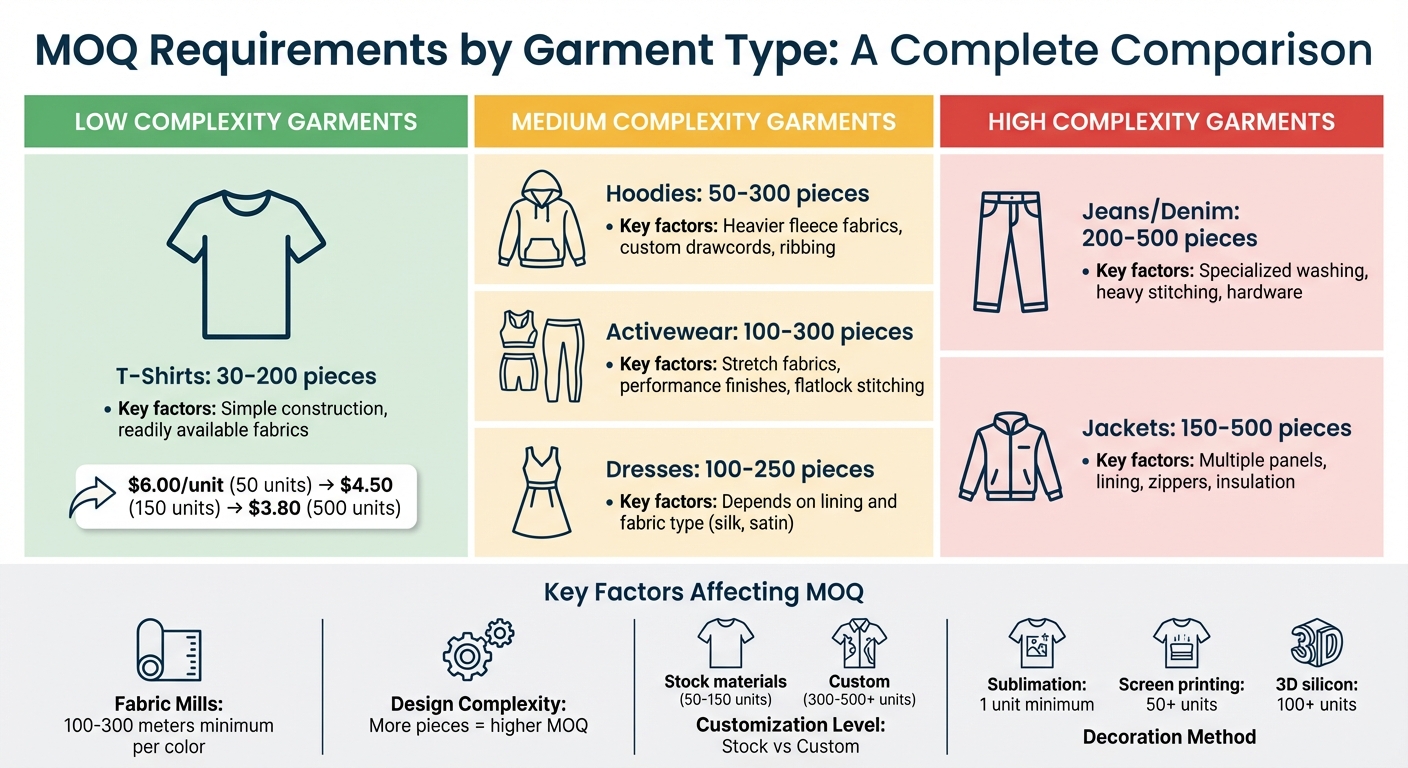
MOQ Requirements and Cost Comparison by Garment Type
What Affects MOQ Numbers
One of the biggest drivers of MOQ (Minimum Order Quantity) is fabric sourcing. Fabric mills often set minimums of 100–300 meters per color to ensure consistency in dyeing and finishing processes. To put this into perspective, if a t-shirt requires 0.8 meters of fabric and the mill's minimum is 150 meters, you'd need to produce at least 188 shirts to use up the fabric efficiently.
Another key factor is design complexity. Simpler garments like basic t-shirts or leggings require fewer pattern pieces and quicker sewing times, which keeps MOQs on the lower side. On the other hand, more intricate items like denim jeans or tailored blazers involve multiple layers, specialized hardware, and longer production setups. For example, technical outerwear can require over 50 production steps, pushing MOQs to 400–500+ units to make manufacturing worthwhile.
The level of customization also plays a significant role in determining MOQs. Using pre-existing stock materials can lower the minimums to around 50–150 units. However, if you're opting for custom finishes or unique designs, MOQs can jump to 300–500+ units. Even the decoration techniques matter: sublimation printing, being digital, can be done for just one unit, while screen printing typically requires a minimum of 50 units due to the cost of setting up the screens. Similarly, 3D silicon decorations often demand a minimum of 100 units because of the custom molds needed.
By understanding these factors, brands can better plan their production to align with market demand and avoid over- or under-ordering. These variables significantly influence the MOQ ranges across different garment categories.
Standard MOQs by Garment Type
Here’s a look at typical MOQ ranges for various garment types, based on the factors above:
| Garment Type | Typical MOQ Range | Key Factors |
|---|---|---|
| T-Shirts | 30–200 pieces | Simple construction, readily available fabrics |
| Hoodies | 50–300 pieces | Heavier fleece fabrics, custom drawcords, ribbing |
| Activewear | 100–300 pieces | Stretch fabrics, performance finishes, flatlock stitching |
| Dresses | 100–250 pieces | Depends on lining and fabric type (e.g., silk, satin) |
| Jeans/Denim | 200–500 pieces | Specialized washing, heavy stitching, hardware |
| Jackets | 150–500 pieces | Multiple panels, lining, zippers, insulation |
Simpler items like t-shirts tend to have lower MOQs due to their straightforward design and standard materials. Moderately complex garments like hoodies and activewear require more specialized fabrics and processes, which increase their minimums slightly. Meanwhile, highly complex pieces like denim and jackets demand extensive production steps, custom hardware, and specialized equipment, leading to much higher MOQs.
How to Negotiate and Manage MOQs
Finding Manufacturers with Low MOQs
Managing MOQs can feel like walking a tightrope, but finding the right manufacturer can make all the difference. Larger factories that thrive on high-volume production often shy away from smaller orders since they disrupt their workflow. Instead, smaller or vertically integrated manufacturers are often more open to working with startups.
Take OneAimApparel, for example. They offer MOQs as low as 50 units per style, making them a great choice for new brands testing their first designs without needing a huge cash outlay. Compare that to the standard 500–1,500+ piece minimums from factories in countries like China, Bangladesh, or Vietnam, and the benefits for small brands become clear. Lower MOQs help reduce the financial risks that small businesses often face.
When evaluating manufacturers, it’s important to understand what drives their MOQ requirements. Is it fabric minimums, machine setup costs, or labor expenses? Some factories with in-house fabric libraries or stock materials can sidestep fabric mill minimums, making smaller production runs possible.
Once you’ve identified a manufacturer, it’s time to explore strategies to lower MOQs and make your production run work for you.
Ways to Lower MOQ Requirements
There are several ways to work around high MOQs without compromising your production goals:
- Consolidate materials: Using the same base fabric across multiple styles - like leggings, shorts, and sports bras - can help meet fabric mill minimums (often around 200 kg or 10 rolls) without overproducing any single item.
- Use stock fabrics: Opting for existing materials in a factory’s inventory can bring MOQs down to 50–150 units. Evergreen colors like black, white, navy, and gray are typically available in bulk, making this approach even easier.
- Simplify designs: Limit the variety of colors, trims, and custom labels in your first collection. Consistent hardware across styles can also help meet bulk purchasing thresholds without inflating production numbers. For processes like embroidery or screen printing, be aware that they usually require minimums of 30–50 units for embroidery and 50–100 units for screen printing.
- Negotiate with surcharges: Many manufacturers will accept smaller orders if you agree to pay a slightly higher per-unit cost to offset their setup expenses. Proposing a small trial run can also build trust and potentially lead to more flexible terms in the future.
- Blend variants: Ask your manufacturer if they’ll allow you to split a style’s MOQ across different colors or sizes. For instance, instead of producing 300 pieces in one color, negotiate for 300 pieces split across three colors (100 each).
- Provide detailed tech packs: Clear specifications reduce the factory’s risk, making them more likely to accept smaller orders.
These strategies can help you strike a balance between keeping costs manageable and maintaining flexibility.
Pros and Cons of MOQ Negotiation
Negotiating lower MOQs isn’t without its trade-offs. Here’s a comparison to help you weigh the options:
| Factor | Negotiating Lower MOQs | Accepting Higher MOQs |
|---|---|---|
| Unit Cost | Higher due to surcharges and inefficiencies | Lower, thanks to economies of scale |
| Cash Flow | Easier to manage with less capital tied up in inventory | More strain due to significant upfront investment |
| Inventory Risk | Reduced risk of unsold stock | Higher risk of overstock |
| Quality Consistency | May vary, especially if using deadstock fabrics | More consistent with larger, efficient production runs |
| Lead Times | Often longer due to batching of smaller runs | Shorter, as larger orders get priority |
| Design Flexibility | Greater flexibility to test multiple designs | Limited by commitment to larger volumes |
"MOQ is not about forcing buyers to order more; it is about ensuring that production runs don't operate at a loss."
– B. Balaji, Factori
It’s important to remember that extremely low MOQs often come with compromises. As AEM Textile explains, "When you see a factory offering '50 pieces per style' or 'no MOQ,' it usually means they're using leftover or mixed-lot fabrics". While this can save costs, it may lead to inconsistencies in color or material for future reorders, potentially affecting your brand’s identity.
On the flip side, accepting higher MOQs can unlock significant cost savings. For instance, a t-shirt that costs $6.00 at 50 units might drop to $4.50 at 150 units and $3.80 at 500 units. However, for brands with limited budgets or those testing the waters, the flexibility and reduced risk of smaller orders might outweigh the appeal of lower per-unit costs.
Conclusion
MOQs are a reflection of the fixed costs and practical realities of clothing production. These minimums stem from factors like machine setup, pattern grading, and fabric mill minimums, which often range between 100–300 meters (roughly 328–984 feet) per color.
For new brands, careful planning can help safeguard cash flow and minimize the risks of excess inventory. Strategies such as limiting color options, using the same base fabric for multiple designs, and choosing stock fabrics whenever possible can help meet manufacturer requirements without incurring high upfront costs or being stuck with unsold inventory. This is particularly important given that nearly 90% of fashion startups fail.
Working with a manufacturer that offers a 50-unit MOQ can be a game-changer, allowing you to test designs without committing too much capital. This approach not only helps maintain cash flow for essentials like marketing but also supports scaling your business. MOQs also provide insight into a factory's operational model and whether it aligns with your brand's current needs. As your brand grows, meeting these minimums becomes less challenging, and per-unit costs often decrease - highlighting the importance of starting with a smart, resource-conscious strategy.
FAQs
How is a clothing MOQ calculated?
A clothing MOQ (Minimum Order Quantity) is determined by the fixed costs involved in manufacturing, like fabric sourcing, setup, and production processes. Manufacturers establish MOQs to make sure these expenses are covered, ensuring production remains financially practical. Key factors influencing MOQs include the minimum amount of fabric needed, the time it takes to set up production, and the factory’s efficiency. These elements work together to define the smallest batch size that balances covering costs, maintaining quality, and keeping per-unit costs manageable for smaller orders.
Can I split an MOQ across sizes or colors?
Yes, many manufacturers let you divide a minimum order quantity (MOQ) across different sizes or colors. For instance, you could split an order of 2,000 pieces into various styles, colors, or sizes, depending on how flexible the factory is. The best approach is to talk directly with the manufacturer about your needs to figure out a solution that works for both sides.
What’s the smartest MOQ for a new brand launch?
When launching a new brand, finding the right MOQ (Minimum Order Quantity) is all about balancing upfront costs with quality and market testing. For many startups, ordering 30–75 units per style is a sweet spot, especially for staple items like T-shirts. This range allows you to test designs, measure demand, and avoid the headache of excess inventory - all while covering the manufacturer’s setup costs.
Starting with 30–50 units is a practical approach. As your brand gains traction, you can gradually increase your MOQs to take advantage of lower costs per unit through economies of scale.