Quality control in garment production ensures every item meets standards for fit, durability, appearance, and safety. Here's the process in a nutshell:
- Catch defects early: Inspections at every stage - from raw materials to final packaging - reduce costly errors and protect your reputation.
- Set clear standards: Use tools like "golden samples", measurement tolerances (e.g., ±0.25 inches), and the AQL system to maintain consistency.
- Inspect materials: Check fabrics for defects (holes, stains) using the 4-Point System, test GSM for weight, and verify shrinkage and colorfastness.
- Monitor production: Inspect during cutting, sewing, and finishing to catch issues like skipped stitches, misaligned seams, or shading mismatches.
- Final checks: Ensure finished garments meet size, color, and safety specs. Use tools like needle detectors and barcode scanners for accuracy.
Why it matters: A $2 inspection can prevent a $20,000 recall. Consistent quality builds trust, reduces waste, and keeps customers happy. The key? A systematic approach that prioritizes early detection and clear communication with factories.
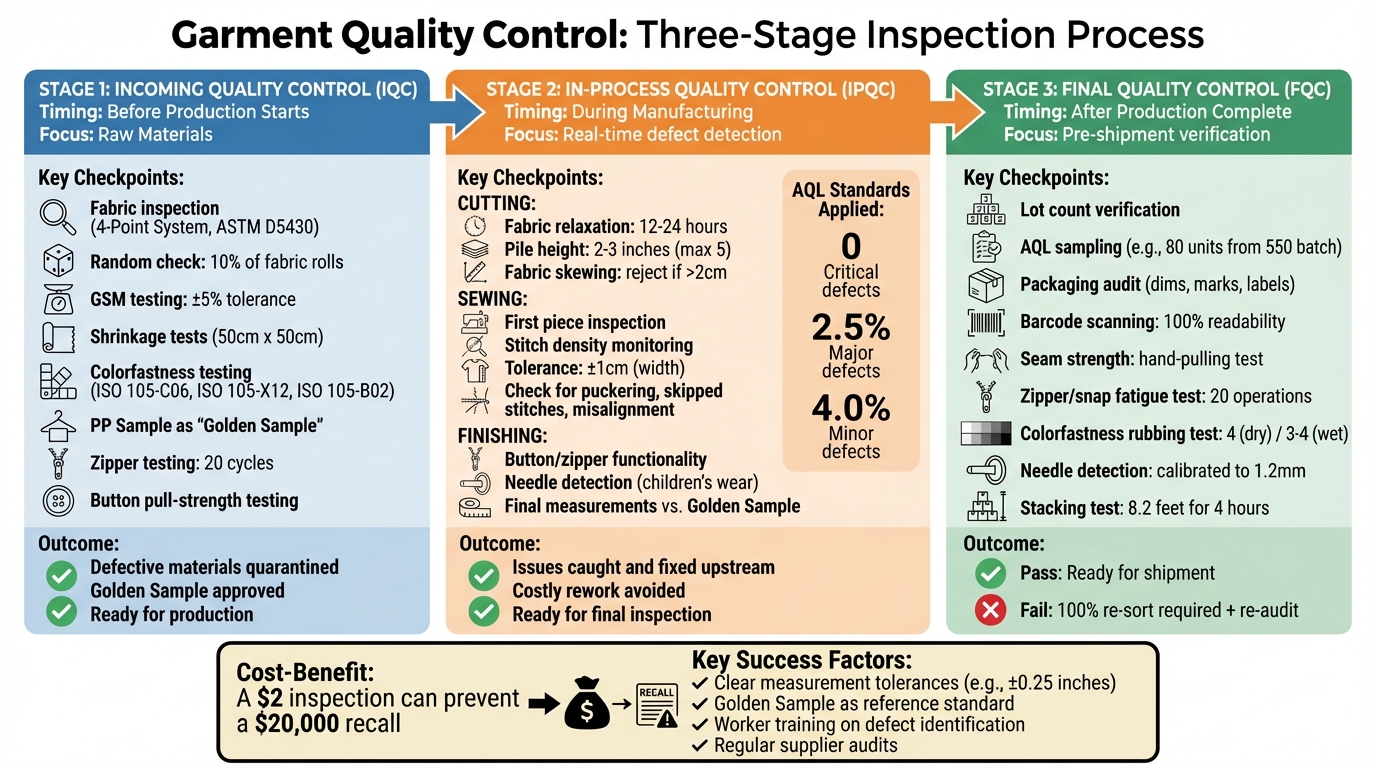
Three-Stage Garment Quality Control Process: IQC, IPQC, and FQC
Mastering Quality Control in Apparel Manufacturing
sbb-itb-76527d2
Quality Control Before Production Starts
Quality control begins well before any garment is stitched. Incoming Quality Control (IQC) focuses on inspecting raw materials - fabrics, trims, and labels - as soon as they arrive at the factory. This early step is critical for minimizing waste and ensuring production runs smoothly.
Fabric Inspection and Testing
Fabric rolls undergo a visual inspection using the 4‑Point System (ASTM D5430), which grades fabric quality by assigning penalty points for defects like holes, stains, slubs, or color shading. Typically, inspectors randomly check at least 10% of the fabric rolls in a shipment. It's also important to verify that the fabric's usable width matches the purchase order to avoid complications during marker making and cutting.
Physical testing follows visual checks. GSM (Grams per Square Meter) is measured to confirm the fabric’s weight aligns with specifications, as deviations beyond ±5% are generally unacceptable. For instance, a 100% cotton jersey t-shirt should fall within 160–180 GSM. Shrinkage tests involve washing and drying 50 cm x 50 cm swatches, which helps patternmakers adjust allowances. Additional tests include colorfastness for washing (ISO 105-C06), rubbing (ISO 105-X12), and light exposure (ISO 105-B02). For children's wear, extra precautions like testing for pH, formaldehyde, azo dyes, and flammability are crucial.
Fabrics containing spandex or elastane should sit unrolled for up to 24 hours before cutting. This allows the material to relax, reducing the risk of undersized garments. Any defective materials should be quarantined immediately.
These rigorous inspections and tests lay the groundwork for consistent production quality.
Pattern and Sample Verification
Patterns must align with the tech pack specifications, ensuring all pieces, notches, and grainlines are correctly positioned. Cutting against the grainline can distort the finished garment, so proper alignment is essential. Additionally, pattern grading must be accurate across all sizes to avoid fit issues when scaling from samples to bulk production.
The Pre‑Production (PP) sample serves as the "golden sample", the final standard for fit, construction, and workmanship before mass production begins. This sample should use actual bulk fabric and trims, not leftover materials. Designer Heidi (Sew Heidi) shared an example from September 2023, where skipping the PP sample stage resulted in an entire order with incorrect dimensions, leaving the brand with unsellable garments.
Testing hardware is equally important. Zippers should be tested with 20 cycles to confirm durability, and buttons must meet pull-strength requirements to ensure reliability.
"The Pre‑Production (PP) sample is arguably the most important checkpoint in the entire manufacturing process... It serves as the 'golden sample' or the contract between the brand and the factory."
– MFG Merch
A pre‑production meeting with the factory team is essential to review specifications, tolerances, and the golden sample. Keep a sealed reference sample in-house for resolving any disputes that may arise during or after production.
Establishing clear pre‑production protocols ensures fewer errors and a smoother transition to bulk manufacturing. These steps set the stage for a successful production process.
Quality Control During Manufacturing
In-Process Quality Control (IPQC) plays a crucial role in identifying defects early during production. By catching issues in real-time - whether during cutting, sewing, or finishing - manufacturers can avoid costly rework and maintain high standards. Each stage of production has its own checkpoints tailored to ensure consistent quality.
Production Stage Checkpoints
Cutting
To maintain accuracy, fabric must relax for 12–24 hours before cutting, especially if it's a stretch material. Pile height is kept between 2–3 inches, with a maximum of 5 inches, to ensure patterns are precise. Inspectors check that bundled pieces are numbered correctly and grouped by shade to prevent color mismatches. For example, if a chest measurement is 60 cm, any fabric skewing beyond 2 cm typically results in rejection.
Sewing
The sewing process starts with a "first piece" inspection to verify proper machine setup. Inspectors then monitor stitching throughout production, focusing on areas like neck seams, armholes, and cuffs. They check for issues like puckering, skipped stitches, and misaligned components. For knitted t-shirts, tolerances are usually ±1 cm for width.
Finishing
The finishing stage involves a final round of checks. Buttons and zippers are tested repeatedly, pressing quality is reviewed, and garments are run through a needle detector to ensure no metal fragments remain - especially critical for children's clothing. Final measurements are compared to the golden sample to confirm compliance.
"A true quality culture is built on discipline at every stage: from fabric gate inspection to the way each finished piece is folded and packed. Don't just rely on the final audit - problems are easier and cheaper to fix upstream."
– Rain Chen, Factory Expert
Quality Checkpoint Comparison Table
| Production Stage | Key Checkpoints | Common Defects to Catch | Inspection Frequency |
|---|---|---|---|
| Cutting | Fabric relaxation, pile height, pattern alignment, bundling/numbering | Fabric skewing, unequal piece sizes, shading/color mismatch | Per batch/marker |
| Sewing | Stitch density (SPI), seam strength, critical joins (neck/armhole), label placement | Skipped stitches, puckering, open seams, misaligned components | Continuous/In-line |
| Finishing | Button/zipper functionality, pressing quality, final measurements, loose threads | Shiny marks from iron, broken snaps, out-of-tolerance dimensions | 100% or AQL Sample |
AQL Standards
The Acceptable Quality Level (AQL) system ensures defects are kept within defined limits. Standard settings are 0/2.5/4.0 - allowing zero critical defects, 2.5% major defects, and 4.0% minor defects. For a batch of 550 garments, a General Level II inspection typically involves checking 80 units.
Final Quality Control After Production
Final quality control ensures that completed garments meet all specifications outlined in the tech pack, as well as regulatory and safety standards. This step builds on earlier in-process checks and serves as the last line of defense before garments are deemed ready for shipment. It follows pre-production and in-process inspections, completing the production cycle.
Final Inspections and Testing Procedures
Inspectors begin by verifying lot counts and storage conditions. They confirm that the total quantity matches the packing list and that shipping marks are correct, ensuring inventory accuracy and proper storage.
"The inspector will check if the packed items are stored properly, in the correct quantity, and if they have the right shipping marks. This helps to ensure production progress, verify storage conditions, and estimate as precisely as possible the total quantity available for inspection." – Polly Chen, Quality Control Expert
For a batch of 550 units, standard AQL settings under General Level II typically require inspecting 80 garments.
Packaging audits focus on carton dimensions, shipping marks, and label content, including fiber composition, origin, care instructions, and RN numbers, as required by FTC regulations. Barcodes are scanned digitally to catch errors that visual checks might miss.
Garments are also inspected for defects such as skipped stitches, stains, color inconsistencies, twisted seams, misaligned panels, puckering, and needle damage. All items are compared to the "Golden Sample" using pre-established tolerances.
The table below outlines key tests performed during the final inspection:
| Test Category | Specific Procedure | Requirement/Standard |
|---|---|---|
| Physical Strength | Seam Strength Check | Connections must withstand hand-pulling with no damage |
| Functional | Fatigue Test | Zippers/snaps operated 20 times; must remain functional |
| Colorfastness | Rubbing Test | No color transfer above 4 (dry) or 3–4 (wet) on a grey scale |
| Safety | Needle Detection | Scanned for metal contamination using a conveyor-type detector |
| Packaging | Stacking Test | Cartons stacked to 8.2 feet for four hours; no bottom carton compression |
Functional tests include operating zippers and snaps 20 times to ensure they remain intact. Buttons undergo pull tests, where inspectors apply force for 10 seconds to confirm durability. Colorfastness tests involve rubbing fabric 10 times over a 4-inch distance with 9N (2.2 lbs) of force; acceptable results are 4 on a gray scale for dry tests and 3–4 for wet tests. For safety, especially in children's wear, garments must pass through a needle detection machine calibrated to 1.2 mm.
The batch either passes or fails based on whether the defect count exceeds the AQL limit. If a batch fails, a 100% re-sort is conducted to identify and correct all defective units before scheduling a re-audit. The final inspection report often doubles as the "Inspection Certificate" required for shipment, and it also highlights areas for improvement in future production runs.
Quality Control Tests and Checklists
After completing in-process and final inspections, using a structured checklist provides a clear framework for assessing garment quality. This approach removes uncertainty by outlining specific checks for each stage, ensuring consistency in evaluating size, color, and workmanship. Such consistency helps maintain brand standards and minimizes customer returns.
"A well-structured quality control checklist serves as a vital tool for manufacturers and suppliers alike, ensuring that every piece of clothing meets the required specifications before it reaches the consumer." – Hook and Eye UK
The checklist should classify defects into three categories: Critical (safety risks or regulatory violations), Major (functional issues or major visual defects), and Minor (small aesthetic flaws like loose threads). This system helps teams address problems effectively while applying the proper Acceptable Quality Level (AQL) standards - usually set at Critical: 0, Major: 2.5, and Minor: 4.0. These classifications streamline testing and inspection processes.
For maximum clarity and efficiency, translate the checklist into the supplier's native language. Include precise measurement tolerances in the tech pack and consistently use the Golden Sample as a reference during inspections. These steps ensure a unified quality control process from the start of production to the final inspection.
Standard Garment Quality Checklist
Size fitting is verified by comparing garments to the measurement chart in the tech pack, ensuring symmetry. Measurement tolerances typically range from ±0.5 cm to ±2.5 cm, depending on the garment area. Color matching involves checking garments against Pantone codes under standardized lighting, reducing subjective interpretations of color.
For stitch accuracy, inspectors check the number of stitches per inch (usually 7–12 SPI for durable seams), confirm proper thread tension, and ensure there are no skipped or broken stitches. Seam strength is tested manually in stress-prone areas like pocket corners and plackets, with standard garments requiring 80–120 Newtons and heavier fabrics needing up to 200 Newtons.
Fabric weight is measured using cutting tools to calculate GSM (grams per square meter), with results acceptable within a ±5% range of the specified standard. Durability tests for zippers and buttons involve checking that they withstand at least 5,000 cycles. Shrinkage tolerances, typically ≤3–5%, are verified through mock-wash tests on sample garments.
The table below outlines key inspection areas and their corresponding standards:
| Inspection Category | Key Parameters | Standard/Tolerance |
|---|---|---|
| Fabric Quality | GSM, fiber composition, shrinkage | Shrinkage: ≤3–5% |
| Stitching | SPI, seam slippage, loose threads | 7–12 SPI; Threads ≤3 mm |
| Color | Pantone matching, rub tests | Variance: ≤0.5 Delta E |
| Construction | Zipper/button fatigue, symmetry | 5,000+ cycles for fasteners |
| Safety | Needle detection, sharp objects | Calibration: 1.2 mm for metal |
| Packaging | Barcode scan, labeling accuracy | 100% barcode readability |
These rigorous quality checks help fashion brands deliver garments that meet high standards, ensuring consumer satisfaction and brand reliability.
Quality Control Tools and Technology
Today's manufacturing processes rely on advanced tools that detect defects with greater speed and precision. For dimensional accuracy, calibrated tools and mannequins ensure measurements align with tech pack tolerances. When it comes to fabric analysis, GSM cutters and scales are used to measure fabric weight, ensuring it stays within a ±5% tolerance. To maintain color consistency, color assessment cabinets equipped with standardized light sources (D65, TL84, and UV) are paired with Pantone charts to confirm uniform shades across production batches.
Safety checks are also a priority. Needle detectors and metal checkers are standard for scanning finished garments - especially for children's clothing - to detect broken needle fragments or small metal objects, with sensitivity calibrated to identify metal as small as 1.2 mm. Durability tests for zippers, buttons, and fasteners are conducted using pull testers and fatigue testers. Additionally, lab equipment evaluates fabric performance over time, measuring pilling, abrasion, and rub fastness. These traditional tools form the backbone of quality control, paving the way for more advanced technologies.
Modern Quality Control Equipment
Building on these foundations, digital tools are revolutionizing quality control processes. Product Lifecycle Management (PLM) platforms streamline operations by centralizing tech packs, tracking revisions, and improving communication with vendors. These platforms can cut tech pack creation time by 55% and shave four weeks off development timelines. Mobile-first Quality Management Systems (QMS) further enhance efficiency, allowing inspectors to log defects with photos directly on the production floor. Automated alerts for nonconformities ensure swift corrective actions. Barcode scanners, whether handheld or app-based, verify that shipping and retail labels are correctly scannable and linked to accurate product data.
Artificial intelligence is taking accuracy to a new level. In October 2018, The Hong Kong Polytechnic University’s Textile and Apparel Artificial Intelligence (TAAI) Research Team, led by Prof. Calvin Wong, introduced "WiseEye." This AI-powered system combines machine vision and deep learning to automate fabric inspections. During six months of manufacturing trials, WiseEye identified 40 common fabric defects at a resolution of 0.1 mm/pixel, reducing fabric loss and waste by 90% compared to human inspections.
"WiseEye is a unique AI-based inspection system that satisfies the requirements of textile manufacturers... The system effectively minimises the chance of producing substandard fabric by 90%, thus substantially reducing loss and wastage in the production." – Prof. Calvin Wong, Cheng Yik Hung Professor in Fashion, PolyU
These digital advancements complement traditional inspection methods, strengthening the overall quality control framework. Manufacturers are encouraged to adopt tools that integrate seamlessly with existing ERP and PLM systems, provide real-time data visibility, and meet international standards like ISO, ASTM, and AATCC. Using mobile devices during inspections ensures instant data synchronization with visual documentation, enabling teams to shift from reactive problem-solving to proactive defect prevention.
Methods for Maintaining Consistent Quality
Achieving consistent quality in production requires a well-structured approach that includes thorough worker training, clear documentation, and vigilant supplier oversight. By focusing on quality from the beginning, you can avoid costly fixes later in the process.
Worker Training and Standard Procedures
Hands-on training in a designated area allows new workers to develop their skills without affecting ongoing production. A solid training program often includes cross-training, enabling workers to handle multiple tasks. This flexibility helps balance the production line during bottlenecks or when workers are absent. In labor-heavy departments like sewing, maintaining an additional 5% workforce is recommended to cover absenteeism.
Visual Standard Operating Procedures (SOPs) are essential for communicating quality expectations, especially in environments with language barriers. Tools like posters, pictograms, and whiteboards at workstations can illustrate exact specifications. Before bulk production begins, factories should create an approved "Golden Sample" that serves as the benchmark for stitching, measurements, and construction. Operation bulletins that detail task sequences and standard allowed minutes (SAM) further ensure consistency across shifts.
Workers should also be trained to spot and report defects immediately at their workstations. Identifying issues early prevents them from escalating further down the line, reducing repair rates. For example, while the average repair quota during final inspections is around 3%, this figure drops significantly when problems are addressed promptly. Additionally, training programs should include basic machine maintenance to prevent issues like skipped stitches, uneven tension, or oil stains caused by poorly maintained equipment.
This comprehensive approach to worker training works hand-in-hand with supplier oversight to ensure quality at every stage of production.
Supplier Monitoring and Regular Audits
Regular audits are crucial for verifying that raw materials meet safety and durability standards. Using third-party inspectors or scheduling external audits provides an unbiased evaluation of quality and reduces the risk of internal biases. These audits also ensure that suppliers adhere to the "Golden Sample" and the technical specifications (tech packs), maintaining consistency in stitching, measurements, and decorative details across batches.
"A true quality culture is built on discipline at every stage: from fabric gate inspection to the way each finished piece is folded and packed. Don't just rely on the final audit - problems are easier and cheaper to fix upstream." – Rain Chen, Factory Insight
To eliminate ambiguity, tech packs should define clear measurement tolerances (e.g., ±0.25 inches for chest width), giving inspectors precise pass/fail criteria. Implementing the AQL (Acceptable Quality Level) sampling standard further ensures a data-driven approach to quality control, minimizing subjective judgments. Conducting "First Piece" inspections - where the first completed item of a new batch is thoroughly checked - helps catch setup errors before full-scale production begins.
Conclusion
Systematic quality control transforms production from a reactive scramble into a smooth, predictable process. By adopting a three-layer approach - Incoming Quality Control (IQC), In-Process Quality Control (IPQC), and Final Quality Control (FQC) - manufacturers can identify and address defects early, saving time and money. Catching issues at the right stage not only prevents costly mistakes but also reduces waste and boosts overall efficiency.
Avoiding a large-scale product recall can save millions of dollars. But the benefits go beyond finances - consistent quality strengthens brand reputation and builds customer loyalty over time.
For customers, this system ensures garments maintain their shape, colors stay vibrant, and sizes remain consistent across batches. It eliminates the annoyance of unpredictable fits and ensures components work as expected. Plus, thorough testing protects consumers from risks like sharp objects or harmful chemicals.
The backbone of these advantages lies in clear documentation and adherence to standards. Tools like tech packs and the "Golden Sample" provide measurable benchmarks, while regular supplier audits and ongoing worker training ensure that quality becomes a core part of production - not an afterthought.
Ultimately, these practices solidify your brand's reputation for dependability. Each inspection and precise measurement reinforces trust, setting your brand apart in a competitive market. When quality is built into every step, it speaks volumes about your commitment to excellence.
FAQs
How do I choose the right AQL level for my order?
Choosing the right AQL (Acceptable Quality Level) requires balancing your quality expectations, the type of product you're dealing with, and what your buyers expect. For premium or high-end items, a lower AQL (like 0.25%) is often more appropriate to maintain stringent quality. On the other hand, a higher AQL (such as 2.5%) might be acceptable for products where minor defects won’t significantly impact functionality or customer satisfaction.
When deciding, consider factors like your lot size, the sample size, and your inspection plan. It's also a good idea to combine final inspections with inline checks during production. This approach helps you identify and address defects early, ensuring a more consistent level of quality throughout the process.
What tests should I require for fabric before cutting starts?
Before starting the cutting process, it's important to run several key fabric tests to guarantee quality. These include checking for defects, ensuring color consistency, and assessing fabric strength. Common methods involve visual inspections to identify flaws, color matching to maintain uniformity, and tests for properties like tensile strength and dimensional stability.
Pre-production checks are equally important. These include evaluating fabric relaxation, measuring shrinkage, and ensuring the material meets technical specifications. Taking these steps minimizes waste, avoids production issues, and helps maintain high-quality standards.
When should I use 100% inspection instead of sampling?
When the risk of defects is high or the consequences are severe - think safety issues, compliance violations, or damage to your brand reputation - 100% inspection is the way to go. This approach ensures every single item is checked, making it ideal when passing even one defective product would be too costly or unacceptable.
On the other hand, sampling methods - such as AQL (Acceptable Quality Limit) - work well for routine inspections. These methods are more cost-efficient and practical when defect risks are lower and inspection costs need to be balanced with operational efficiency.
