Choosing between Cut and Sew and Print on Demand (POD) depends on your budget, goals, and production needs. Here’s the quick takeaway:
- Print on Demand is perfect for low-risk entry. It requires no upfront inventory, making it ideal for testing designs or starting with little capital. However, it offers lower profit margins (15%-40%) and limited control over customization.
- Cut and Sew allows for full control over design, fabric, and quality, with higher profit margins (60%-80%) at scale. But it demands significant upfront investment, technical expertise, and longer timelines.
Key Differences:
- POD: Low cost, fast setup, limited customization, higher per-unit cost.
- Cut and Sew: High cost, long lead time, full design control, lower per-unit cost at scale.
Quick Comparison:
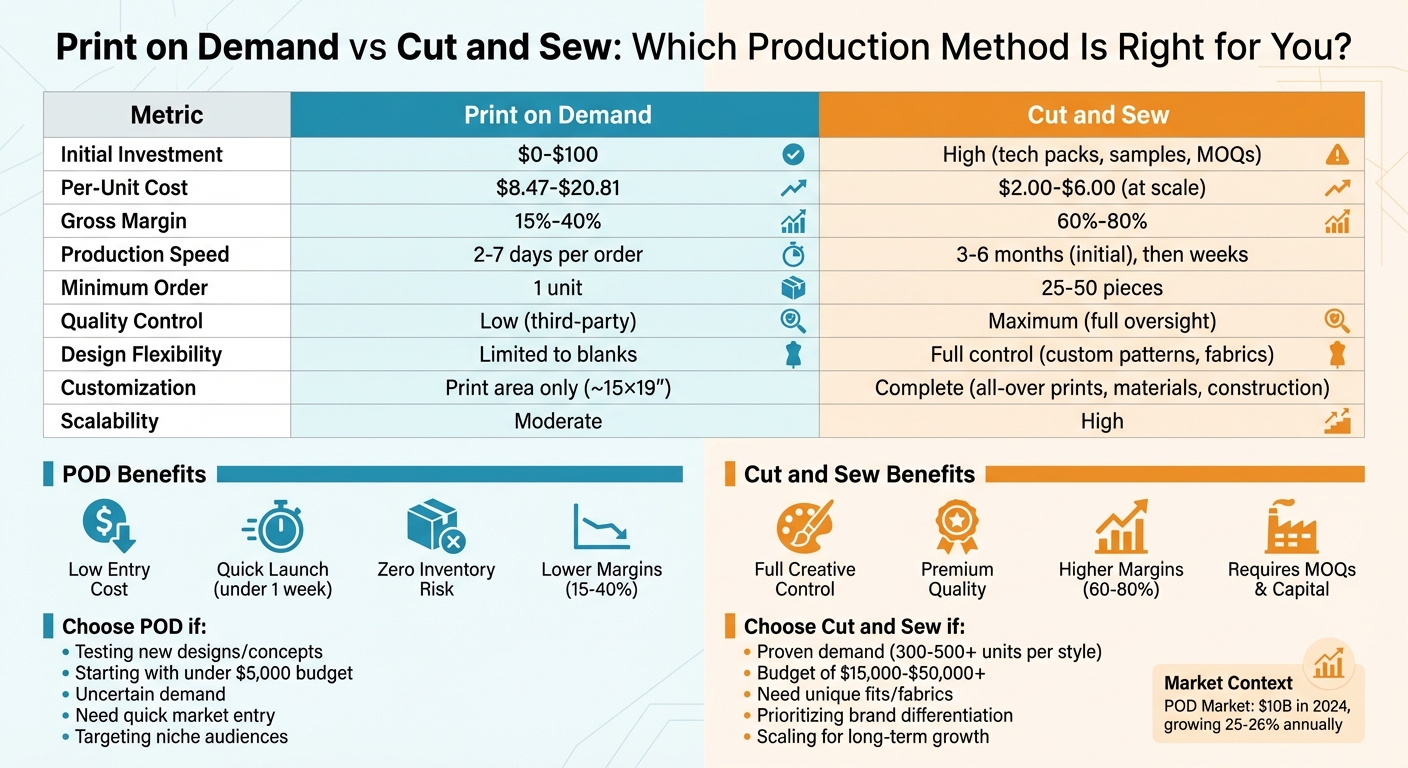
| Metric | Print on Demand | Cut and Sew |
|---|---|---|
| Initial Investment | $0-$100 | High (tech packs, MOQs) |
| Per-Unit Cost | High ($8.47–$20.81) | Low at scale ($2–$6) |
| Margins | 15%-40% | 60%-80% |
| Customization | Limited to blanks | Full control |
| Production Speed | 2–7 days per order | 3–6 months (initial) |
| Ideal For | Testing ideas, small runs | Established brands, scaling |
Use POD to validate demand or launch with minimal risk. Switch to Cut and Sew when scaling or prioritizing premium quality.
Print on Demand vs Cut and Sew: Complete Comparison Guide
Private Label vs Print on Demand vs Cut & Sew Manufacturing | Pro & Cons | What's the Best Option
sbb-itb-76527d2
Print on Demand: Low-Risk Entry Point
Print on demand (POD) is a business model where you upload your designs, and the provider takes care of printing and shipping when orders come in. This setup means you don't have to worry about managing inventory, paying upfront for stock, or handling shipping logistics - the provider does it all.
The biggest advantage? It eliminates the need for upfront capital. You can start a POD store with as little as $50 to $100, which covers essentials like a domain, an e-commerce subscription, and sample products to check quality. Alternatively, you can even start for free on platforms like Redbubble. Compare that to traditional manufacturing, where you'd need thousands of dollars just to produce your first batch.
"Print on demand is appealing not only because of the entry costs associated with it, but also because of its flexibility." - Amelia Sebastian, Affix Apparel
The market for POD is thriving. In 2024, it reached about $10 billion and is growing at a rate of 25% to 26% annually. Many brands use POD as a testing ground for new ideas before committing to large-scale production. For example, in 2025, Darren Metz, a member of Snotty Nose Rez Kids, started with just $50 to create 15 iron-on printed t-shirts. After selling out, he reinvested the profits and scaled up to orders of over 100 screen-printed units.
However, there’s a trade-off: margins. POD typically offers gross profits of 15% to 40%, which is much lower than the 60% to 80% possible with bulk production methods like Cut and Sew.
Benefits of Print on Demand
No waste and quick market entry. Since items are only produced after a customer places an order, there's no risk of unsold inventory. This approach also avoids the overproduction issues common in traditional fashion. With designs ready, you can launch a store in under a week. Platforms like Shopify and Etsy integrate with POD services, automating everything from orders to delivery. This leaves you free to focus on marketing and creating designs.
A safe way to test new ideas. POD is perfect for experimenting with designs, niches, or product ideas without financial risk. If a design doesn’t sell, you can simply remove it from your store. If it does well, you can switch to bulk production methods like Cut and Sew to improve margins. For instance, POD allows you to target specific audiences - like "nurses who love hiking" - without committing to large production runs.
Low operational complexity. Most POD services are white-label, meaning the items arrive at your customer’s door with your branding, not the printer’s. This keeps things simple, especially when you're just starting out and figuring out what resonates with your audience.
While POD offers a low-risk, fast way to launch, keep in mind that its lower margins can limit profitability compared to other production methods.
Drawbacks of Print on Demand
Lower profit margins. With gross profits ranging from 15% to 40%, pricing requires careful planning to ensure you cover costs like platform fees and marketing. For example, if a t-shirt costs you $15 from the provider and you sell it for $25, you make $10 before factoring in other expenses. While that’s a 40% margin, it can shrink quickly with advertising or promotions.
Limited customization. POD uses pre-made blanks, such as standard t-shirts or hoodies, so you can’t customize fabric, fit, or construction like you would with Cut and Sew. If your brand requires unique designs or materials, POD may not be the best fit.
Quality control is out of your hands. Since production is handled by a third party, inconsistencies in print or garment quality can arise. You might not notice these issues until customers complain. Always order samples before launching to ensure quality.
Higher per-unit costs. Because each item is made individually, POD has higher unit costs compared to bulk manufacturing. This can make it harder to compete on price, especially in markets where affordability is a key factor.
Understanding these challenges helps clarify when POD is the right choice for your business.
When to Use Print on Demand
POD is ideal when you’re testing demand for new designs. If you’re unsure whether a concept will sell, POD allows you to validate it without financial risk. Launch your design, see how it performs, and decide whether to scale up or move on.
It’s also a great option for small merchandise collections aimed at specific audiences. For example, content creators, musicians, or event organizers can use POD to offer branded merchandise without worrying about inventory. The logistics are handled for you, so you can focus on your primary work.
"Use print on demand as a validation and launch tool, not a long term production solution. It is ideal for testing concepts, not maximizing margins." - Local Threads
Lastly, POD is perfect for those starting with limited capital. Its low entry costs make it possible to begin generating revenue before investing in more expensive production methods.
Cut and Sew: Control Over Design and Quality
Cut and sew is a manufacturing process where garments are crafted from raw fabric using custom patterns, offering unmatched creative control. This method lets you tailor every detail - from patterns and paneling to seams and integrated branding. Want to combine materials, like stretch-tech sleeves with a heavyweight fleece body? Cut and sew makes it possible.
"Cut & sew gives designers the control to shape fit, fabric, and detail in ways print-on-demand (POD) simply can't."
– Raquel Almeida, Content Manager, THE/STUDIO
The process involves several stages: creating a tech pack, pattern making, fabric sourcing, cutting, sewing, finishing, and quality control. It typically requires 3–6 months for initial production and 2–3 sample revisions. For instance, Under Armour’s Kevin Plank created 400 samples of his first moisture-wicking t-shirt before finalizing the design.
One standout feature is the ability to produce all-over prints that cover the entire garment, including seams and collars. Designs are printed on fabric panels before assembly, avoiding alignment issues common with POD. This precision not only improves aesthetics but also allows for higher profit margins, often between 60% and 80%.
Benefits of Cut and Sew
Full creative freedom. Unlike pre-made templates, cut and sew lets you design custom silhouettes, choose specific fabric blends, and control construction details like seam placement and paneling.
Superior quality assurance. By overseeing the entire production process, you can ensure the highest garment quality. Integrated branding elements, such as woven labels or neck tape, can be directly incorporated into the design.
Higher profit margins. Although the startup costs are steep, cut and sew can yield gross margins of 60% to 80% once demand is established - far exceeding what POD typically offers.
Ethical production options. Close collaboration with factories allows you to verify and maintain ethical production practices more effectively.
Drawbacks of Cut and Sew
Higher upfront costs. Developing tech packs, creating samples, and meeting minimum order quantities (MOQs) require significant initial investment. MOQs can range from 50 to 10,000 pieces depending on the factory.
Longer timelines. While samples can be ready in about a week, full production runs may take up to four weeks. The entire process for a first order often spans 3 to 6 months.
Technical expertise needed. Success with cut and sew requires knowledge of pattern making, size grading, and detailed spec sheets. Vague instructions can lead to inaccurate quotes and unsatisfactory samples.
Inventory challenges. Unlike POD, which produces items after a sale, cut and sew requires upfront inventory production. This can lead to surplus stock if sales don’t meet expectations.
When to Use Cut and Sew
If your brand prioritizes premium quality and long-term growth, cut and sew is the way to go. It’s ideal for brands with proven demand, especially those producing unique fits, proprietary fabrics, or non-standard silhouettes that distinguish their products. This method works best when you have sufficient capital to cover upfront costs and can meet MOQs, which some providers now offer as low as 25–50 pieces. Ultimately, cut and sew caters to brands aiming for long-term success rather than short-term experiments.
"Cut and sew is the highest level of control and differentiation in apparel. This model is used by serious apparel brands, not casual merch experiments."
– Local Threads
Cut and Sew vs Print on Demand: Side-by-Side Comparison
When deciding between these two production methods, it's all about finding the right balance between risk, cost, and creative control. Each option has its own advantages, and the choice often comes down to convenience versus long-term profitability.
"From a designer's perspective, cut & sew is about craft; POD is about convenience."
– Raquel Almeida, Content Manager, THE/STUDIO
Print on Demand (POD) is ideal for those wanting to minimize upfront costs. By eliminating the need for inventory, POD reduces financial risk. However, the trade-off is a higher per-unit cost, which results in lower profit margins compared to bulk production. On the other hand, Cut and Sew demands a larger initial investment for tech packs, samples, and minimum order quantities (MOQs). Despite this, it offers much higher profit margins - ranging from 60% to 80% - once you scale.
Customization is another key difference. POD limits you to pre-made blanks with fixed print areas, typically around 15×19 inches. In contrast, Cut and Sew gives you full control over every aspect of the garment, from fabric selection to construction, and even allows for seamless all-over prints without visible white streaks. This method also supports mixing materials, adding woven labels during production, and creating unique silhouettes - something POD simply can't match.
Comparison Table: Key Metrics
Here's a quick breakdown of the main differences:
| Metric | Print on Demand | Cut and Sew |
|---|---|---|
| Initial Investment | $0 | High (tech packs, samples, MOQs) |
| Per-Unit Cost | High ($8.47–$20.81) | Low at scale ($2.00–$6.00) |
| Gross Margin | 20%–40% | 60%–80% |
| Production Speed | 2–7 days per order | Weeks to months (initial) |
| Quality Control | Low | Maximum |
| Design Flexibility | Limited to blanks | Full (custom patterns, fabrics) |
| Minimum Order | 1 unit | 25–50 pieces |
| Scalability | Moderate (operational) | High (financial and brand equity) |
This comparison highlights the strengths of each method, helping you align your choice with your brand's goals and current stage of growth. Whether you prioritize speed and low risk or aim for full creative control and higher margins, understanding these differences is crucial.
How to Choose the Right Production Method
Recommendations by Brand Stage
Your brand's stage plays a big role in deciding which production model makes the most sense. If you're just starting out and sales data is uncertain, Print on Demand (POD) can be a smart choice. It allows you to test ideas without the financial risk of unsold inventory. This approach is perfect for validating designs and identifying a "hero product" - a standout item that signals it's time to scale up to bulk production or transition to Cut and Sew.
"If your budget is under $5,000, private label or POD is likely a better starting point. There is no shame in starting small and graduating to cut-and-sew once you have validated demand."
– James Kennemer, Founder, Cosmo Sourcing
For brands with steady demand, Cut and Sew offers higher profit margins and complete creative freedom. If you're consistently moving 300 to 500 units per style and have a budget between $15,000 and $50,000 for manufacturing, you're likely ready to make the leap. The rule of thumb? Use POD when demand is uncertain, and switch to Cut and Sew once you've proven your product's traction.
From here, it's essential to evaluate these methods based on cost, quality, and control to find the best match for your brand.
Weighing Costs, Quality, and Control
Start by identifying your top priority. If cash flow is tight, POD is ideal because it eliminates inventory risk altogether. However, it comes with lower margins, typically around $5–$15 per unit. On the other hand, if standing out in the market is your main goal, Cut and Sew gives you control over details like fabric weight, fit, and custom branding elements such as woven labels - features that standard blanks can't deliver.
POD relies on third-party fulfillment, which limits oversight. In contrast, Cut and Sew allows for in-depth quality checks, covering 80%–100% of production at an extra cost of $200–$400. This level of inspection is especially important for brands aiming for a premium image. The downside? Cut and Sew introduces more operational challenges, including managing tech packs, building factory relationships, and dealing with longer lead times of 30 to 90 days.
Ultimately, the right choice depends on balancing your budget, quality expectations, and how much control you want over the production process.
Conclusion
Deciding between Print on Demand and Cut and Sew depends on your brand's current position and long-term goals. Print on Demand is ideal for testing ideas with minimal upfront costs, as it uses pre-made blanks and carries lower risk. On the other hand, Cut and Sew offers complete design flexibility and higher profit margins (typically 60% to 80%), though it requires more capital and technical know-how. Balancing cost, creative control, and risk is key to crafting a production strategy that fits your brand's needs.
"The wrong production model can quietly kill margins, slow momentum, and erode perceived quality. The right model supports scale, consistency, and brand trust."
– Local Threads
Start with Print on Demand if you're testing the waters or dealing with uncertain demand. This approach allows you to gauge interest without significant investment. Once you identify your best-performing products and establish predictable sales, transitioning to Cut and Sew can elevate your brand by offering distinctive designs and improved quality.
Take a close look at your budget, sales trends, and growth trajectory. For brands in the early stages with limited resources, Print on Demand provides a practical entry point. As your business matures and demand becomes more reliable, Cut and Sew can help you stand out with unique offerings and a stronger brand identity.
Your production choice doesn’t just influence the products you create - it impacts your margins, scalability, and how customers perceive your brand. Aligning your production method with your brand’s stage and goals ensures you're positioned for steady growth and long-term success.
FAQs
When should I switch from print on demand to cut and sew?
When you’re aiming for greater control over garment quality, fit, and design details, cut and sew might be the way to go. This approach works perfectly for crafting high-end, tailored pieces with custom fabrics, precise graphics, and intricate details. It’s especially useful when your needs go beyond what print-on-demand can handle - like matching artwork across seams or using specific materials. Plus, it’s a solid option when you’re ready to step into small-batch, high-quality production.
How do I estimate my profit after fees and shipping?
To figure out your profit, start by adding up your total costs - this includes production, shipping, and any fees. Then, subtract these costs from your selling price. Don’t forget to factor in platform or transaction fees as well.
Once you have your numbers, use this formula to calculate your profit margin:
Profit Margin (%) = (Net Profit ÷ Revenue) × 100
Here, your net profit is simply your selling price minus all the costs and fees.
What do I need to start cut and sew (tech pack, samples, MOQ)?
To get started with cut and sew production, you'll need three key things: a detailed tech pack, samples, and a good understanding of your minimum order quantity (MOQ).
A tech pack serves as a blueprint for your product, laying out specifications, measurements, and design details that manufacturers will follow. Samples are equally important - they let you test the fit, construction, and overall design before committing to full production.
MOQs can differ depending on the manufacturer and the complexity of your project. However, by providing a clear tech pack and well-tested samples, you can ensure accurate production and maintain quality standards.
.jpeg)
.jpeg)