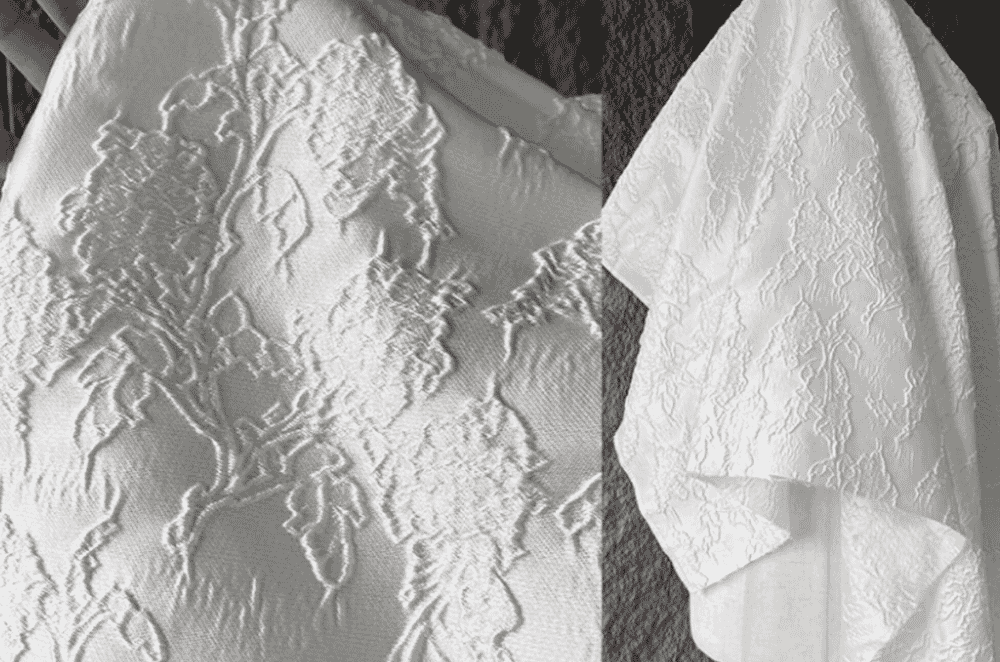
Jacquard material is one of the oldest and most technically demanding fabrics still in production, powering roughly 8% of Europe's decorative apparel output and nearly all high-end upholstery textiles in 2025 (EURATEX, 2025). It's the fabric behind brocade coats, damask dresses, textured knit sweaters with woven-in patterns, and the tapestry-style pieces that keep reappearing on Parisian runways. For fashion founders sourcing production in Portugal, understanding jacquard is often the difference between a garment that reads couture and one that reads cheap.
This guide covers what jacquard actually is, the difference between woven and knit jacquard, the main sub-families (brocade, damask, matelassé, jacquard knit), real EUR pricing per meter across the Portuguese cluster, MOQ realities, and how the 12% of our documented factories capable of jacquard production actually route these orders. Every number below reflects the manufacturer-side view.
Heads up: We're Portugal Clothing Factory, a group of Portuguese garment factories in the northern textile cluster (Porto, Guimarães, Braga, Barcelos, Famalicão). We've documented 80 factories across the region and verified 25 active producers, so the observations in this article come from that research and from production runs placed across the group between 2024 and 2026.
Key Takeaways
- Jacquard is a fabric produced on a specialised loom (or knitting machine) that controls each yarn individually, allowing complex patterns to be woven directly into the structure
- Two main families exist: woven jacquard (brocade, damask, matelassé) and jacquard knit (softer, more elastic, sweater-friendly)
- Portuguese jacquard costs €7-15/m for cotton knit, €8-15/m for standard woven, €18-32/m for wool blends, €25-60/m for silk blends
- Fabric-level MOQs typically run 300-500 meters; garment MOQ starts at 200 units at most jacquard-capable factories
- Modern electronic jacquard machines (Stäubli, Bonas, Vandewiele) control up to 12,000+ warp yarns per pattern repeat (CITEVE, 2024)
Try it free: Pressure-test your jacquard production cost with our garment cost calculator. 60 seconds, no email required.
What Is Jacquard Material?
Jacquard is a fabric with a pattern woven or knitted directly into the structure, rather than printed or embroidered on the surface. It's produced on a specialised loom (or knitting machine) where each warp yarn can be lifted independently, allowing designs of huge complexity. Europe's decorative and figured-fabric market reached roughly €4.1B in 2024 (EURATEX, 2024), with jacquard the dominant construction category.
The name refers to the loom, not the fibre. Jacquard fabric can be made from cotton, wool, silk, linen, viscose, or blends, and can be woven or knitted. What defines it is the mechanism: individual yarn control that lets designers weave motifs into the fabric itself. Flip a jacquard piece over and you'll see the pattern reversed on the back, with the yarn floats visible. That structural reversibility is the fastest way to spot a real jacquard versus a print pretending to be one.
Within the fabric family, jacquard sits at the technical top of the tree. It requires more setup than plain weaving, longer cycles, and higher fabric MOQs, which is why the price and MOQ tiers are notably higher than jersey or plain woven cotton.
Citation Capsule: Jacquard material is a woven or knitted fabric produced on a specialised loom that controls each warp yarn independently, allowing complex figured patterns to be built directly into the fabric structure. The European figured-fabric market reached roughly €4.1B in 2024, with jacquard the dominant construction category (EURATEX, 2024).
Other names you might see
Depending on the sub-family, jacquard shows up in supplier catalogues as "brocade" (heavy, often metallic-thread woven), "damask" (reversible tone-on-tone woven), "matelassé" (quilted-look double-cloth jacquard), or "jacquard knit" (the sweater-friendly variant). Portuguese mills sometimes label it "tecido jacquard" or "malha jacquard" depending on the construction. The underlying loom mechanism is the same across all of these.
What Is the History of the Jacquard Loom?
The jacquard loom was invented by Joseph Marie Jacquard in Lyon, France, in 1804, and is widely credited as one of the earliest programmable machines in industrial history. It used punched cards to control which warp yarns lifted for each row, prefiguring the punched-card computing systems that would follow more than a century later (Musée des Tissus, Lyon, historical record).
Before the jacquard mechanism, figured fabrics required a "draw loom" operated by two workers: the weaver and a helper who manually lifted individual yarns for each pass. A single meter of complex brocade could take a full day. Jacquard's punched-card system replaced the human helper with a repeatable, encoded pattern, and multiplied output dramatically. Lyon became Europe's silk-weaving capital largely because of it, and the mechanism spread across Italy, Britain, and eventually Portugal's northern textile belt during the 19th century.
Modern jacquard looms are electronic. Machines from Stäubli, Bonas, and Vandewiele use servo-controlled hooks and digital pattern files instead of punched cards, but the principle is identical: individual warp yarn control, one warp end at a time. The best Portuguese jacquard mills today run electronic looms controlling 6,000 to 12,000+ warp yarns per pattern repeat, which is what lets designers push complex multi-colour figured designs into a single continuous fabric.
Why this history still matters: the jacquard loom is why complex patterns exist in modern apparel at accessible prices. Without it, a printed floral tee is easy, but a woven-in floral coat would still cost thousands. That 220-year-old mechanism is what makes brocade dresses viable at €150 retail instead of €1,500. It's easy to forget, but every jacquard order you place is a direct descendant of Lyon 1804.
Citation Capsule: Joseph Marie Jacquard invented the jacquard loom in Lyon, France, in 1804, using punched cards to control individual warp yarns and enabling complex figured-fabric production at industrial scale. Modern electronic jacquard machines from Stäubli, Bonas, and Vandewiele control 6,000 to 12,000+ warp yarns per pattern repeat (CITEVE, 2024).
Woven Jacquard vs Knit Jacquard: What's the Difference?
Woven and knit jacquard use the same core idea, individual yarn control, but the machinery, drape, and end use differ significantly. Roughly 62% of Portuguese jacquard output in 2025 was woven, with the remaining 38% knit (ATP, 2025). The two constructions serve different garment categories and rarely compete for the same brief.
Woven jacquard is produced on a jacquard loom with warp and weft yarns interlacing at right angles. The fabric is stable, structured, holds shape for tailored garments, and typically shows a crisp, defined motif. Weight ranges from about 180 GSM up to 400+ GSM for coating-weight brocades. Woven jacquard is what you see in couture dresses, tailored coats, upholstery, and decorative accessories.
Jacquard knit is produced on a jacquard-capable circular or flat knitting machine (Stoll, Shima Seiki, and similar), where each needle can be controlled independently. The result is a fabric with the same figured pattern capability but the elasticity and hand-feel of a knit. Weight ranges from about 200 to 320 GSM. Jacquard knit dominates sweater production, structured tops, and knitwear with woven-in motifs.
| Attribute | Woven Jacquard | Jacquard Knit | Plain Woven |
|---|---|---|---|
| Construction | Warp + weft interlaced on loom | Knitted with individual needle control | Warp + weft, no yarn-level control |
| Stretch | Minimal | Moderate to high | Minimal |
| Drape | Structured, crisp | Softer, more give | Depends on weight |
| Pattern complexity | Very high (6,000-12,000 warp) | High (per-needle control) | Uniform (no motif) |
| Weight range | 180-400+ GSM | 200-320 GSM | 100-350 GSM |
| Typical uses | Coats, dresses, upholstery | Sweaters, structured tops | Shirting, linings |
| Cost per meter (PT, cotton) | €8-15 | €7-13 | €3-7 |
| Typical lead time | 6-10 weeks | 5-8 weeks | 3-5 weeks |
Sources: PCF factory group data (2024-2026), industry references.
Citation Capsule: Woven jacquard uses a loom to interlace warp and weft yarns with per-warp control, producing structured fabrics for coats and dresses. Jacquard knit uses per-needle machine control on Stoll or Shima Seiki machines, producing softer, stretchier fabrics for sweaters. Roughly 62% of Portuguese jacquard output in 2025 was woven (ATP, 2025).
What Are the Types of Jacquard Fabrics?
Jacquard breaks into four main sub-families that emerging brands should recognise: brocade, damask, matelassé, and jacquard knit. Together they represent more than 90% of jacquard production shipped from Portuguese mills in 2025 (ATP, 2025). Each has a distinct look, weight profile, and price ladder.
Brocade
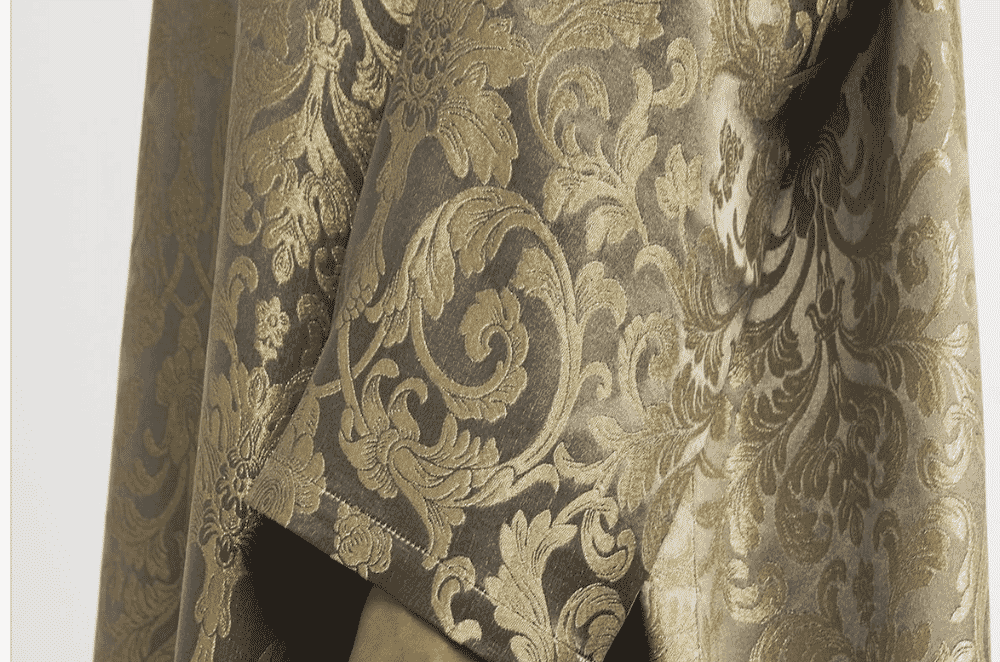
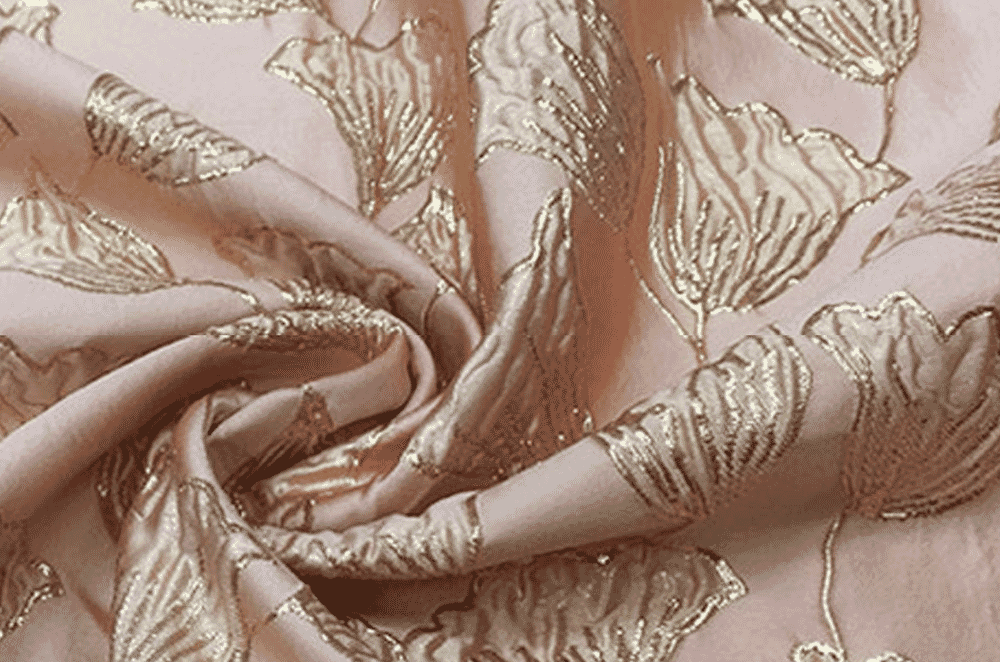
Brocade is a heavyweight woven jacquard, historically shot with silk and metallic threads, now most often produced in cotton, viscose, or blends with lurex accents. The pattern sits raised against a satin or twill ground, giving brocade its characteristic three-dimensional look. Weight typically 220 to 400+ GSM. Used for occasion coats, statement jackets, evening wear, and structured skirts. Portuguese brocade in cotton runs €10 to €18 per meter; wool and silk-blend brocades push €25 to €60.
Damask
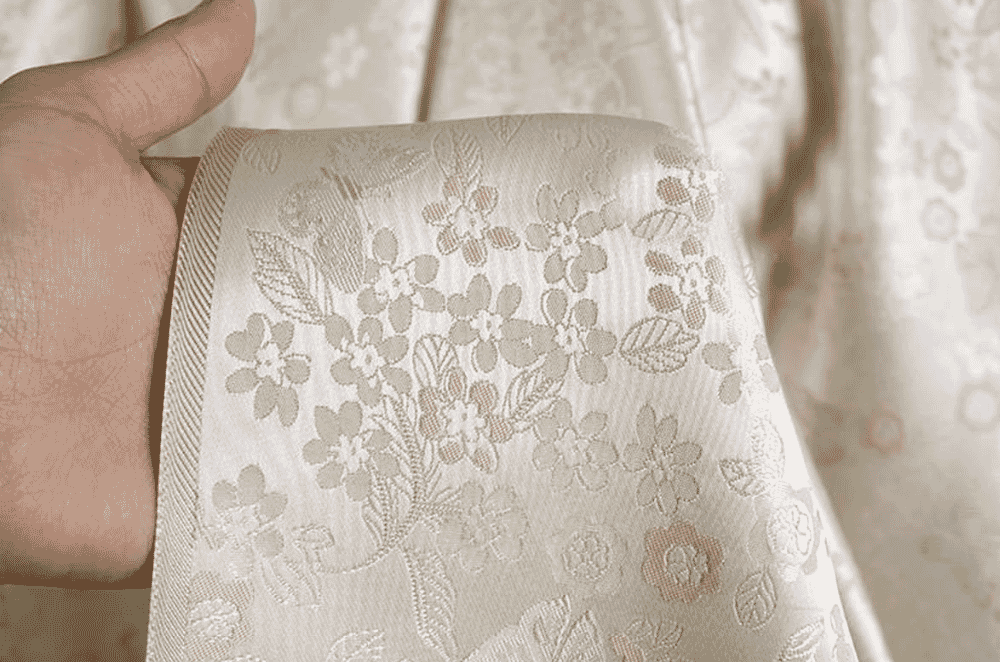
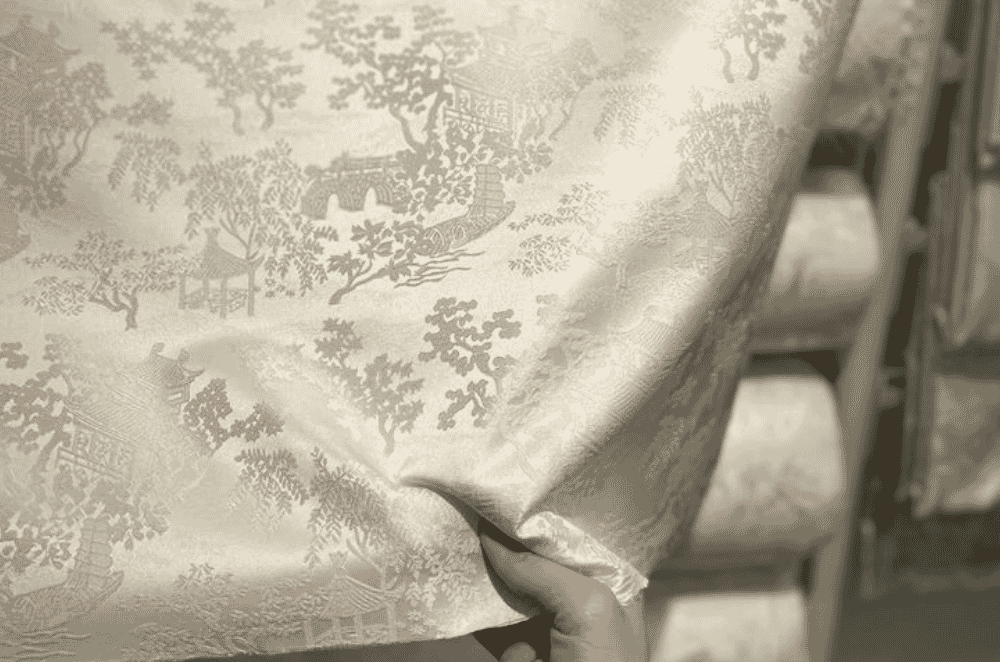
Damask is a reversible tone-on-tone woven jacquard, where the pattern is created by contrasting the satin face and matte ground of the same colour. It reads elegant and understated, and shows the exact same design on both sides (with reversed contrast). Weight typically 180 to 300 GSM. Used for shirting-weight dresses, blouses, structured tops, tablecloths, and interiors. Cotton damask from Portuguese mills runs €8 to €15 per meter.
Matelassé
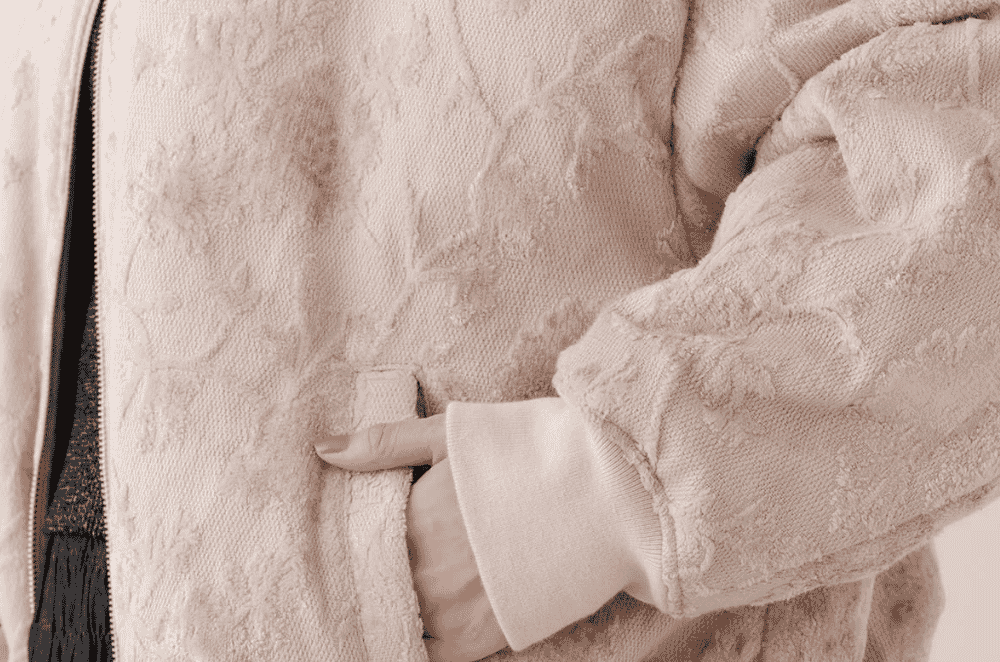
Matelassé is a double-cloth jacquard that produces a quilted or padded appearance without any actual quilting. The pattern is raised through two layers of fabric loomed together with stuffer yarns between, creating dimensional relief. Weight typically 240 to 360 GSM. Used for structured jackets, dresses, and cropped tops with body. Portuguese matelassé in cotton or cotton-blend runs €12 to €22 per meter.
Jacquard knit (tapestry-style)
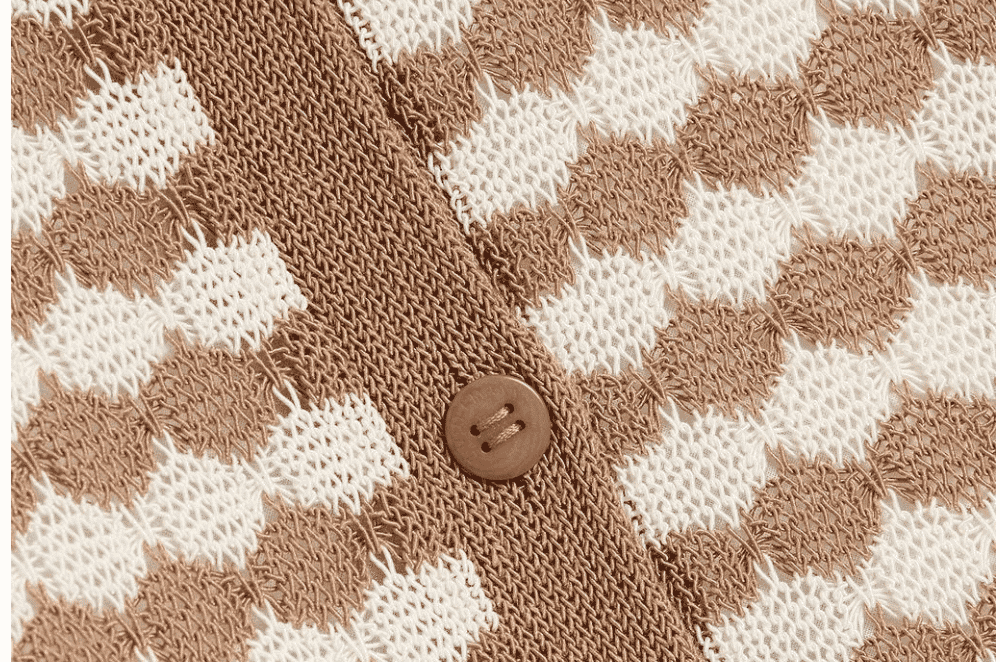
Jacquard knit uses per-needle machine control to build patterns into a knitted fabric. Sub-styles include intarsia jacquard, birdseye jacquard, and full-colour figured jacquard (sometimes called "tapestry-style" knit for the dense multi-colour look). Weight typically 200 to 320 GSM. Used for sweaters, cardigans, structured tops, kids' knitwear, and modern streetwear pieces with woven-in graphics. Portuguese jacquard knit runs €7 to €13 per meter for cotton, €14 to €28 for wool blends.
Citation Capsule: The four dominant jacquard sub-families are brocade (heavy woven, coats), damask (reversible tone-on-tone, dresses), matelassé (double-cloth quilted look, structured jackets), and jacquard knit (per-needle sweater fabric). Jacquard knit and brocade together account for over 70% of Portuguese jacquard output in 2025 (ATP, 2025).
What Garments Use Jacquard?
Jacquard shows up across a wider range of apparel than most emerging brands realise. Its largest single application is knitwear, followed by occasion outerwear, dresses, and upholstery-inspired ready-to-wear. Approximately 27% of premium women's dresses and 19% of premium coats produced in the EU in 2025 used a jacquard fabric (EURATEX, 2025).
Specific garment applications by construction type:
- Jacquard knit sweaters and cardigans: the largest category by volume. Chunky Nordic-style pullovers, birdseye knit polos, intarsia-look pieces with woven-in graphics
- Brocade coats and jackets: structured statement outerwear, often for autumn/winter capsule pieces and occasion collections
- Damask dresses and shirting: midi and maxi dresses, structured shirt-dresses, elegant blouses with tone-on-tone motifs
- Matelassé jackets and cropped tops: structured jacket bodies with quilted-look relief, dresses with dimensional pattern
- Upholstery-inspired ready-to-wear: the "renaissance-tapestry-blazer" and floral-brocade-trench trend that keeps cycling back onto runways
- Accessories: jacquard bucket bags, ties, headbands, and belts using narrower woven jacquard trims
Emerging brands frequently underestimate the versatility of jacquard knit at 220 to 260 GSM. It knits beautifully into cardigans, structured tops, and kids' knitwear, and doesn't carry the price ceiling of woven brocade. If a founder wants "woven-in graphic" without the couture-level cost, jacquard knit is usually the right answer.
What Does Jacquard Fabric Cost per Meter in Portugal?
Jacquard fabric prices in Portugal in 2026 range from €7 per meter for the lightest cotton jacquard knit to €60 per meter for silk-blend brocade. Fibre composition is the single largest cost driver, explaining roughly 55% of price variance, followed by pattern complexity (about 20%) and certification stack (about 15%) (ATP, 2025). A one-time custom-pattern setup fee typically runs €400 to €1,500 on top of the per-meter cost.
Understanding these tiers helps founders budget accurately during tech pack preparation, especially since jacquard is one of the fabric categories where "assumed" pricing is most often wrong by 2x or more.
Fibre composition drives base cost
Cotton jacquard sits at the bottom of the price ladder, viscose blends and cotton-lurex sit in the middle, wool blends and silk blends sit at the top. A silk brocade at 240 GSM can cost 4x to 6x more per meter than a comparable cotton jacquard knit, purely on fibre input.
Pattern complexity adds meaningful cost
A two-colour geometric motif with a 10 cm repeat is much cheaper to weave than a 6-colour floral with a 90 cm repeat. Complex multi-colour patterns require more warp yarns per repeat, longer loom setup, and slower weaving cycles. In our experience routing jacquard orders across the group, complex-pattern fabrics run 20 to 35% above simple-pattern equivalents at the same fibre and GSM.
Setup fees are real and one-time
Custom jacquard patterns require a CAD file conversion, a loom-file build, and a sample loom cycle before production begins. Portuguese mills typically charge €400 to €800 for a straightforward pattern setup and €1,000 to €1,500 for complex multi-colour or double-cloth matelassé patterns. This fee is one-time per pattern, not per production run, but the first run has to absorb it.
Practical planning: for a jacquard-knit sweater using 1.4 meters of 240 GSM cotton jacquard, fabric cost lands at €10 to €18 per garment. For a brocade coat using 2.8 meters of 300 GSM cotton-lurex brocade, fabric cost lands at €28 to €50 per garment before the setup fee is amortised. Add the setup across the first production run: on a 300-unit brocade coat run, a €800 setup adds €2.67 per unit.
Need a tech pack? Get a factory-ready single-style tech pack for €79. See what's included.
What Are the MOQs for Jacquard Production?
Fabric-level MOQs for jacquard in Portugal typically run 300 to 500 meters at the mill, which is higher than plain-woven or standard knit because the loom setup and warp preparation are expensive to justify below that threshold. At the garment level, MOQs at documented jacquard-capable factories in our group start at 200 units per style (ATP, 2025). This is a meaningful jump above the 100-unit floor that applies to French terry or single jersey.
Three factors drive jacquard MOQs higher: the mill's warp-thread setup cost (which can't be recovered on a 50-meter run), the loom occupation time (a jacquard loom running your pattern is not running anyone else's), and the pattern-file build cost that has to be spread over some minimum length.
Fabric MOQ tiers at Portuguese mills
Roughly 40% of jacquard-capable mills in the region accept 200-meter minimums on stock patterns (existing patterns already loomed, no new setup). 45% require 300 to 500 meters as the standard floor for custom patterns. The remaining 15% require 800+ meters, typically the higher-end silk and wool jacquard specialists who won't warp a loom for anything smaller.
Garment MOQ tiers at jacquard-capable factories
At the garment stage, MOQs are more forgiving than fabric MOQs. Most factories in our group that produce jacquard garments accept 200 to 300 units per style. A handful accept 100 to 150 units if the fabric MOQ is already covered by a larger multi-style order or the pattern is a stock design.
What this means in practice: we've observed that founders launching a jacquard capsule almost always solve the MOQ problem by ordering enough fabric for two or three garment styles at once. A single 400-meter fabric run can cover a coat, a dress, and a top from the same brocade, which spreads the setup cost and keeps unit economics viable.
How Do Portuguese Factories Produce Jacquard?
Portugal produces jacquard across two clusters: the woven-jacquard belt around Guimarães and Vila Nova de Famalicão, and the jacquard-knit specialists concentrated in Barcelos and Braga. Together they account for roughly 6% of national fabric output by value, but a much higher share of the export value because jacquard sits at higher price points (ATP, 2025). About 12% of documented factories in our group work with jacquard.
Portuguese jacquard production follows a specific sequence: brand supplies a design (usually as a repeat-ready CAD file or an artwork brief), the mill converts it to a loom file and produces a sample on a smaller loom (2 to 3 weeks), the sample is approved or revised, the mill warps the production loom and runs the fabric (3 to 5 weeks depending on GSM, complexity, and finish), then the fabric ships to a CMT factory for garment assembly (3 to 5 additional weeks). Total lead time from CAD to shipped garment typically runs 9 to 13 weeks, which is roughly 3 to 4 weeks longer than a plain-knit garment programme.
Production-side observation: across 2024-2026 runs coordinated through our factory group, the average lead time for a first jacquard-knit sweater programme was 71 days from approved CAD to shipped units. For a woven brocade coat programme, the average was 87 days. Custom pattern development consumed 18 to 22 days on average, longer than most founders expect. That's the stage where fabric booking and loom scheduling collide, and it's the single biggest lead-time lever we adjust when routing production.
The role of the CAD-to-loom step
The CAD file for a jacquard pattern isn't a printable image. It has to be converted into a per-warp instruction file that the loom's controller reads row by row. This conversion is done by the mill's technical team or a dedicated pattern studio, and it involves colour reduction (jacquard is limited by the number of warp colours the loom can handle simultaneously), repeat definition, and sometimes weave-structure choices that affect the fabric's feel. A well-prepared brief cuts this stage from three weeks to two.
Why in-cluster routing matters
The Portuguese jacquard cluster is tight geographically. A mill in Vila Nova de Famalicão and a CMT factory in Braga are 30 minutes apart by van. That means finished fabric can move from mill to garment factory in the same day, versus the two to four days of transit that horizontal Asian supply chains typically require. In our experience, this in-cluster proximity saves 5 to 8 days per production run and reduces the "fabric arrived damaged, we don't know from where" incidents that plague cross-border jacquard sourcing.
Citation Capsule: Portuguese jacquard production is concentrated in two clusters: woven-jacquard around Guimarães and Vila Nova de Famalicão, and jacquard-knit around Barcelos and Braga. Around 12% of the 80 documented factories in the Portugal Clothing Factory group work with jacquard, with lead times running 9 to 13 weeks from approved CAD to shipped garment (ATP, 2025).
Talk to a real person: Get in contact and we'll tell you which 2 to 3 jacquard-capable factories in our group actually fit your brief.
Jacquard vs Print vs Embroidery: How to Choose?
The most common founder question about jacquard is whether to use it, or use a print, or use embroidery to achieve a similar visual effect. Each solves a different problem. Roughly 54% of European brands producing "pattern-forward" apparel in 2025 used print, 28% used jacquard, and 18% used embroidery (EURATEX, 2025). The right choice depends on drape, feel, budget, and how the garment is meant to read on the body.
Jacquard weaves the design into the fabric structure, so the pattern is fully integrated: reversible, texture-forward, and impossible to peel or crack. It's the premium choice for occasion pieces and knitwear, but carries higher MOQ, cost, and lead time. Print puts the design on top of the fabric, either digitally, rotary-screen, or sublimation. It's the cheapest and fastest option, allows unlimited colour, and works on almost any fabric, but the design sits on the surface and can fade over wash cycles. Embroidery stitches the design into the fabric with additional yarn, producing a raised, tactile motif in specific placements, but doesn't scale for large-coverage patterns and adds significant per-unit cost.
| Attribute | Jacquard | Embroidery | |
|---|---|---|---|
| Where the design lives | Woven into structure | On surface of fabric | Stitched into fabric |
| Colour count | Limited by loom (typ. 2-8) | Unlimited (digital) | Limited by thread stops |
| Coverage | Full fabric | Full fabric | Placement only |
| Reversibility | Yes (visible on both sides) | No | Partial |
| Feel | Textured, dimensional | Flat | Raised, tactile |
| Lead time added vs plain | +3-4 weeks | +0-1 week | +1-2 weeks |
| Cost premium vs plain | 60-200% | 5-30% | Per-stitch, varies |
| Best for | Sweaters, coats, dresses | Everything, especially graphics | Logos, monograms, placements |
Sources: PCF factory group data (2024-2026), industry references.
When to choose which: we consistently see three patterns. Brands prioritising a premium, structural, tactile aesthetic (occasion pieces, sweaters, upholstery-inspired outerwear) go with jacquard. Brands prioritising cost, speed, and unlimited colour (streetwear graphics, seasonal capsules with turnover) go with print. Brands prioritising specific-placement branding (chest logos, pocket monograms, cuff details) go with embroidery. It's rarely either/or: a well-designed collection often uses all three across different styles.
Citation Capsule: Jacquard weaves patterns into fabric structure; print applies them to the surface; embroidery stitches them in with extra yarn. In 2025, print led European pattern-forward apparel with 54% share, followed by jacquard at 28% and embroidery at 18% (EURATEX, 2025). Jacquard adds 3-4 weeks and 60-200% cost over plain fabric.
Conclusion: What This Means for Your Brand
The practical takeaway across the sections above: match jacquard to the product categories where its properties actually matter, specify it clearly on the tech pack (name the branded fibre or exact composition), and route production to a Portuguese factory in the subset that stocks the yarn or has the finishing lines built for it.
Get the spec right and the fabric becomes a repeatable, reliable choice. Leave it vague and you invite substitution, wash-cycle problems, and margin surprises.
Running into production issues? Get in contact and tell us what you're making. We're a group of documented Portuguese garment factories and we answer every serious brief within 24 hours.
Frequently Asked Questions
What is jacquard material made of?
Jacquard refers to the loom mechanism, not the fibre. The fabric can be made from cotton, wool, silk, linen, viscose, polyester, or blends. In 2025, roughly 48% of Portuguese jacquard output was cotton or cotton-blend, 22% wool or wool-blend, and 12% silk or silk-blend, with the remainder synthetics and mixed compositions (ATP, 2025).
What's the difference between jacquard and brocade?
Brocade is a specific type of woven jacquard: heavy, with a raised motif against a satin or twill ground, often shot with metallic or contrasting threads. All brocade is jacquard, but not all jacquard is brocade. Damask, matelassé, and jacquard knit are the other main sub-families in the jacquard fabric family.
Is jacquard fabric expensive?
Jacquard is typically 60 to 200% more expensive per meter than a plain fabric of the same fibre and weight, driven by loom setup, longer weaving cycles, and higher fabric MOQs. In Portugal in 2026, prices run €7 to €15 per meter for cotton jacquard, €18 to €32 for wool blends, and €25 to €60 for silk blends.
Is jacquard fabric good for warm weather?
It depends on the construction and weight. Light cotton or linen jacquard at 180 to 220 GSM breathes well and works for summer dresses and shirting. Heavier brocade or wool jacquard at 300+ GSM is autumn/winter fabric. Jacquard knit at 200 to 240 GSM sits comfortably in spring and autumn wardrobes.
Can jacquard fabric be washed?
Yes, but care depends on fibre. Cotton jacquard tolerates machine washing at 30°C with mild detergent. Wool and silk jacquard require hand wash or dry clean to preserve pattern integrity and prevent yarn distortion. Roughly 30% of jacquard garment returns in premium fashion stem from customer wash-care mistakes (Textile Exchange, 2023).
What is the minimum order for jacquard production in Portugal?
Fabric-level MOQs run 300 to 500 meters at most Portuguese jacquard mills, and 800+ meters at high-end silk and wool specialists. Garment MOQs at jacquard-capable factories in our group typically start at 200 units per style, versus the 100-unit floor common on plain-knit programmes. Custom pattern setup fees add €400 to €1,500 one-time.
How long does jacquard production take in Portugal?
Total lead time from approved CAD to shipped garment typically runs 9 to 13 weeks: 2 to 3 weeks for CAD-to-loom conversion and sample, 3 to 5 weeks for fabric production, and 3 to 5 weeks for garment CMT. This is roughly 3 to 4 weeks longer than a plain-knit programme, driven mostly by the pattern setup and loom scheduling stages.
Is jacquard the same as damask?
No. Damask is a specific sub-type of woven jacquard, distinguished by its reversible tone-on-tone construction where the pattern reads on both sides in reversed contrast. Jacquard is the broader category, including damask, brocade, matelassé, and jacquard knit. Every damask is a jacquard, but not every jacquard is a damask.
We're a group of 80 documented Portuguese clothing factories, 25 verified, based in Porto and Guimarães. Tell us your product, volume, and timeline. We'll route your production to the right factory in the group, usually within 24 hours. Flat fees, no commissions, no upsell.
Get in contact Download the directory (€39)Need a tech pack? Get a factory-ready single-style tech pack for €79. See what's included.
Sources used in this article
- EURATEX - European Apparel and Textile Confederation, Facts & Key Figures (2024-2025)
- ATP - Associação Têxtil e Vestuário de Portugal, fabric price and production data (2025)
- CITEVE - Centro Tecnológico das Indústrias Têxtil e do Vestuário de Portugal, loom and weaving production data (2024)
- Textile Exchange - Preferred Fiber and Materials Market Report (2023)
- Musée des Tissus, Lyon - historical record of the Jacquard loom (Joseph Marie Jacquard, 1804)
- PCF internal factory documentation (2024-2026) - Data from 80 documented and 25 verified Portuguese factories in our group, covering jacquard capability, MOQ thresholds, fabric pricing observations, and lead time patterns
Portugal Clothing Factory is a group of 80 documented Portuguese clothing factories, 25 verified, in the northern textile cluster (Porto, Guimarães, Braga, Barcelos, Famalicão). We charge flat fees, reply within 24 hours, and route production to the factory in our group built for your product. See how we work or get in contact to place your order.
.jpeg)
.jpeg)